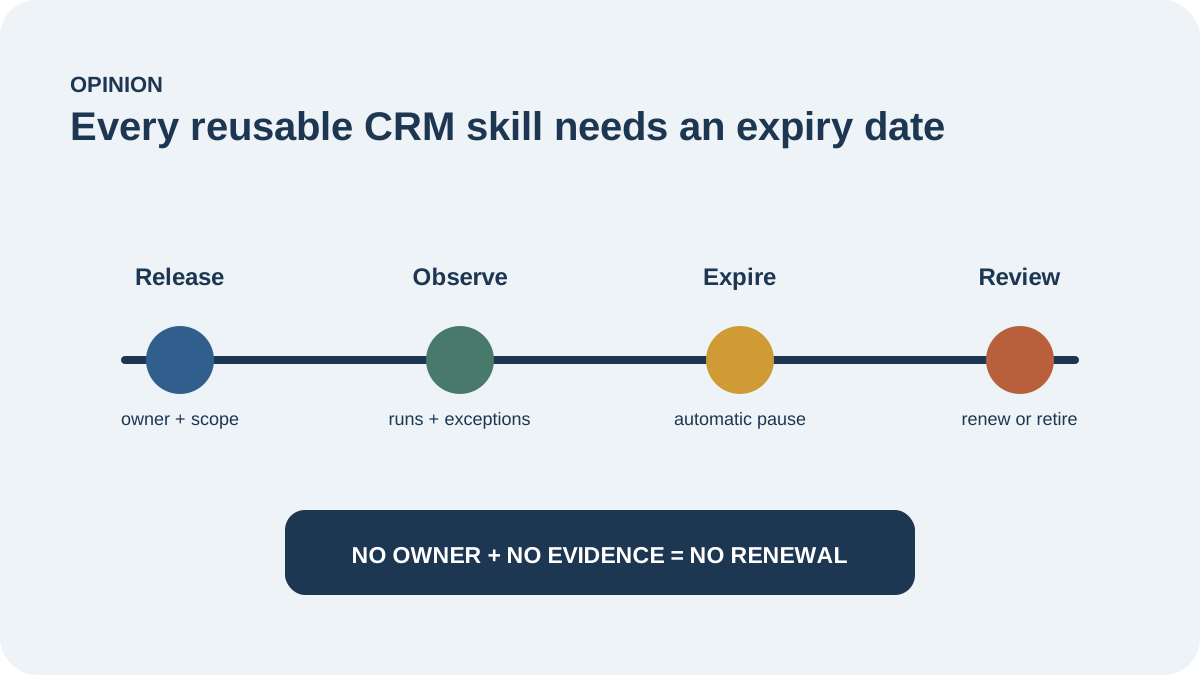
Microsoft's October 8 release makes 30 pre-built Dynamics 365 CRM skills generally available in Copilot Cowork. The architecture is sensible: MCP tools expose CRM context and approved actions, while skills provide job-specific guidance about evidence, uncertainty and useful output. It also makes a neglected governance problem urgent. Reusable skills should expire unless an owner revalidates them.
An expiry date does not mean the text becomes false at midnight. It means the organization refuses to keep treating old procedure, permission and availability assumptions as production-approved without review. Customer data models change. Fields are retired. business units reorganize. Preview features move, pause or ship differently. A timeless skill silently accumulates authority drift.
Versioning alone is not review
A repository can show that a skill file has not changed for six months. That says nothing about the environment around it. The Dynamics objects it reads may have new validation rules. A forecast category may be redefined. A service queue may have a different escalation policy. The invoking Copilot host may expose new tools or change its release status.
Store a skill version, but also store the evidence date and expiry condition. Revalidation should compare the procedure with current objects, fields, permissions, host availability, product documentation, policy and downstream actions. A new commit is not required to renew approval, but a named reviewer and retained test result are.
Expiry belongs to consequence class
Not every skill needs the same interval. A read-only customer brief using stable fields may be reviewed quarterly. A procedure that proposes opportunity amount, forecast category or case priority may need monthly validation and review after any schema change. A skill that can send communication or create a financial record deserves a shorter period and event-driven expiry.
Define the consequence class before choosing the date. Consider customer impact, reversibility, data sensitivity, financial effect and the degree of autonomous execution. The highest-risk trigger should govern. A procedure that usually drafts text but sometimes invokes a write tool is not merely a drafting skill.
Availability changes should expire approval
Microsoft's source separates generally available Cowork skills from private-preview Autopilot and Frontier-based Code access. That should prevent a common error: approving a procedure in one host and assuming approval follows it everywhere. Each host combines different interaction, execution and review behavior.
Add host and release status to the approval scope. A change from preview to general availability should trigger review rather than automatic promotion. So should a tool appearing in a new host, a change to supported actions or a new background-execution mode. Greater availability can increase the operational blast radius even when the skill text stays unchanged.
Data-model changes are expiry events
A CRM skill depends on semantics, not just field names. The field called next step may move from free text to a governed object. Deal risk may gain a required reason. Case severity may be recalculated by policy. A skill that keeps reading the old pattern can produce a plausible but obsolete answer.
Connect skill approval to the CRM change process. When an object, field, validation, pipeline, queue or ownership rule changes, identify affected skills and place them in review. The change owner does not have to understand every agent implementation; a dependency registry should make the impact discoverable.
Permission review must include an intended denial
A skill can remain semantically correct while gaining broader effective authority because a group membership, tenant setting or tool scope changed. Revalidation should run one allowed case and one intended denial. The denial is evidence that the current identity still stops where the policy expects.
Preserve the acting user, host, tool, target record, requested action and result. A shared administrator identity defeats the purpose because it proves only that the platform can act, not that the intended operator can act safely. Review both the skill's declared authority and the platform's effective authority.
Source freshness should be visible to the invoker
A user should see when the skill was last validated and when it expires. Do not hide the date in a repository that only administrators can inspect. For higher-risk work, show the evidence sources and limitations too. The operator can then decide whether a newly changed account or policy needs a manual path.
Expired does not always mean disabled. A read-only, low-risk skill might remain available with a clear warning and restricted output. A skill that can write, send or create a commercial commitment should fail closed or drop to proposal-only mode until review. The behavior belongs in the contract before expiry occurs.
Renewal should be cheap and evidence-rich
The best expiry control produces a small packet automatically: current skill hash, host, tools, scopes, dependency changes, sample inputs, allowed result, denied result, destination read-back and open exceptions. The owner reviews the delta instead of repeating an unstructured demo.
Use a narrow representative test set with clean, missing, ambiguous, denied and conflicting records. Store the outcome and next expiry. If a reviewer accepts an exception, name its scope, owner and deadline. Never renew a broad approval because the team is busy; narrow the allowed workflow instead.
The objection: expiry creates maintenance work
It does create visible work. The alternative is invisible maintenance debt carried by customer-facing automation. Organizations already accept expiry for credentials, certificates and access reviews because the surrounding risk changes over time. Reusable agent procedures deserve the same operating discipline.
The work can remain proportional. Long intervals for stable read-only skills, short intervals for consequential writers, and event-driven review for dependencies. A dashboard of approaching expiries is useful only when each item has an owner and a known fallback. Expiry without ownership becomes another alert nobody acts on.
Make expiry part of publication
A production skill release should contain the exact version, host, capability, allowed objects, consequence class, owner, evidence date, expiry date, revalidation triggers and fallback. Publication without those fields is incomplete. The catalog should sort expired and soon-expiring items into a review queue rather than presenting them as equally trusted.
Microsoft's expanding skill layer is a positive signal for reusable CRM operations. Reuse becomes durable only when trust is renewed deliberately. A skill that can travel across interfaces should not carry permanent authority with it. Expiry is the control that forces procedure, data, permission and availability to meet again before the next consequential action.
Source notes
These official sources support the workflow model and product concepts. They do not prove a specific retention outcome, benchmark, or vendor claim.
- Microsoft Dynamics 365 CRM skills: Official October 8, 2026 release for 30 pre-built CRM skills, with separate availability statements for Cowork, Autopilot and Code.
- Maxio October 2026 product release: Official release page documenting the October 7 Wallet Product sync and recurring Usage-item classification.
- Gainsight Skilljar October 2026 release: Official October 8 release for Wistia-caption and learning-path support in AI Tutor, including stated limitations.
- NIST AI Risk Management Framework: General risk-management context; not product evidence or a vendor benchmark.
Last updated: 2026-10-12