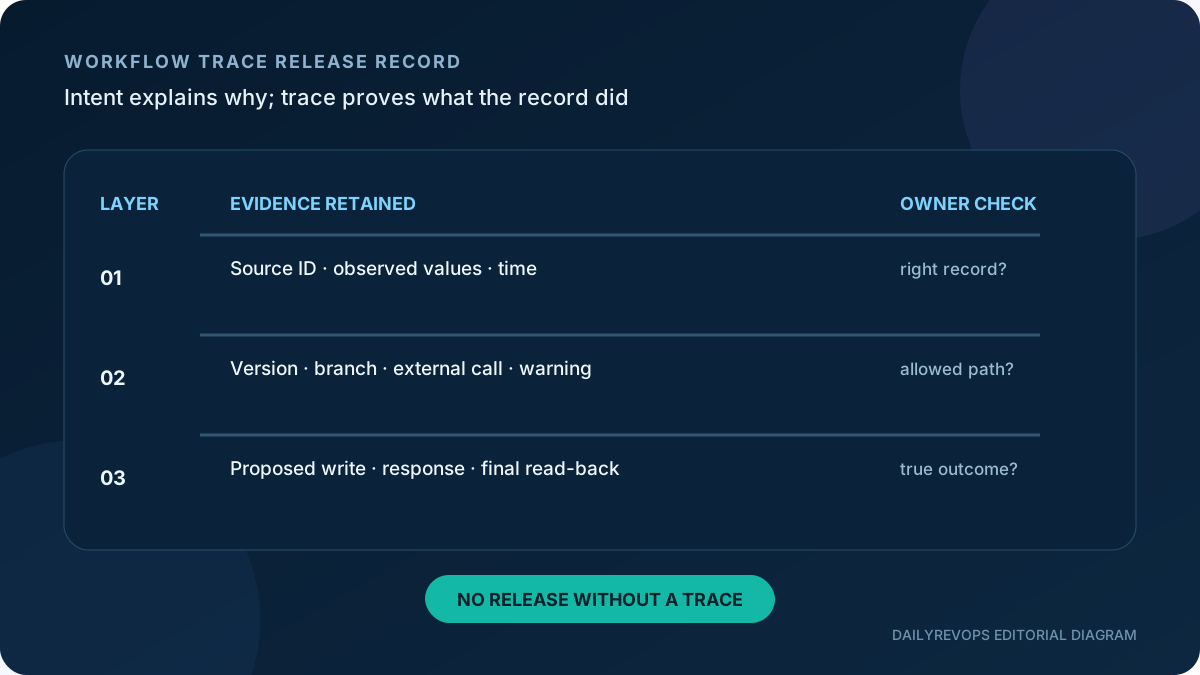
RevOps teams have learned to ask for a ticket, owner and approval before a material automation change. That is necessary, but it is no longer sufficient. As builders accept natural-language instructions, connectors widen the reachable systems and routing canvases make complex branches easier to manipulate, every production change should ship with a workflow trace.
A trace is not a promotional screenshot and not a generic success message. It is a reviewable record of one representative input moving through a specific workflow version: which source values were read, which branches were taken, which external calls ran, which writes were proposed, which destination responses returned and which final state was independently verified.
Intent is not execution
A change request can be perfectly written and still behave differently in production. A field may be blank, a connector may paginate, a credential may lack scope, a branch may receive an unexpected type, or a destination may accept a request without completing the business action. Approval of the intent does not establish that the execution matched it.
Clay's October 8 recap explicitly connects natural-language workflow building with a visual run trace and bulk rerun. Talkdesk's October 9 release brings its revamped Studio experience, including validation and context-management controls, to general availability through a progressive rollout. These are useful product signals: builders are gaining better ways to see the program they created. RevOps should turn that visibility into a release requirement.
A trace needs five layers
First is source evidence: the stable record identifier, observed timestamp and exact fields or events admitted to the run. Second is interpretation: the rule, model or transformation version and the material intermediate output. Third is authority: the policy or named approver that allows the next action. Fourth is execution: the connector, action, request identifier and response. Fifth is verification: a fresh read of the system that owns the final state.
Do not collapse those layers into a single green check. A model can produce an acceptable suggestion while the action remains unauthorized. An API can return success while an asynchronous job later fails. A CRM write can succeed while it updates the wrong duplicate. The trace must preserve where confidence changes and who owns the decision at each boundary.
Representative means adversarial, not convenient
The release trace should include a normal case, a missing-value case, a conflicting-source case, an ineligible record and a downstream failure. For a routing workflow, include a record that matches more than one branch and a record that matches none. For an agent-assisted workflow, include insufficient evidence and an output that must be rejected.
Choose cases from real production shapes with sensitive values removed or protected under the team's policy. Synthetic records are useful for deterministic structure, but they often miss duplicate identities, stale dates, unusual characters, legacy values and permission differences. A trace that covers only the cleanest example is demonstration evidence, not release evidence.
The trace should survive the builder
Export or retain the trace in an operating record linked to the change. Record the workflow identifier, old and new version, test population, run identifiers, reviewer, decision, deployment time and rollback condition. If the platform exposes a version comparison or validation panel, link it; do not make the platform view the only place where the release can be understood.
This matters when an incident crosses systems. Workato's connector roundup spans web extraction, research, voice, database, storage and vector operations, plus changes to authentication and error details. A failure may sit below the visible orchestration. The release record must name the dependency version and credential boundary so the incident owner can isolate the layer that changed.
Warnings deserve explicit dispositions
Talkdesk documentation notes that some flow validation warnings surface inconsistencies without blocking publication. That is the correct shape for many operational controls: a warning gives context, while an accountable owner decides whether the risk is acceptable. The mistake is allowing a warning to disappear into a successful publish.
For every material warning, record accepted, repaired or not applicable, with a reason. Define which errors always block release and which warnings require a second reviewer. If the team routinely accepts one class of warning, change the rule or the workflow; do not normalize unexplained exceptions.
Reruns must extend the evidence chain
Bulk rerun is not merely a convenience. It is a production change applied to a population that may already have partial results. Before rerunning, classify records by prior state, freeze the set, state the overwrite behavior and preserve the first attempt. After rerunning, reconcile the destination rather than trusting the new run status.
Link the correction to the original trace. This makes it possible to calculate affected records, corrected records, unresolved exceptions and unintended changes. Without that link, a rerun can make the current table look clean while destroying the evidence that explains customer contact, ownership movement or reporting differences.
Make traces the unit of automation review
Weekly automation reviews should sample traces, not count workflows. Ask whether another operator can reproduce the input, route, authority and final state. Track missing source IDs, unknown versions, unexplained warnings, unverified writes, partial reruns and overdue exceptions. Those are actionable control failures.
A workflow trace will not make automation risk-free. It will make change discussable at the record level. That is the standard RevOps needs as building gets faster: no meaningful production change without a representative path another operator can inspect, challenge and verify.
Source notes
These official sources support the workflow model and product concepts. They do not prove a specific retention outcome, benchmark, or vendor claim.
- Clay: Recapping the products announced at Sculpt 2026: Official October 8, 2026 recap. Clay says Workflows is in beta for all Clay users and the Inbound SDR Agent is a pre-beta preview with a waitlist.
- Workato: Community Connectors—what's new in September 2026: Official October 7, 2026 changelog describing new community connectors plus schema, authentication, error-reporting and stability changes.
- Talkdesk Orchestration & Routing release notes: Official release notes for the progressive October 9, 2026 general-availability rollout of the revamped Studio experience.
Last updated: 2026-10-09