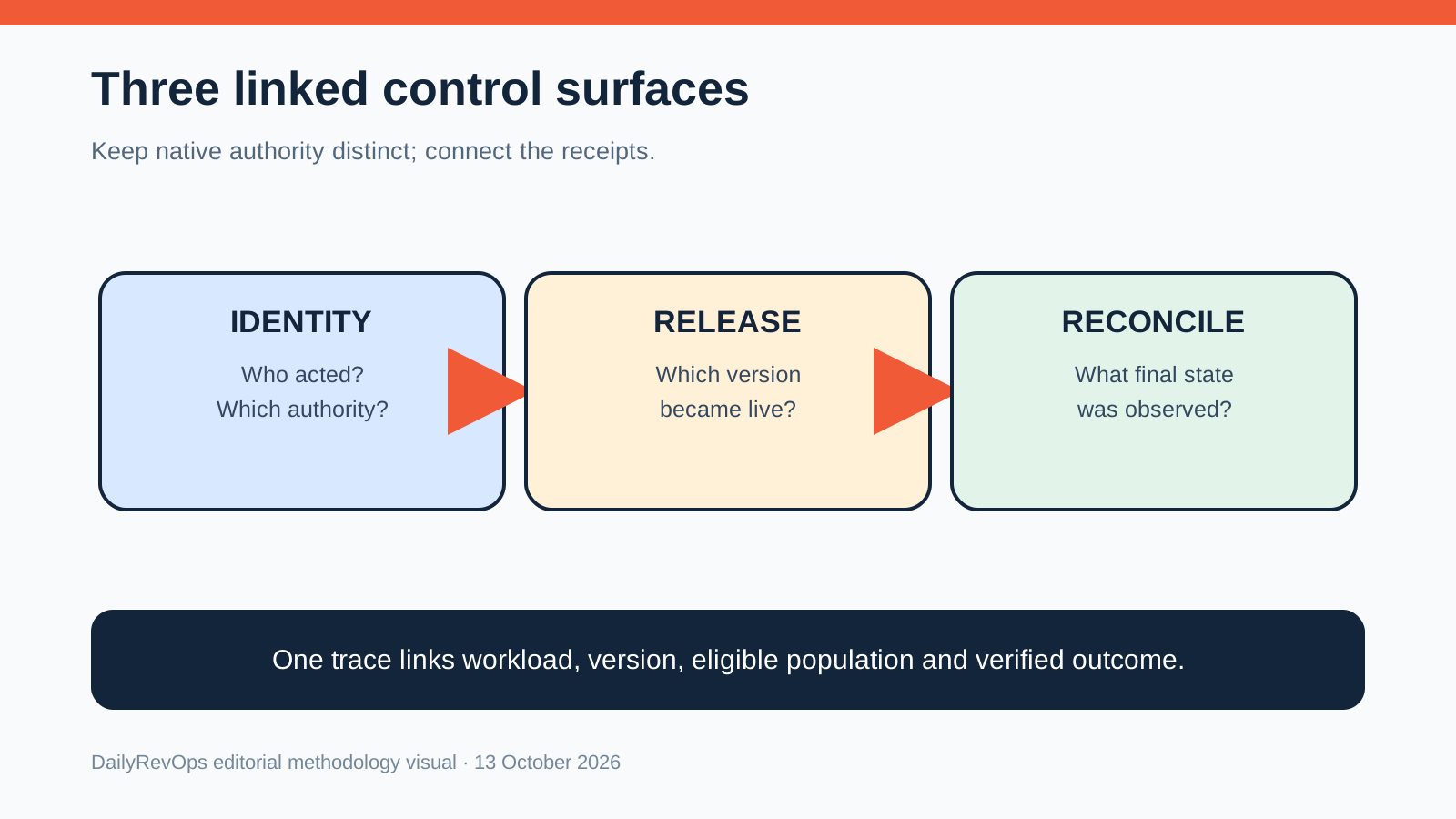
Three product changes published on October 12 look like separate administrative details. Intercom API 2.17 adds draft and version operations for articles plus configuration and execution history for Data Connectors. Snowflake adds named workload identities for service users. Maxio corrects a prepayment lookup that could silently miss an older funded prepayment on a busy site. Together they show a customer-operations control plane separating into three useful layers: identity, release and reconciliation.
Identity answers which workload is acting. Release answers which proposed configuration or content is allowed to become live. Reconciliation answers whether the authoritative commercial or customer state actually reflects the work. Mature automation keeps all three visible. A named identity does not prove the right content was released. A publish response does not prove a downstream payment arrived. A complete sync does not explain which workload performed it.
Identity establishes attributable action
Snowflake's named workload identities create a finer-grained unit beneath a service user. A revenue-data team can distinguish a CRM replication job, a billing export and an experimental agent even when a broader service account architecture remains. That helps rotation and incident containment, but identity remains only one part of authority.
For every automated workload, capture the service user, named identity, provider, business owner, runtime, roles, expected data objects, environment and retirement condition. Run both a permitted and a denied test. If the audit trail cannot connect the identity to a stable workload and run ID, the name is administrative decoration rather than operational evidence.
Identity design should follow consequence and lifecycle. A customer export that distributes personal data has different review and recovery needs from an internal aggregate model. The default limit or available configuration should not decide the grouping. The operator needs to stop or rotate one workload without obscuring unrelated work.
Release separates proposal from live state
Intercom's article drafts and version history make a publish boundary explicit. A draft may be created and reviewed while the current live article remains unchanged. That is the right place for factual checks, audience review, links, escalation language and legal or policy approval. Saved, approved, published and verified should remain different states.
The release receipt should preserve content identity, prior live version, draft version, source evidence, acting identity, approver, publish response and post-publication read-back. The same pattern applies to a Data Connector: proposed configuration, approved audience, deployed version, execution result and sampled output. The object type changes, but the control principle does not.
Version history improves investigation only when recovery is rehearsed. A prior version being visible does not prove that reverting is permitted or that agents and search will immediately use it. Test the supported correction path on low-risk content and inspect retrieval after the change. Keep the incident version for reconstruction.
Reconciliation tests the commercial consequence
Maxio's prepayment correction is a reminder that a healthy latest run can hide an old hole. The previous lookup could omit an older funded prepayment when more than 20 newer payments existed. A direct-ID lookup corrects future processing, but Maxio says previously missed prepayments are not repaired automatically.
Reconciliation therefore begins with the eligible source population, not with records visible at the destination. Freeze funded prepayments in the affected interval, query destination state by stable identifier, classify each result and repair through a supported path. Then inspect balance, application and reporting separately. One present transaction does not prove every downstream view is correct.
This layer also prevents an automation from overstating success. An API acknowledgement, connector completion or publish response is intermediate evidence. Verified outcome comes from reading the authoritative destination and comparing it with the accepted proposal or source population.
The three layers need one linked receipt
A useful control plane does not merge identity, release and reconciliation into one status. It links their receipts. The identity receipt says which workload and authority acted. The release receipt says which version or configuration crossed into production. The reconciliation receipt says which eligible outcomes were present, missing, duplicated or unresolved.
Use stable IDs across the chain: workload ID, run ID, configuration or content version, source object ID, destination object ID and exception ID. Preserve observation time because each layer changes independently. A reconstruction should not require an operator to infer the release from a chat transcript or the payment from a dashboard screenshot.
For customer-facing or financial actions, add a named approval and recovery route. Low-consequence reads may use lighter review, but they still need identity and source freshness. High-consequence writes need an explicit before state, accepted change, destination read-back and owned exception.
Do not turn the model into one universal platform
The control plane is an operating model, not necessarily a new product. Intercom should remain authoritative for its knowledge and connector objects, Snowflake for warehouse access and Maxio for its billing records. A central register can link the evidence without copying every source field into a parallel database.
Keep native system identifiers and URLs in the receipt. Store only the evidence necessary for review, retention and recovery. A new governance layer that becomes another stale source of truth defeats the purpose. The goal is shared semantics for state transitions, not central ownership of every state.
A practical minimum schema includes workload, owner, identity, environment, proposed version, approved version, source population, execution, destination observation, exception, recovery and expiry. Each field should have one declared authority. Unknown should remain unknown; do not convert missing evidence into a successful default.
A 30-day rollout
In week one, inventory the five highest-consequence customer or revenue automations. Name their acting identities, production changes and authoritative outcomes. Highlight shared credentials, unversioned configuration and jobs whose success is measured only by a scheduler.
In week two, choose one workload and add a release receipt. Freeze the current version, approval condition and rollback route. In week three, add destination reconciliation with an eligible denominator. In week four, run a failure drill: deny access, publish a controlled correction or withhold one eligible object and verify that the exception reaches an owner.
Report three measures: attributable runs, releases with verified read-back and eligible outcomes reconciled. Do not combine them into one opaque score. The separate counts show where control is improving and where missing evidence remains.
The operator takeaway
Intercom, Snowflake and Maxio are exposing control surfaces at different points in customer operations. RevOps can use them to make automation easier to explain and safer to change. The advantage comes from preserving the boundaries: identity is not permission, release is not outcome and successful current processing is not historical completeness.
Connect the layers with stable identifiers and explicit receipts. Keep native systems authoritative, verify consequential changes at the destination and route uncertainty to a named owner. That produces a control plane made of inspectable decisions rather than a new dashboard claiming that everything is green.
Source notes
These official sources support the workflow model and product concepts. They do not prove a specific retention outcome, benchmark, or vendor claim.
- Intercom API 2.17 changelog: Official October 12, 2026 release for Data Connectors, article drafts, version history and other API changes.
- Maxio October 2026 product release: Official October 12 entry describing direct-ID prepayment lookup and non-retroactive recovery.
- Snowflake new features: Official October 12 feature update for named workload identities.
- NIST AI Risk Management Framework: General governance context, not product evidence or a vendor benchmark.
Last updated: 2026-10-13