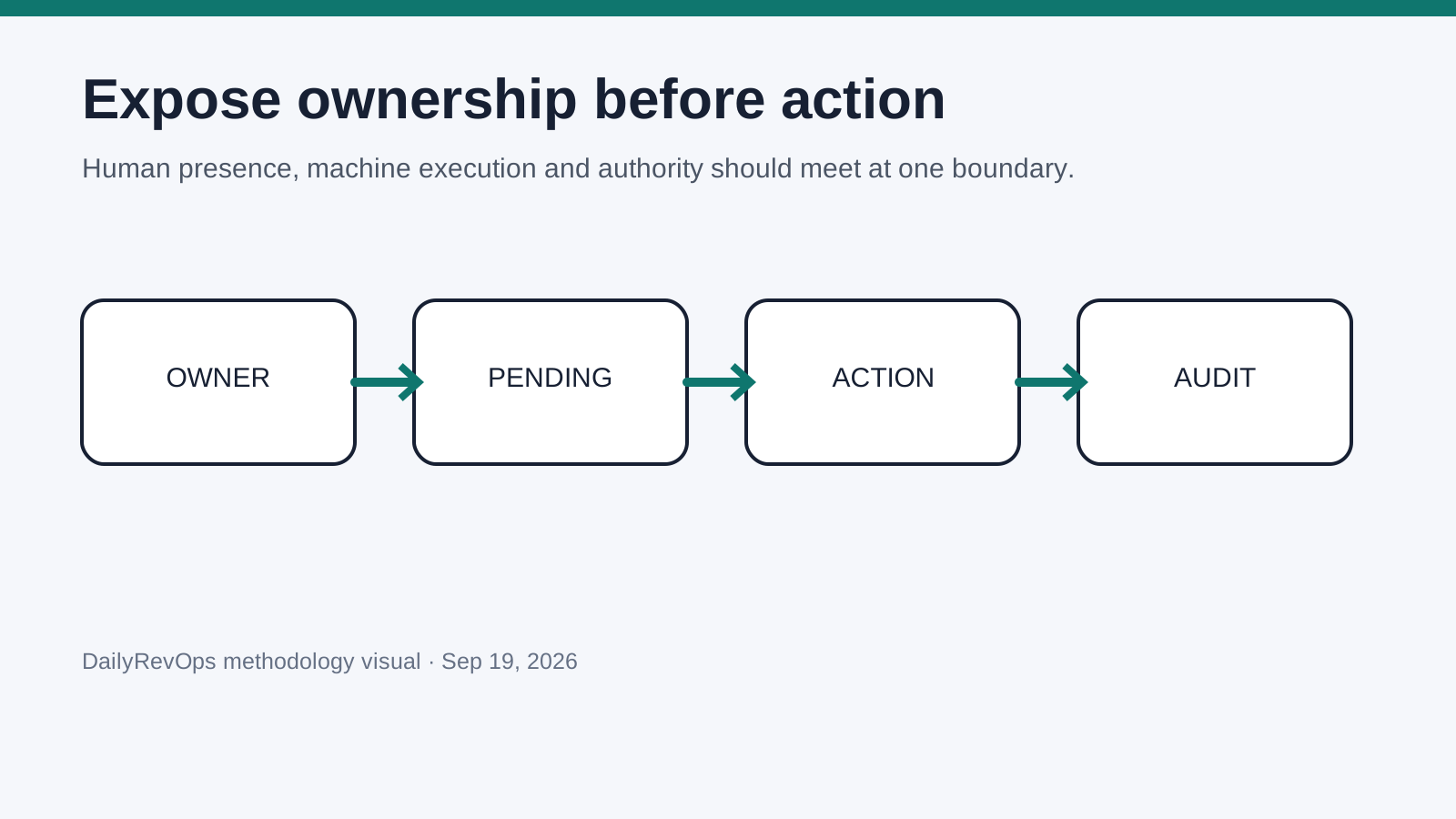
Intercom's decision to put active teammate avatars directly on conversation rows is a small product change with an unusually clear operating principle: work in progress should be visible before the next person acts. In a shared inbox that can prevent an embarrassing duplicate reply. In an agentic customer stack, the same principle needs to extend beyond avatars to every automation that can touch the customer or change the record that another workflow is using.
Most collision problems are not caused by two people intentionally ignoring ownership. They happen because the systems show different slices of state. The inbox knows who is viewing a conversation, the CRM knows the assigned owner, the billing system knows whether a refund exists, and an automation platform knows that a job is queued. If those states cannot meet at the action boundary, each participant can make a locally reasonable decision that creates a globally duplicated outcome.
This is why I think visibility should come before additional autonomy. A team should first be able to answer who owns the case, what action is currently pending, which downstream system is authoritative, and whether the intended action has already happened. Once those states are inspectable, automation can safely take a larger share of the routine work. Adding autonomy before shared state usually turns hidden coordination problems into faster hidden coordination problems.
Zendesk's Specialized AI Agents announcement makes the issue more concrete. Zendesk describes agents that can use connected systems, take actions and run proactively in response to events or schedules. Those capabilities are useful, but they also mean a customer action can begin without a human opening the ticket that another person is already reading. The system needs an equivalent of the co-viewing avatar for machine work: active execution, action key, pending approval and current owner should be visible to both humans and agents.
Assignment alone is not enough. A conversation can remain assigned to one teammate while another investigates it, and a scheduled automation can have authority to act even though no person appears active. Presence alone is not enough either. A viewer may simply be reading background. The useful state combines ownership, presence and execution intent. That combination tells an operator whether to continue, coordinate, wait or stop an automated path before the customer sees two competing outcomes.
The same pattern appears in lifecycle messaging. Customer.io now allows a CSV to define recipients for a one-time send. That file may have been assembled by another team while a support workflow is already handling some of the same customers. The messaging system can validate subscription and identity, but it may not know that an account is in the middle of a sensitive incident unless the organization exposes that state. Cross-channel customer action needs a shared stop signal, not only better audience targeting inside each tool.
Idempotency is the machine side of ownership. If a refund, task, message or status change carries a stable business-action key, a second execution can discover that the consequence already exists and stop. That is stronger than relying on a person to notice a conversation avatar and stronger than relying on an agent to infer from narrative history that someone probably did the work. The most important customer-facing automations should be able to prove that the intended action is new before they create it.
Teams should measure collisions explicitly. Sample duplicate replies, repeated refunds, repeated CRM tasks, contradictory lifecycle messages and rapid reopen-close cycles. For each case, ask which state was hidden at the moment of the second action. That review turns vague complaints about coordination into specific product requirements: expose active ownership, publish pending actions, add a shared execution identifier or move the final write into one authoritative system.
Human review is more useful when it is reviewing state rather than prose. An approval screen should show the customer, current owner, source evidence, proposed action, already-running work and the consequence of approval. A polished AI response that omits those facts invites the reviewer to judge language instead of whether the organization is about to act twice. The same interface can help a human teammate avoid colliding with another human.
The practical standard is simple: before a customer-facing action executes, the system should make current ownership and action state available to the actor, whether the actor is a person, workflow or AI agent. Intercom's Table-view visibility is one implementation of that idea for humans. RevOps should push the same idea through the rest of the stack before celebrating a higher automation rate.
Ownership visibility also needs an expiry model. A person who opened a conversation ten minutes ago may no longer be working it, and an agent execution that crashed can leave a stale pending flag. Presence and locks should therefore have heartbeats, timeouts or explicit completion states. The system should distinguish active work from abandoned work so collision prevention does not become a new source of blocked customers and manual cleanup.
The same discipline makes escalation easier. When an operator takes over from automation, the handoff should identify the last verified customer state, actions already committed, actions merely proposed and any approval still pending. That prevents the human from repeating a machine action out of uncertainty. Good ownership design is not only about deciding who goes first; it is about making the transfer of responsibility reconstructable when the first actor stops.
Source notes
These official sources support the workflow model and product concepts. They do not prove a specific retention outcome, benchmark, or vendor claim.
- Customer.io release notes: CSV recipients: Official September 17, 2026 release note for CSV-defined recipients in one-time sends.
- Customer.io one-time sends: Official implementation documentation for recipient conditions, CSV requirements, subscriptions, scheduling and rate limits.
- Intercom Table-view co-viewing: Official September 17, 2026 changelog describing live teammate viewer avatars in Inbox Table view.
- Zendesk Specialized AI Agents: Official September 14, 2026 launch of Industry Agents and Custom Agents.
Last updated: 2026-09-19