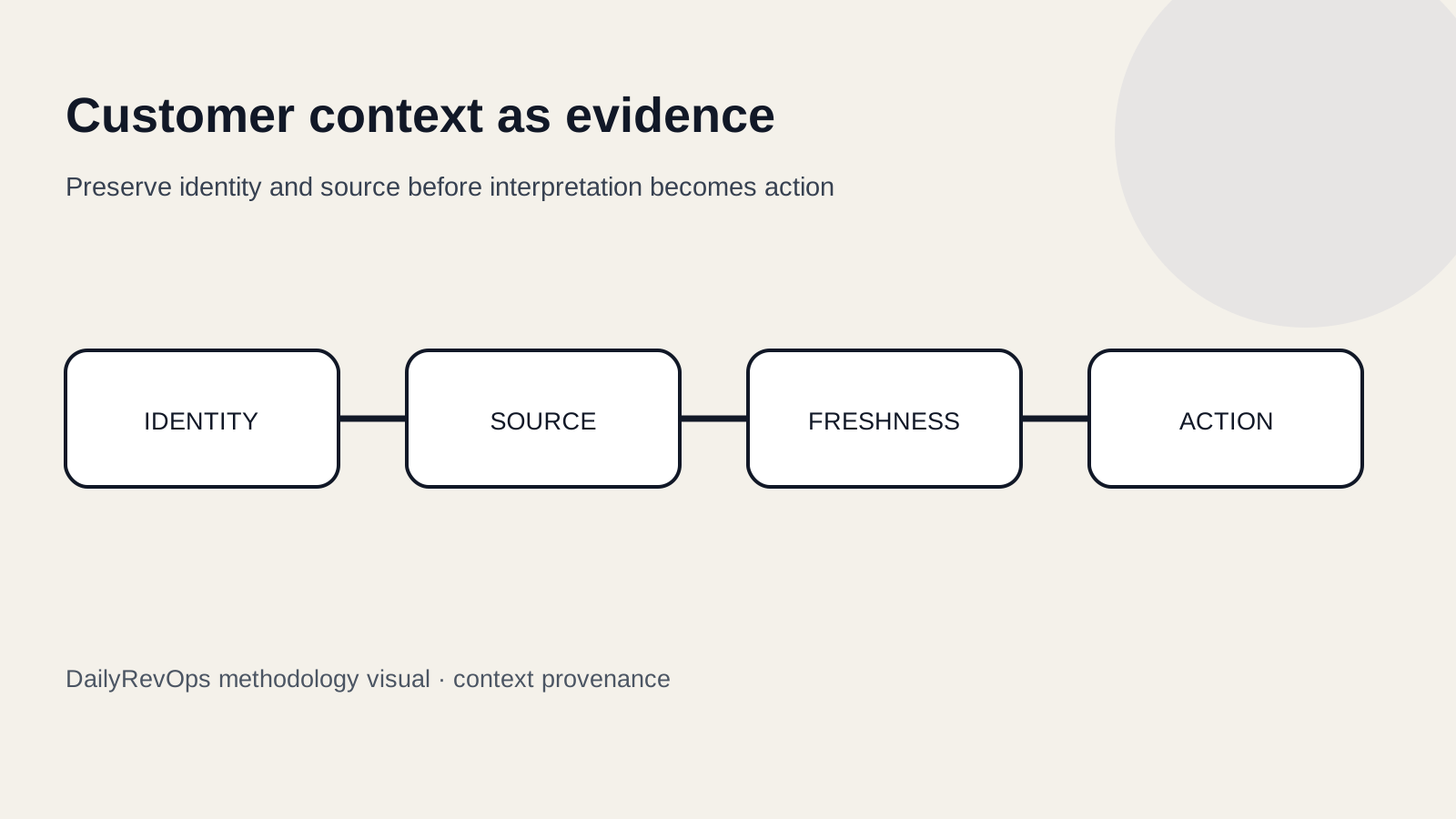
Three recent product changes point in the same operational direction even though they sit in different parts of the revenue stack. Gainsight is making customer relationship and conversation context callable from Copilot, Slack and MCP. Close now places an Ask Chloe path inside the CRM command palette. Mixpanel is exposing a much broader product-analytics surface through a typed Python SDK. The interface is different in each case, but the underlying shift is similar: context that once required a person to navigate several screens can increasingly be retrieved, summarized and composed at machine speed.
For RevOps, that changes the status of context. A customer-health signal, stakeholder relationship, CRM activity trail or product-behavior cohort is no longer merely something an operator reads before making a decision. It can become an input to an assistant, script or agent that prepares the next action. Once that happens, the team needs to know more than whether the answer looks plausible. It needs a durable record of which customer or product entity was used, where the fact originated, when it was observed, how it was transformed and which decisions it is allowed to influence.
Context should keep its business identity
The first requirement is identity. Gainsight's September release is a useful example because it distinguishes Company-level context from product-level Relationships. The platform says Timeline activity can be mapped automatically to a relevant Relationship when it can determine one, while ambiguous activity stays at Company level. That fallback is important. An interaction about one product relationship should not silently become evidence about every commercial motion associated with a parent account. The same principle applies to any assistant querying CRM, support or analytics data: preserve the stable business IDs that define the scope of the answer.
Natural-language interfaces can make identity feel less visible because users ask for names rather than IDs. A question about Acme can resolve to a parent company, subsidiary, opportunity, contact or several similarly named records. RevOps should not force people to think in database keys, but the system should keep those keys behind the answer and expose enough human context to catch collisions. Domain, owner, relationship type, product line, opportunity stage and other distinguishing fields are not decorative metadata; they are part of the evidence that the answer refers to the intended business object.
Retrieved facts and derived interpretation are different artifacts
The second requirement is provenance. A support escalation, a stakeholder departure and a decline in product activity can all contribute to a risk assessment, but they are not the same kind of evidence. A useful operating record separates the retrieved fact from the interpretation built on top of it. Store the source system, source object or event, observed value, observed time and relevant identifier. Then store the recommendation, classification or summary as a derived result with its own version and timestamp. If the interpretation changes later, the original evidence can still be inspected.
This distinction becomes more important as context moves through agents. Gainsight says Ask Staircase can answer account-specific questions using emails, meetings, calls, tickets and escalations. Mixpanel Headless can expose behavioral analytics to scripts that may then feed another system. A polished synthesis can obscure the fact that one source was stale, another was missing and a third referred to a different time window. RevOps should design the trace first and the prose second. An operator should be able to move from conclusion back to the records that supported it without reconstructing the chain from memory.
Freshness belongs to the decision, not the data source
A field can be technically current and still be too old for the action being considered. Product usage from yesterday may be acceptable for a weekly health review but too stale for a real-time entitlement decision. A meeting summary from last week may be useful context for an account plan while being insufficient to override a contract change made this morning. Freshness therefore needs to be defined at the decision boundary: which facts must be re-read immediately before execution, and which historical observations remain valid evidence.
The smallest practical pattern is a blocking-field list. For every consequential action, name the facts that can invalidate the proposal if they change: current owner, consent, contract state, open opportunity, customer tier, audience membership, product relationship or another material field. Re-read those facts near execution. Do not reload the entire customer graph simply because an AI system was involved. The goal is to make current-state validation precise enough to be reliable and cheap enough to run routinely.
Query scope and action authority must stay separate
Close's command-palette update illustrates a subtle interface risk. A question can now begin from the same keyboard surface people use to navigate the CRM. That is convenient, but convenience can blur the distinction between asking, recommending and acting. RevOps should maintain separate permissions and evidence requirements for read-only retrieval, a draft or recommendation, an internal write and a customer-facing or commercial action. A text box is not an authority model, even when the assistant behind it is capable of several kinds of work.
The same principle applies to programmatic analytics. Mixpanel describes Headless as able to work with reports, cohorts, dashboards, feature flags and experiments. Reading a funnel is not equivalent to changing a feature flag. A production script should carry an explicit action class and credential scope. If an agent authors the code, the code should still pass a normal review that shows project identity, environment, target object and rollback path. The model's reasoning can be flexible while execution remains constrained by ordinary software controls.
The context contract can be small
Teams do not need a new governance platform to start. A context contract can fit into the execution record for a workflow: business entity ID, relationship or object ID, source system, source record, observed-at timestamp, freshness rule, transformation or query version, permission scope, action class and destination result. Add mapping confidence when identity resolution is not exact. Add an exception reason when a required source is missing or ambiguous. These fields make context inspectable across a CRM assistant, a CS copilot, an MCP client or a Python job without forcing every system into one universal schema.
The contract should also describe what the context cannot authorize. A product-usage signal can support an expansion review without becoming proof of entitlement. A support conversation can indicate customer risk without becoming contractual renewal truth. A stakeholder signal can prompt outreach without proving churn. Keeping those boundaries explicit prevents a common failure mode in agentic workflows: useful evidence gradually becomes de facto authority because it is convenient to retrieve.
Measure traceability before scaling autonomy
A sensible rollout starts with a set of representative questions or jobs and measures whether the correct records were used. Include duplicate customers, multiple product relationships, stale state, permission-limited users, sparse data and a question the system cannot answer. Check target resolution, required-source coverage, freshness, citation or record traceability and correct refusal before scoring answer style. A fluent response that used the wrong customer is not a near miss; it is an identity failure.
Only after the evidence path is stable should the workflow gain a reversible write, such as creating a tagged internal task. Re-read the blocking state, execute with a stable action key, verify the destination and test rollback. If the same context later supports a higher-consequence action, the team can widen authority deliberately rather than assuming that better retrieval justifies broader execution.
Customer context is becoming easier to access precisely because the interfaces between systems are becoming more agent-friendly. That is a useful architectural improvement. It also means RevOps has to stop treating context as ephemeral screen content. The operating advantage comes when context becomes portable evidence: attributable to the right business object, current enough for the decision, separable from interpretation and constrained by an explicit action boundary.
Source notes
These official sources support the workflow model and product concepts. They do not prove a specific retention outcome, benchmark, or vendor claim.
- Gainsight CS September 2026 release: Official September 21 release describing Relationship mapping, stakeholder context and Ask Staircase across Copilot, Slack and MCP.
- Close: Ask Chloe from the command palette: Official September 22 changelog entry moving an AI question path into the CRM command palette.
- Mixpanel Headless: Official September 18 announcement for the early-access Python SDK exposing Mixpanel analytics and configuration to code.
Last updated: 2026-09-23