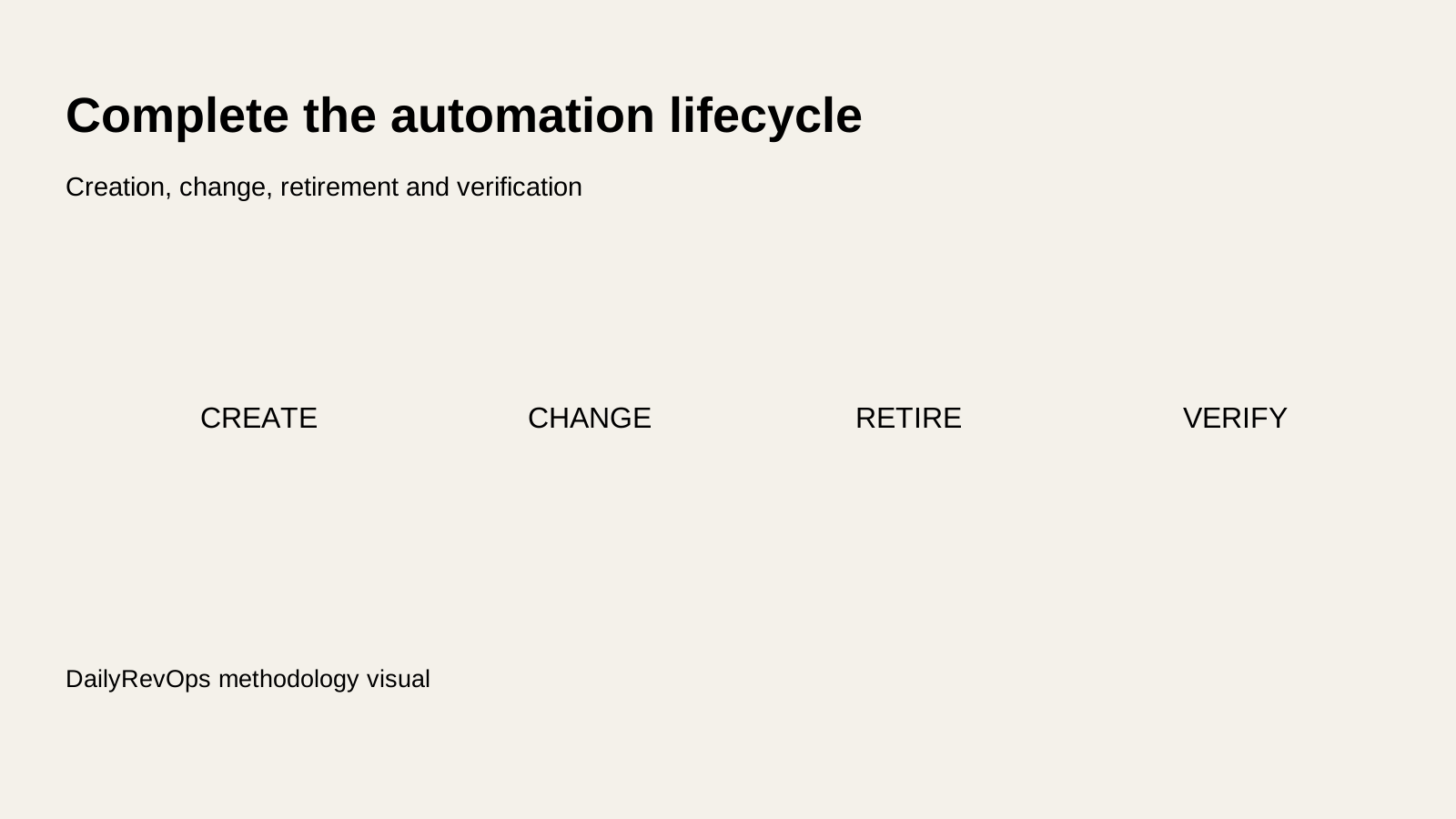
Revenue automation is usually designed from left to right: detect a signal, create a record, generate content, route work and execute an action. That framing makes launch easy to describe, but it hides what happens after the first successful write. Objects become stale, permissions change, templates are replaced, brand rules evolve, customer records merge and a workflow that once matched policy may no longer do so. The more systems automate customer-facing work, the more important the reverse path becomes. RevOps needs to know not only how state is created, but how it is changed, invalidated, deleted and proven gone.
Three September 24 product updates make that lifecycle problem visible from different angles. Customer.io added AI-first Design Studio capabilities that can generate brand rules from websites, logos and files and use those rules while drafting or editing email. Front added a Channel API endpoint that can delete an application message template when the external source deletes it, instead of waiting for a later full resync. Salesloft published a product vision in which forecasting, execution and adaptive multi-step playbooks increasingly feed each other. None of those releases proves an outcome by itself. Together they show why automation controls need to cover the full life of the state they create.
Creation is only one quarter of the contract
For every automation-managed object, write four verbs before discussing scale: create, change, retire and verify. A Customer.io brand rule can be generated, overwritten or revised. A Front application template can be created from an external catalogue and now explicitly deleted. A revenue playbook can be proposed, adjusted as conditions change and eventually stopped. The exact verbs differ by product, but the operating question is the same: which system is authoritative for each transition, and what evidence proves the destination now matches that authority?
This contract is especially useful for objects that look like configuration rather than customer data. Templates, prompts, mappings, routing rules and brand documents are easy to treat as static setup. In practice they influence every downstream action that references them. A stale template can continue to shape customer messages after the source team thinks it has been removed. A stale brand rule can keep guiding generation after a rebrand. Configuration state deserves the same ownership, timestamps and retirement semantics as customer records when it can change customer-facing behavior.
Generated policy needs an effective version
Customer.io says Design Studio can generate brand rules from a website, logo and other files, and that an operator can choose whether to overwrite existing styles. It also says the Design Studio agent can use the resulting brand document and existing emails when building a new message, while an inline agent can make smaller component-level edits. The useful control is not whether AI is involved. It is whether the team can identify which policy version the message was generated under.
Store a brand-policy identifier or effective date with material message reviews. The policy should distinguish visual rules, tone guidance, mandatory legal language, prohibited claims and accessibility requirements where those matter. If an operator regenerates rules from a website after a redesign, do not let that silently rewrite the historical explanation for a message already approved. New drafts can use the new policy while old messages retain the policy version that governed their review. That is ordinary configuration management applied to lifecycle marketing.
Deletion is a synchronization event, not housekeeping
Front's September 24 developer update is unusually concrete about deletion. For application channels that synchronize message templates, Front previously retained its copy after the external service deleted a template until a full resync occurred. The new DELETE endpoint lets an integration act when the external deletion webhook fires. That closes a state gap: the external catalogue can now say a template no longer exists and the destination can remove its copy immediately.
RevOps should treat delete propagation as part of integration correctness. Define what happens when a source object disappears, is archived, becomes invalid or loses permission. Does the destination delete it, archive it, detach it from active workflows or hold it for review? What if the delete webhook is retried? What if the destination returns not found because the object was already removed? A deletion path should be idempotent and should leave enough evidence to distinguish successful removal from an object that was never synchronized in the first place.
Adaptive workflows increase the need for stop conditions
Salesloft's September 24 announcement separates current capabilities from an upcoming vision that includes Agentic Forecasting, Agentic Playbook, more real-time conversation intelligence and Context Intelligence. The roadmap describes workflows that can respond to changing signals rather than execute one fixed sequence. That kind of adaptation makes stop conditions more important, not less. A system that can choose a new next step should also know when no next step is permitted.
For an adaptive revenue workflow, define terminal states before defining branches. A customer reply may transfer control to a human owner. A closed-lost opportunity may stop prospecting. A changed territory or account owner may invalidate an earlier action proposal. A legal or consent flag may block customer-facing communication. A forecast change can create a review task without automatically authorizing outreach. When adaptation is open-ended, termination rules are the boundary that prevents an old objective from continuing after the business state has moved on.
Verification must exist after destructive and corrective actions
Create operations often return a new object ID, which makes success easy to log. Delete and correction operations can be less visible. A 204 response can say the endpoint accepted a deletion, but the operating workflow may still need to verify that the intended external identifier no longer resolves and that no active workflow references the retired template. The same principle applies when replacing a brand policy or stopping a playbook: verify the resulting state that matters to the business, not only the HTTP response.
A minimal lifecycle evidence record includes object type, stable source ID, destination ID where one exists, source authority, action verb, prior state, intended state, policy or workflow version, actor, request or execution ID, occurred-at time and verification result. Keep denied and no-op outcomes too. An already-deleted template is not necessarily an error; it may be the correct idempotent result. A proposed overwrite that was rejected is useful evidence that a control worked.
Lifecycle completeness is a better scale test than automation count
Teams often measure automation by how many actions run without intervention. That is useful capacity information but a weak readiness signal. A workflow can process thousands of records while accumulating stale configuration, orphaned objects and changes nobody can reconstruct. Before increasing volume, sample one object from creation through retirement. Can another operator identify where it came from, what changed it, which current policy applies, how it is stopped and how the final state is verified?
The practical test is small. Pick one customer-facing template, one policy object and one adaptive workflow. Exercise create, update and retirement paths in a controlled environment. Repeat the same delete or stop action twice. Change source state between proposal and execution. Confirm that the workflow either revalidates or refuses stale work. Then review the evidence without opening the original chat or builder session. If the lifecycle cannot be reconstructed, the system is not yet ready to become more autonomous.
The deeper pattern is that automation maturity is not defined by how quickly software can create state. Mature systems can also unwind, supersede and explain it. Customer.io's generated brand context, Front's explicit template deletion and Salesloft's adaptive-workflow direction each make a different part of that contract visible. RevOps can use the same operating discipline across them: every durable object should have an authority, a version, a retirement path and a verified final state.
Source notes
These official sources support the workflow model and product concepts. They do not prove a specific retention outcome, benchmark, or vendor claim.
- Customer.io: Design Studio AI-first email creation: Official September 24, 2026 release describing generated brand rules, AI-built email drafts and inline editing.
- Front: Delete application message templates via the Channel API: Official September 24, 2026 developer update describing explicit deletion of synchronized application message templates.
- Salesloft: Agentic revenue vision: Official September 24, 2026 product-news post separating capabilities already delivered from an upcoming agentic forecasting and playbook roadmap.
Last updated: 2026-09-25