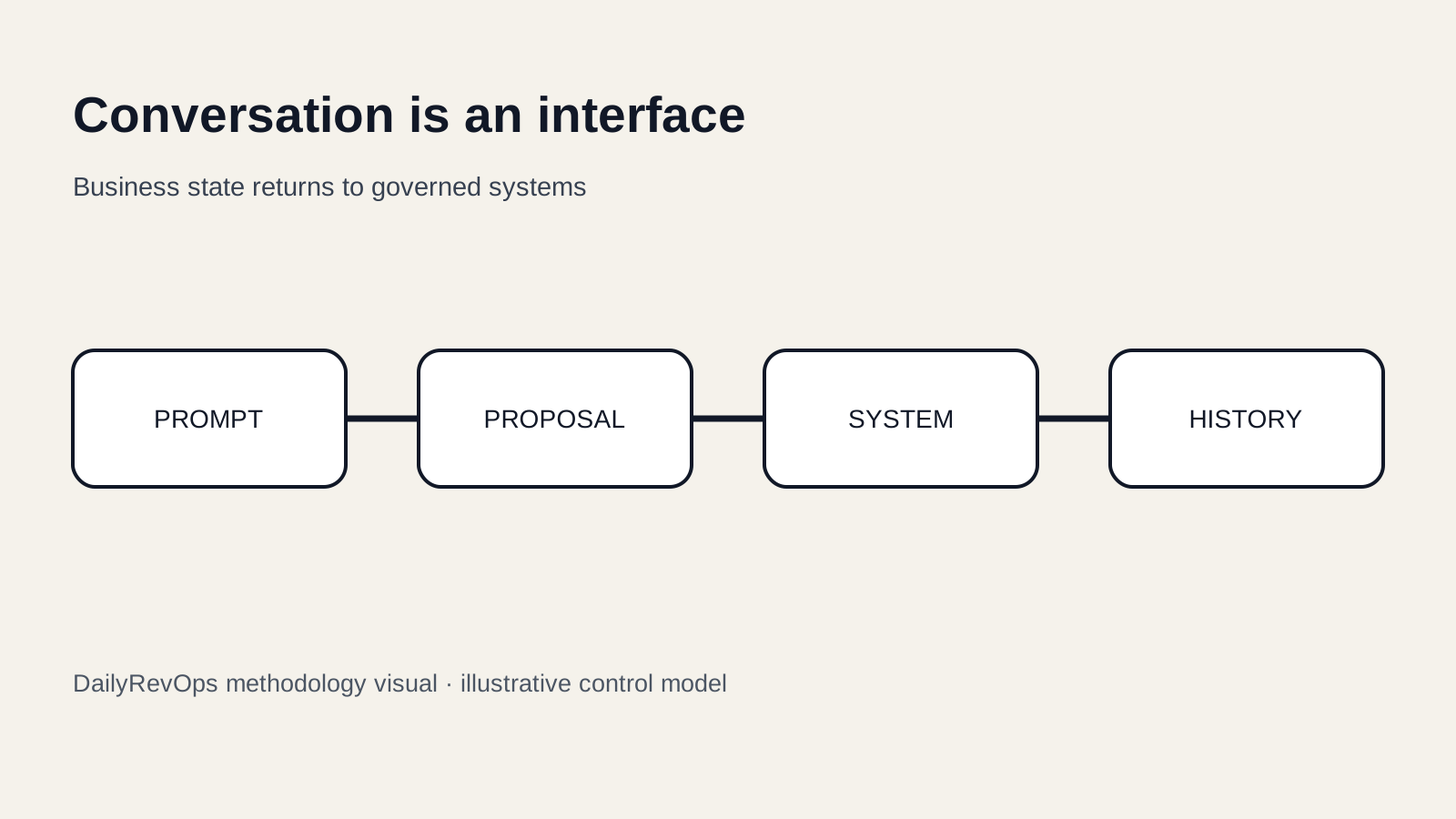
A conversational interface can become a shadow CRM faster than teams expect. The warning sign is not that people use Claude, ChatGPT, Slack or another assistant to ask questions. It is that decisions, campaign changes, ownership changes and customer actions exist only in those conversations while the governed systems retain incomplete or stale state.
UserGems' MCP launch is a useful example because it makes campaign work available from external AI assistants. Demandbase is also moving signal and execution closer together. The right response is not to prohibit new interfaces. It is to insist that business state returns to durable systems after the interface has done its job.
The interface should be disposable
An operator should be able to lose the conversation and still reconstruct the business process. The campaign specification should exist in the campaign system. The CRM write should exist in CRM history. The audience membership should be attributable to a source rule. The approval should have a durable actor and timestamp. If the chat is the only place where the reasoning and change survive, the interface has quietly become a second system of record.
That is fragile because conversational history is optimized for interaction, not operational reconciliation. Threads are hard to query across teams, identity and retention can vary, and downstream systems may change after the conversation. The durable record belongs with the object and action that another operator must support later, not only with the UI that initiated it.
Convenience should not create hidden authority
Natural language makes complex actions feel lightweight. A request to update a campaign or enroll an account can look like the same kind of interaction as a request to summarize a record. They are not equivalent. The first mutates business state; the second produces information. The product surface should make that authority change visible.
Read-only requests can return evidence. Draft actions can produce a proposed configuration. Production actions should expose the target, consequence and permission before execution. The interface can remain conversational while the authority model stays explicit. The user should not have to infer whether a sentence is informational, a proposal or an executed change.
Shadow state appears in partial failures
The worst cases are not always obvious mistakes. They are partial success: the assistant says the campaign was updated, the CRM change succeeded, but an ad audience failed; a sequence was created, but half the contacts were rejected; a routing update applied to one number while another kept old membership. The user may see one high-level status while the business state is split across systems.
Durable destination records and reconciliation states are what expose that split. Interfaces should link to those records instead of summarizing away the partial result. A high-level success label is useful only when every material destination has either confirmed the intended state or has an explicit exception that someone owns.
Shared memory is not shared truth
An assistant can maintain context across a conversation, but that memory should not resolve conflicts between authoritative systems. Billing owns some commercial facts, CRM owns some operational fields, marketing automation owns campaign state and telephony owns call-routing configuration. The assistant can combine those facts for a proposal; it should not invent a new authority hierarchy inside its context window.
Maintain an authority map for high-impact fields and actions. When sources conflict, return the conflict or apply the documented rule. A conversational answer that silently picks one value is harder to detect than a traditional integration error because it can sound completely coherent and may be acted on immediately.
Design for handoff to another operator
Every production action should leave enough context for someone who was not in the original conversation. Link the source records, target object, before-and-after state, approving policy or person, execution ID and exception if any. That packet is more important than preserving every sentence of reasoning because it follows the business object rather than the original user session.
The same design improves supportability. When an operator reports that a campaign or CRM field changed unexpectedly, RevOps can inspect a known execution record instead of searching chat histories or trying to reproduce a prompt. The system becomes easier to debug precisely because the interface is not carrying the whole operational memory.
A conversational layer should reduce UI, not governance
There is real value in reducing screen navigation. Admins should not have to click through dozens of views to make a safe, well-specified change. But the path from intent to execution can be shorter only if the control packet travels with it. Removing interface friction should not remove evidence, review or ownership.
The standard should be simple: an assistant can be the place where work starts, but it should not become the only place where business state is explained. Keep the conversation convenient and the underlying record boring, explicit and durable. That makes the new interface replaceable instead of making the business dependent on its history.
A useful operating test is whether a colleague who never saw the original conversation can explain the current state from the governed records alone. If that person still needs the chat transcript to discover what changed, who approved it or which destination accepted the action, the interface is carrying operational state that belongs elsewhere.
Related reading: AI workflows · Revenue data quality · GTM operations
Source notes
These official sources support the workflow model and product concepts. They do not prove a specific retention outcome, benchmark, or vendor claim.
- UserGems MCP launch: Official launch showing campaign operations exposed through external AI assistants.
- Demandbase Orchestration release: Official execution-layer announcement.
Last updated: 2026-09-21