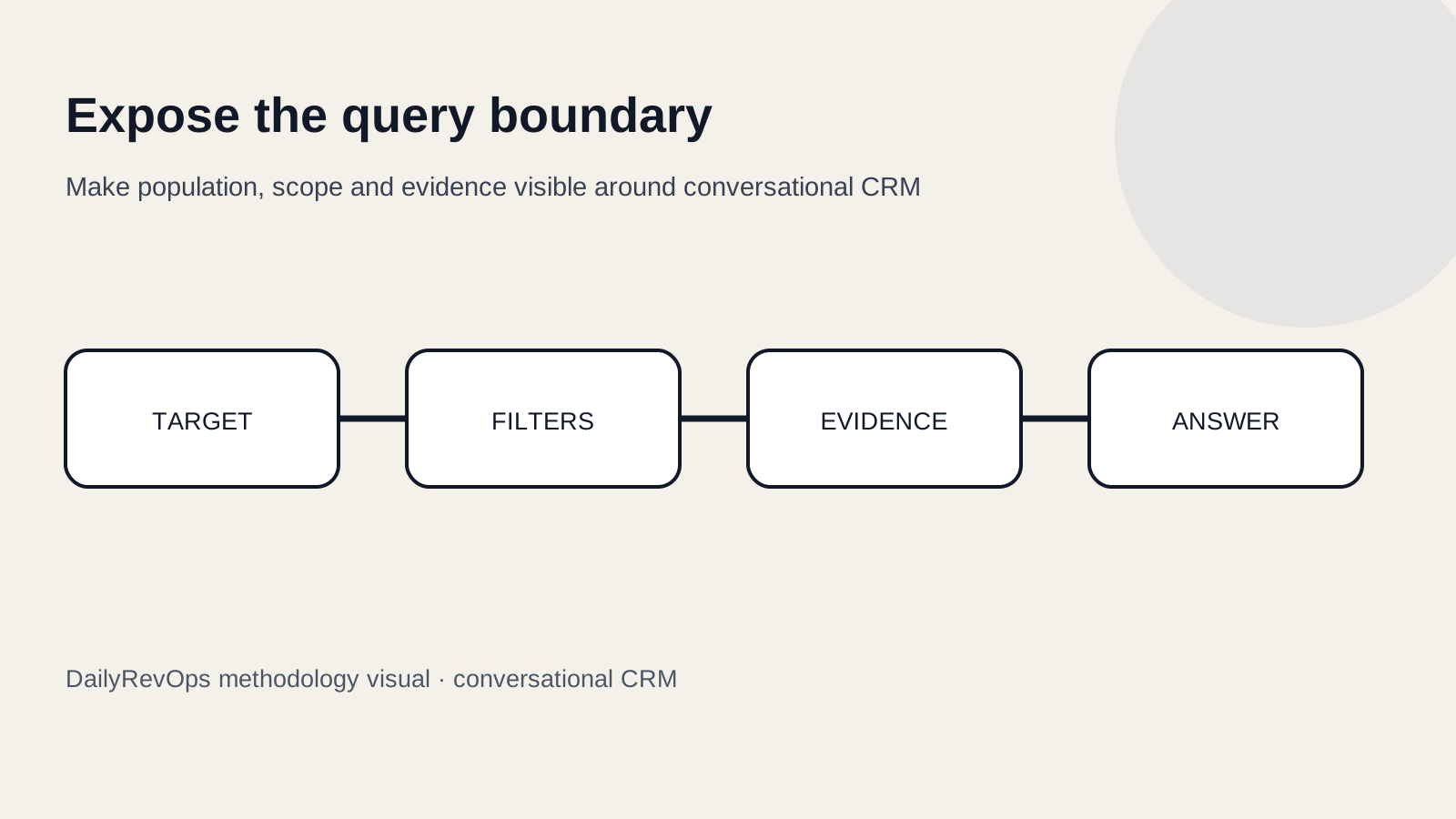
The next useful improvement in conversational CRM is not a smarter answer. It is a visible query boundary. When an operator asks an assistant what is happening with an account, which deals are at risk or who needs follow-up, the interface should make it clear which records were searched, which filters were applied, what time range mattered and which facts were unavailable. That information is usually treated as implementation detail. It should be part of the product surface whenever the answer can influence revenue or customer action.
Close's September 22 update is a small but telling example. Ask Chloe now appears when a user types a query in the CRM command palette. Gainsight is taking a related direction from another angle, exposing more customer relationship and conversation context through Copilot, Slack and MCP. These are useful ways to reduce navigation. But the easier it becomes to ask a cross-system question, the more important it becomes to show what the system believed the question was about.
Natural language hides filters that tables make visible
A CRM table forces an operator to see at least some of the mechanics: object, view, filter, columns and row count. A natural-language answer compresses those choices. Ask which accounts need attention and the assistant has to decide what counts as an account, what population is in scope, what evidence signals attention and how far back to look. If those decisions are hidden, users can mistake a convenient interpretation for an authoritative population.
The answer does not need to dump a query plan onto the screen. A compact boundary is enough: 42 open opportunities owned by this team, activity through 10:32 today, excluding archived accounts, using meeting, reply and stage-change evidence. That kind of summary gives an operator a chance to spot a wrong assumption before acting. It also creates a durable comparison when the same question produces a different answer next week because filters, permissions or schemas changed.
Entity resolution should be a first-class state
Conversational interfaces also hide identity resolution. Humans are comfortable saying Acme, but the CRM may contain Acme Inc., Acme EMEA, a parent holding company, several opportunities and duplicated contacts. If the assistant silently picks the first text match, every downstream explanation is contaminated even if the language model reasons perfectly. Products should show the selected business entity and allow ambiguity to remain unresolved when several candidates are plausible.
This is especially important for account summaries that combine systems. A CS platform can hold a product-level relationship while CRM holds the parent account and billing owns the subscription. The assistant should not flatten that structure merely because the user asked one sentence. Stable IDs, association type and source ownership can remain invisible most of the time, but they should be recoverable from the answer and present in the execution record.
Citations should point to business records, not just documents
AI products have made citations familiar, but enterprise context needs a stronger version of the same idea. A claim about an account should point to the meeting, ticket, CRM field, product event or relationship signal that supports it. A link to a generic source system is not enough. The operator should be able to inspect the exact record and its observed time, particularly when the answer describes risk, ownership, commitment or next action.
Gainsight's release notes say Ask Staircase can surface citations from customer conversations and related context. That is the right design direction because it lets a human distinguish retrieved evidence from synthesis. The same pattern should become normal in CRM assistants: claims that influence action should remain attached to the records that produced them, while model-generated interpretation is labelled as a separate layer.
Permission boundaries should be legible in the answer
A user may receive a partial answer because they do not have access to one source or record. That is safer than leaking restricted data, but it can be misleading if the interface presents the partial result as complete. Conversational CRM should indicate that the answer is constrained by the user's current access and should distinguish no matching evidence from evidence that exists but is outside the permitted scope.
The same applies to actions. Reading a record, drafting a recommendation and changing customer state should not inherit one permission simply because they share an assistant. A query boundary should therefore connect to an action boundary. When an answer becomes an executable change, the interface should show the target record, current state, proposed state and execution identity before the write. The transition from information to mutation deserves more visibility than the prompt that initiated it.
Time belongs in the answer contract
Business context decays at different speeds. The latest deal stage may need to be re-read seconds before an action, while a contract term remains valid for months. An assistant should expose the freshness of material evidence instead of presenting all fields as equally current. A simple observed-at time on the cited record is often enough. For aggregate answers, show the query window and the last refresh of any external source that materially affected the conclusion.
This also improves incident review. When someone asks why the assistant recommended an action on Tuesday but not Wednesday, the team can compare record state and query time instead of guessing whether the model behaved differently. Without that evidence, conversational interfaces turn ordinary data drift into mysterious AI behavior.
The query boundary should be reusable across interfaces
The principle is not specific to Close or Gainsight. The same user may ask a question in CRM, Slack, mobile, an MCP client or a custom agent. The visible interface can change while the query contract remains stable: target population, entity IDs, filters, evidence sources, observed times, access scope and query or prompt version. That makes results comparable and prevents each new surface from inventing its own hidden interpretation of the same business question.
RevOps should ask vendors and internal builders for this boundary before asking for more autonomy. It is easier to trust an assistant that can say what it looked at, what it could not see and which record it means than one that merely sounds confident. The best conversational interface is not the one that hides every technical detail. It is the one that hides routine complexity while making consequential assumptions inspectable exactly when they matter.
Source notes
These official sources support the workflow model and product concepts. They do not prove a specific retention outcome, benchmark, or vendor claim.
- Close: Ask Chloe from the command palette: Official September 22 product update.
- Gainsight CS September 2026 release: Official September 21 release describing customer-context access in Copilot, Slack and MCP.
Last updated: 2026-09-23