Talkdesk's October 7 billing-report change, Intercom's October 6 macro fields and Method's October 5 workflow and audit updates expose evidence at three different points in an operating process. None of the vendors publishes a comparable benchmark for evidence quality across revenue systems. Teams should therefore measure their own reconstructability with explicit units, denominators and observation windows instead of presenting a universal score.
The research question is narrow: can an independent operator reconstruct what happened, why it was permitted and whether the final state was verified? The study does not test whether a product is best, whether automation increased revenue or whether a customer was satisfied. It tests the evidence chain around consequential work.
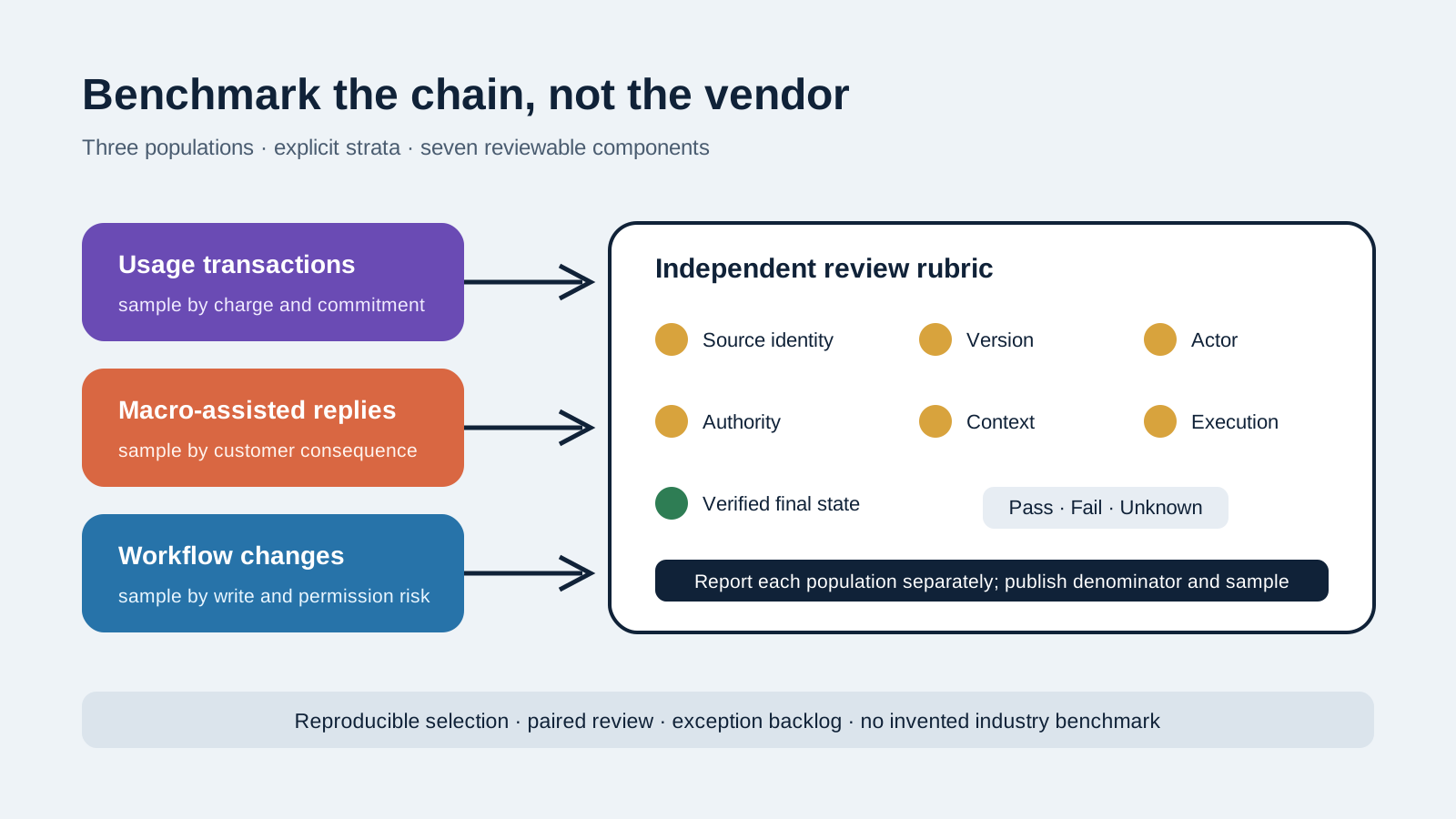
Define three separate populations
Population one is billable usage transactions during a named billing period. Use the Talkdesk report grain: one interaction may create several transactions, and a transaction report may not equal the final invoice. Preserve the interaction, transaction, commitment and invoice relationships rather than sampling invoices alone. Population two is customer replies created with a governed macro. Population three is production workflow or connector changes, including builds, permission changes and disconnect events.
Choose a fixed observation window and freeze the extraction time. Record the total eligible count for each population. Exclude tests or sandboxes only under a written rule that can be repeated. Do not drop failed, unowned or incomplete records, because those are likely to contain the evidence gaps the study is intended to find.
Stratify by consequence
Within usage, separate free-unit application, prepaid-credit consumption, direct debit and commitment-related transactions. Within replies, separate informational messages from communications affecting money, access, entitlement, renewal or a promised date. Within workflow changes, separate display or formatting changes from routing, CRM write, customer communication, accounting and permission changes.
Sample every high-consequence item when the population is small. Otherwise select a reproducible random sample within each stratum and preserve the seed or ordered selection method. Report population and sample counts by stratum. A convenience sample of clean records will overstate reconstructability.
Score components, not impressions
Use seven binary components. Source identity means the original interaction, customer record or workflow version can be retrieved. Version means the applied commitment, macro or automation definition is known. Actor means the person or service principal is visible. Authority means the actor was permitted to make that class of decision. Context means the commercial or customer facts used are traceable. Execution means the transaction, send or run is recorded. Final state means the invoice, sent reply, CRM or accounting destination was checked after action.
A component passes only when a reviewer can retrieve acceptable evidence. A field containing a name is not enough if the named owner no longer exists or the record cannot be opened. A dashboard total is not enough when it cannot be reconciled to the sampled unit. A screenshot can supplement evidence but should not replace stable IDs and source records.
Use paired review to test the rubric
Have two reviewers independently assess at least a subset of every population. Give them the same definitions and source access. Record agreement for each component and discuss disagreements before finalizing the study. If reviewers repeatedly disagree about authority or final state, improve the rubric or evidence rather than averaging their judgments away.
Preserve an unknown outcome. If access expired or a source was legitimately deleted under retention policy, the reviewer should not guess. Report unknown separately from pass and fail. The rate of unknown evidence is itself operationally useful because it reveals retention, permission or source-link fragility.
Report a profile, not one maturity score
For each population and stratum, publish the eligible count, sampled count and proportion passing each component. Also report the share with a complete chain, defined as all required components present. Do not average billable transactions, support replies and workflow changes into one percentage. Their risks, grains and evidence systems differ.
Add exception categories: missing source link, unresolved identity, unknown version, ambiguous actor, authority not documented, stale context, execution without outcome, and outcome without source. Count each sampled unit in every applicable category. This creates a repair backlog that can be assigned to Finance, Support Operations, RevOps, IT or Accounting.
Compare periods only after definitions stabilize
Run the method once as a baseline, repair definitions and permissions, then repeat with the same strata. If the product or process changes, publish the definition change and avoid presenting the movement as pure improvement. A new Talkdesk column, Intercom field type or Method audit event may make evidence easier to find; it can also change which items qualify or what a pass requires.
Do not claim causal business impact from a higher reconstructability rate. The study can show that more sampled work is explainable under the defined rubric. Revenue, cost, speed or customer outcomes require separate designs and data. That distinction keeps an internal evidence benchmark defensible.
Add a sensitivity check before publishing the result. Recalculate the component profile after treating every unknown as a failure, then again after excluding unknowns from the denominator. A large movement between those views means access or retention quality is materially shaping the headline. Publish both views and the unknown count instead of selecting the more flattering result. Also inspect whether one source system or reviewer accounts for most unknowns; that pattern is more actionable than a blended average.
Protect the study from process gaming. Do not announce the exact sampled records before the evidence window closes, and do not allow owners to repair a sampled record without retaining the original state and repair timestamp. The purpose is not to punish teams for a gap. It is to distinguish evidence that existed during the workflow from evidence reconstructed only after review. Report remediation separately so the benchmark remains repeatable and the improvement work is still recognized.
The final artifact should include the observation window, extraction timestamp, populations, exclusions, strata, selection method, rubric, reviewers, agreement, component results, unknowns and exception backlog. With those pieces, another team can reproduce the study. Without them, a neat percentage becomes another unsupported benchmark.
Source notes
These official sources support the workflow model and product concepts. They do not prove a specific retention outcome, benchmark, or vendor claim.
- Talkdesk Admin release notes, October 7, 2026: Official release note adding Credit Commit ID and Credit Commit Balance to the Billing Usage Transactions Report.
- Talkdesk Billing Usage Transactions data dictionary: Official field and grain documentation; one interaction can produce multiple transactions, and the report does not necessarily equal the final invoice.
- Intercom: Personalize macro replies with fill-in fields: Official documentation for text, long-text and choice fields, required inputs, optional sections, preview behavior and rollout limitations.
- Method release notes, October 5, 2026: Official release note enabling Method AI Action Editor Build mode by default and expanding audit coverage for QuickBooks and Xero disconnects or permission changes.
Last updated: 2026-10-07