New workflow builders and connector catalogs make it easier to create and extend automated revenue operations. Clay now describes natural-language building, a visual run trace and bulk rerun for Workflows. Talkdesk is rolling its revamped Studio experience to general availability with validation and version-oriented controls. Workato's latest community-connector roundup adds new dependencies and documents several schema, authentication and error-handling changes.
Those releases create a useful measurement question: when an automation changes, can a second operator replay the release and reach an explainable final state? This methodology measures local replayability. It does not compare vendors, claim a universal safety level or treat a product capability as evidence that a team's implementation is controlled.
Define the eligible change population
Choose a fixed review window and include every production automation change that could alter a customer, prospect, account, opportunity, conversation, audience, invoice input or owner action. Include new workflows, logic edits, connector changes, credential changes, model or prompt changes, schema mappings, schedule changes and bulk reruns.
Retain cancelled and rolled-back changes in the denominator. Excluding failures would overstate control quality. Record the workflow ID, old and new version, change owner, deployment timestamp, affected systems and estimated eligible population. If the platform has no explicit version, create an immutable export or hash of the configuration used.
Draw a stratified sample
Stratify by consequence and change type before sampling. Useful consequence bands are read-only analysis, internal task creation, reversible descriptive write, routing or ownership write, external customer communication and commercial or billing action. Change types can include rule, agent instruction, connector, schema, credential, schedule and rerun.
Sample from every non-empty stratum using a fixed seed or ordered rule. Review every high-consequence change when the count is small. Publish the eligible count, sampled count and exclusions. Do not replace the sample because a selected change is poorly documented; missing evidence is the result.
Score six replayability components
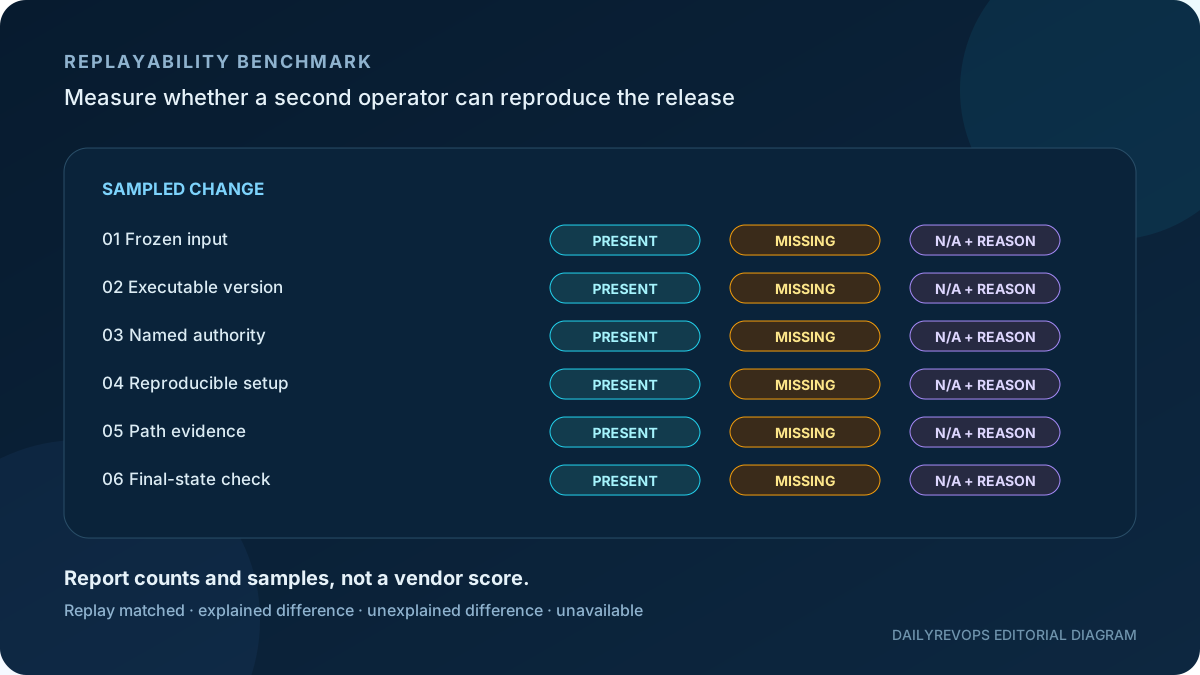
Score each component as present, missing or not applicable with a written reason. Component one is frozen input: stable record IDs, input values and observation time. Component two is executable version: logic, model or prompt, connector action and relevant dependency version. Component three is authority: named approver or versioned policy for the action.
Component four is deterministic setup: credentials, permissions, environment and flags needed to reproduce the run without exposing secrets. Component five is path evidence: branches, external calls, warnings, errors and destination responses. Component six is final-state verification: a fresh read from the authoritative destination plus any customer- or finance-facing outcome required by the workflow.
Run a bounded replay
Replay the sampled change on a protected copy, sandbox or non-writing mode where possible. If the platform cannot simulate safely, reconstruct the path from retained evidence and mark execution replay unavailable. Never rerun a customer message, ownership change or billing action simply to satisfy the study.
Use at least one original representative record and one exception record. Compare branch decisions, transformed values, external calls and proposed writes with the release trace. Record exact mismatches. A replay can be technically repeatable while producing a different result because source data, model behavior or an external service changed; that difference is part of the finding.
Test rerun control separately
For changes that used a bulk rerun, verify whether the team froze the target population, retained prior results, defined overwrite behavior, assigned an exception owner and reconciled the destination. Count a rerun as controlled only when each affected record can be tied to the original attempt and the corrective attempt.
Do not assume idempotency. Test whether the same input creates a duplicate task, message, record or transaction. When the action cannot be safely repeated, require an idempotency key, preflight read or manual reconciliation rule. Report non-replayable actions as a separate risk class rather than forcing them into a pass rate.
Calculate transparent local measures
Report the number and share of sampled changes with all applicable components present. Also report each component separately, because one average can hide a missing authority record behind strong logging. Publish replay attempted, replay matched, replay differed for an explained reason, replay differed without explanation and replay unavailable.
Add two operational measures: median time for a second operator to assemble the evidence and count of unresolved destination differences. Use the team's own time units and publish sample sizes. Do not set an industry target. Establish a local baseline, repair the weakest component and repeat with the same definitions.
Separate product capability from implementation evidence
A platform may offer traces, validation, version history or connector error details. The study should record whether the sampled implementation retained and used them. Product availability is contextual evidence; a complete release packet is organizational evidence. Likewise, an absence in the platform may be mitigated by an external change record, test harness or destination audit.
Record feature availability and rollout state at the time of change. Clay describes Workflows as beta for all users and the Inbound SDR Agent as pre-beta. Talkdesk describes a progressive general-availability rollout. A reviewer should be able to tell whether the exact account had the feature when the release occurred.
Turn failures into a repair queue
Route frozen-input gaps to the data owner, version gaps to the builder, authority gaps to the process owner, credential gaps to Platform or Security, trace gaps to the automation owner and destination mismatches to the system owner. Give every sampled failure a due date and a proof-of-repair requirement.
Repeat the measure after a defined interval or material platform change. Keep the original sample and results so improvement cannot be created by narrowing the population. Replayability is valuable because it turns automation safety from an opinion about the builder into evidence another operator can reproduce.
Source notes
These official sources support the workflow model and product concepts. They do not prove a specific retention outcome, benchmark, or vendor claim.
- Clay: Recapping the products announced at Sculpt 2026: Official October 8, 2026 recap. Clay says Workflows is in beta for all Clay users and the Inbound SDR Agent is a pre-beta preview with a waitlist.
- Workato: Community Connectors—what's new in September 2026: Official October 7, 2026 changelog describing new community connectors plus schema, authentication, error-reporting and stability changes.
- Talkdesk Orchestration & Routing release notes: Official release notes for the progressive October 9, 2026 general-availability rollout of the revamped Studio experience.
Last updated: 2026-10-09