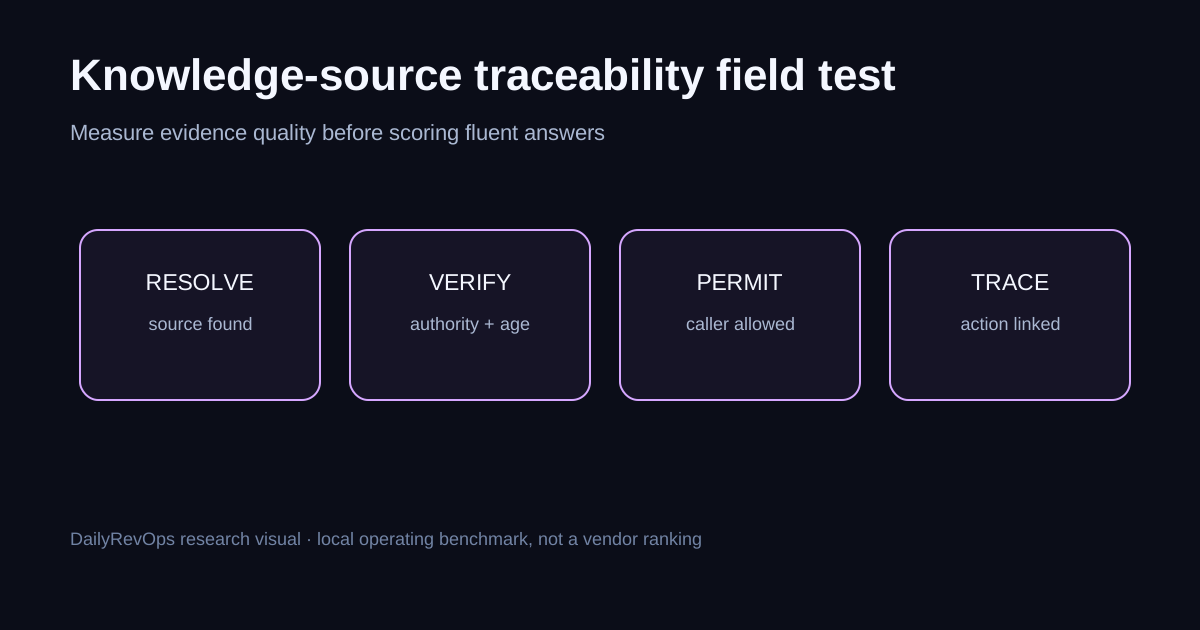
Teams often evaluate automation with outcome measures such as completion rate, response quality or time saved. Those measures can be useful later, but they are weak starting points when the underlying workflow cannot be reconstructed. This field benchmark tests trace completeness first. It asks whether an operator can explain which business record triggered a run, which evidence was available, which workflow version produced the decision, what business change followed and what state exists now. It is a local operating benchmark, not a cross-vendor score.
Define the sample before collecting results. Include successful runs, failed runs, retries, manually replayed runs, stale-source cases and at least one workflow that depends on an external data source. If the workflow uses warehouse data, include one late-arriving record and one identity mismatch. If it uses knowledge retrieval, include a recently changed source and a source that is temporarily unavailable. A convenience sample of clean successes will overstate how explainable the system is under the conditions that produce real operating exceptions.
For every sampled run, start with the business trigger. Record the stable entity ID, trigger type, source timestamp and material state that made the record eligible. A CRM stage change should capture the stage transition. A scheduled warehouse query should capture the query version and stable destination key. A manually initiated review should capture the operator, target record and stated objective. Mark the trigger incomplete when another reviewer has to infer it from free text or surrounding context.
Next measure evidence provenance. Record each material source system, source identifier or URL and the relevant checked-at or observed-at time. A reference is only useful when a reviewer can tell why that source was appropriate for the decision. Zendesk's widening external knowledge surface illustrates the point: public pages, support procedures and technical documentation can all be available to the same experience while carrying different business authority and refresh rhythms.
Then measure decision traceability. The benchmark does not require an exhaustive transcript. It requires the operational conclusion that controlled the next step: the category assigned, branch selected, proposed field value, customer segment or exception reason, plus the workflow version that produced it. The reviewer should be able to distinguish source facts from the interpretation that followed. That distinction is what allows a data-quality issue to be repaired differently from a workflow-design issue.
The fourth element is the resulting business action or record change. Capture the destination, the type of change and the intended outcome. If a task was created, identify the customer record and owner. If a CRM field changed, identify the object and field. If an audience or lifecycle segment changed, preserve the population definition or query version. The goal is to connect the workflow result to something an operator can inspect later, rather than treating the automation run itself as the final business state.
The fifth element is verification. After a consequential run, compare the expected state with the current destination state. A created task should appear on the intended customer record with the expected owner and timing. A CRM update should contain the intended value. A warehouse-driven audience should contain a known eligible record and exclude a known negative record. Verification turns the trace from a record of attempted work into a record of observable business outcome.
Use a binary checklist for the first pass. Mark each sampled run yes or no for trigger, evidence, decision, outcome and verification. Report the share of runs with all five elements and the distribution of missing elements. Also report sample size, date window, workflow versions and selection method. Avoid publishing a universal acceptable percentage without comparable evidence and a shared operating definition. The value of the measure is internal consistency and repairability, not a headline benchmark.
Add a failure class to every incomplete run. Missing trigger identity points to enrollment or source-model problems. Missing evidence provenance points to data-lineage or knowledge-source gaps. Missing decision context points to weak workflow observability. Missing outcome references point to unclear handoffs between systems. Missing verification points to a process that records execution without confirming the resulting business state. Each failure class should map to a named owner or operating area.
Repeat the sample after significant workflow, connector, model or source changes. Compare the missing-element distribution rather than only the overall completeness rate. A new workflow-history feature may improve decision visibility while a new data integration introduces more ambiguous source timing. The benchmark should make that tradeoff visible. Keep the previous measurement so the team can explain why traceability improved or deteriorated over time.
Only after trace completeness is reliable should teams add broader outcome measures such as correction rate, exception resolution time, duplicate work or customer-impact measures. Those metrics become much more useful when every sampled result can be traced back to the exact business evidence and workflow that produced it. Otherwise the team can see that something went wrong without being able to identify which part of the operating model should change.
Attio's new workflow history and agent log, Customer.io's Databricks activation path and 6sense's current MCP documentation expose different pieces of the same evidence problem. RevOps should use those product surfaces to build a local traceability contract that survives source changes and repeated runs. The benchmark is intentionally simple: before judging whether automation is effective, prove that the team can explain what happened.
Source notes
These official sources support the workflow model and product concepts. They do not prove a specific retention outcome, benchmark, or vendor claim.
- Attio 2026 changelog: Official September 23 workflow-history and agent-log release.
- Customer.io release notes: Official Databricks support release used for warehouse-to-activation traceability context.
- 6sense MCP documentation: Official documentation used for current MCP retrieval scope.
- 6sense MCP FAQ: Official September 24, 2026 FAQ used for current product boundaries.
Last updated: 2026-09-27