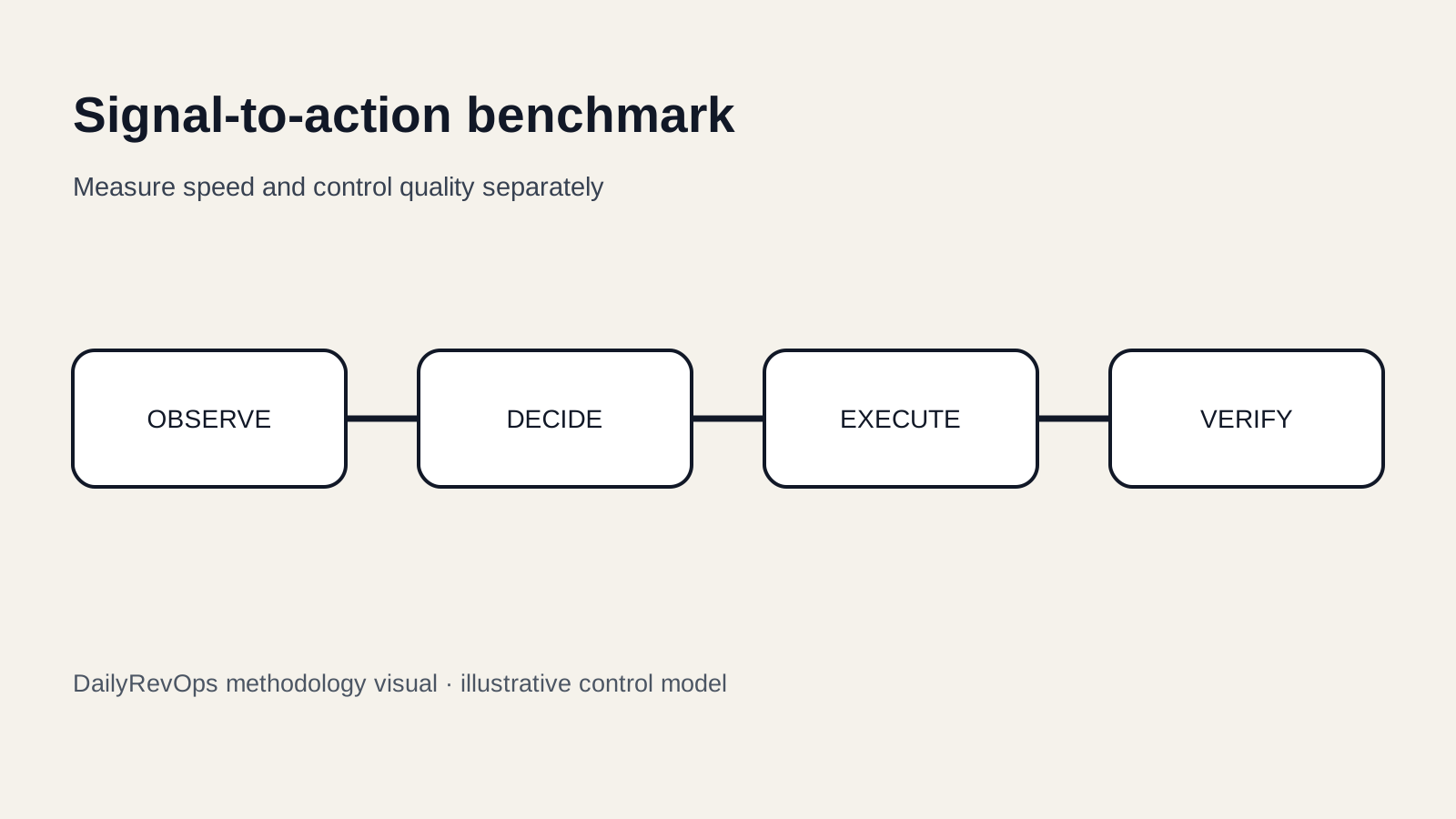
Signal-to-action latency is becoming a product metric across GTM platforms, but faster is not automatically better. A team can reduce the time between an intent signal and an outbound action while increasing duplicate touches, stale-state errors or low-quality eligibility decisions. RevOps needs a local measurement contract that treats speed and correctness as separate observations.
Demandbase's redesigned Orchestration emphasizes faster activation of intent and opportunity signals. UserGems' MCP makes campaign changes easier to request from AI assistants. These releases create a useful research question: how should a team measure the path from observed signal to verified business action without rewarding premature automation?
Define the clock start
Choose the event that starts the latency clock: source signal observed, signal ingested, score recomputed, threshold crossed or workflow evaluated. These are different timestamps. Store all of them when possible so data ingestion delay is not confused with decision or execution delay. One latency number without a stated clock start is not reproducible.
For an account-intent workflow, the most useful start can be the time the qualifying source event became available to the automation. For a CRM change requested by a user, the start may be the approval-ready proposal time. State the definition with every metric rather than publishing one generic response-time number.
Split decision latency from execution latency
Decision latency covers enrichment, identity resolution, scoring, policy checks and approval. Execution latency starts only after the action is authorized and ends when the destination confirms it. A slow decision can be appropriate when the record is ambiguous; a fast execution can still be wrong if the eligibility decision used stale evidence.
Measure both distributions separately. Keep median and tail observations for your own workflow if useful, but do not turn them into universal benchmarks. The operating goal is to locate where delay comes from and whether removing that delay changes correctness or simply removes a useful control.
Add a correctness outcome
For every sampled action, classify whether the intended target was correct, the source evidence was current, the action was allowed, the destination matched the approved state and no equivalent action already existed. A fast action that fails one of those checks should not count as an operational success.
Review blocked actions as well. A policy that stops an ambiguous record can increase latency while improving control quality. The measurement should preserve the reason for the block rather than treating every non-execution as lost throughput. Correctly blocked work is part of the system's quality profile.
Observe collision and duplicate rates locally
When several systems can act on the same account or person, record whether another campaign, task, sequence or customer communication was already active. Count duplicate-prevention blocks and collisions discovered after execution. These are workflow-specific controls, not cross-company benchmarks, because the underlying operating models differ.
Use a stable action key so a retry is distinguishable from a genuinely new action. Network timeouts otherwise inflate the apparent number of actions and can create a misleading impression that the workflow is fast and productive when it is simply repeating work. One business action should have one durable identity even across transport retries.
Preserve source freshness
Store the age of each blocking fact at decision time: ownership, lifecycle stage, customer status, opportunity state, suppression, consent or whatever the workflow depends on. Then compare corrections or reversals against freshness. If errors concentrate on old source state, the bottleneck is the data contract rather than the model or orchestration engine.
Do not average freshness across all inputs. A two-day-old company description may be harmless while a two-day-old suppression or ownership value is unacceptable. Use field-level maximum ages based on consequence and keep the observed timestamp next to the decision so later analysis can reproduce the state that was available.
Build a representative evaluation cohort
Select records that cover normal and difficult states: clean qualified account, near-threshold account, duplicate identity, active customer, open opportunity, missing owner, recent stage change, suppressed person, stale signal and a record already in another motion. Run the same workflow contract across the cohort rather than measuring only the easiest successful cases.
Capture trigger time, evidence time, decision time, approval time if present, execution request time, destination confirmation, verification time and final classification. That timeline lets RevOps identify whether a delay came from ingestion, reasoning, human review, integration or destination processing and whether that delay prevented or caused an error.
Report a latency-quality matrix
Group sampled executions by latency band and show the number that were correct, blocked correctly, corrected later or collided with other work. Do not infer causation from a small sample. The matrix is a diagnostic that helps the team choose where to automate further and where to retain a control gate.
If faster bands show more stale-state errors, add current-state validation. If approval creates most delay but rarely changes the action, test a narrower policy-approved action. If integration delay dominates, fix transport or batching before changing decision logic. Each intervention should address the observed bottleneck rather than chasing a lower headline latency.
What this benchmark does not claim
This method does not set an ideal response time, conversion rate or pipeline outcome. Vendor sources may cite customer results, but those populations and definitions are not automatically comparable with another operation. The purpose is to make local signal-to-action behavior reproducible enough to improve safely.
A useful internal benchmark is one another operator can recompute from the event log and policy version. Faster execution becomes valuable only after the team knows that the action was targeted, permitted, non-duplicative and verified. Speed is one dimension of control quality, not the definition of it.
Related reading: Research & benchmarks · GTM operations · AI workflows
Source notes
These official sources support the workflow model and product concepts. They do not prove a specific retention outcome, benchmark, or vendor claim.
- Demandbase Orchestration release: Official September 18 announcement emphasizing signal-triggered execution.
- UserGems MCP launch: Official September 18 launch showing conversational campaign control.
Last updated: 2026-09-21