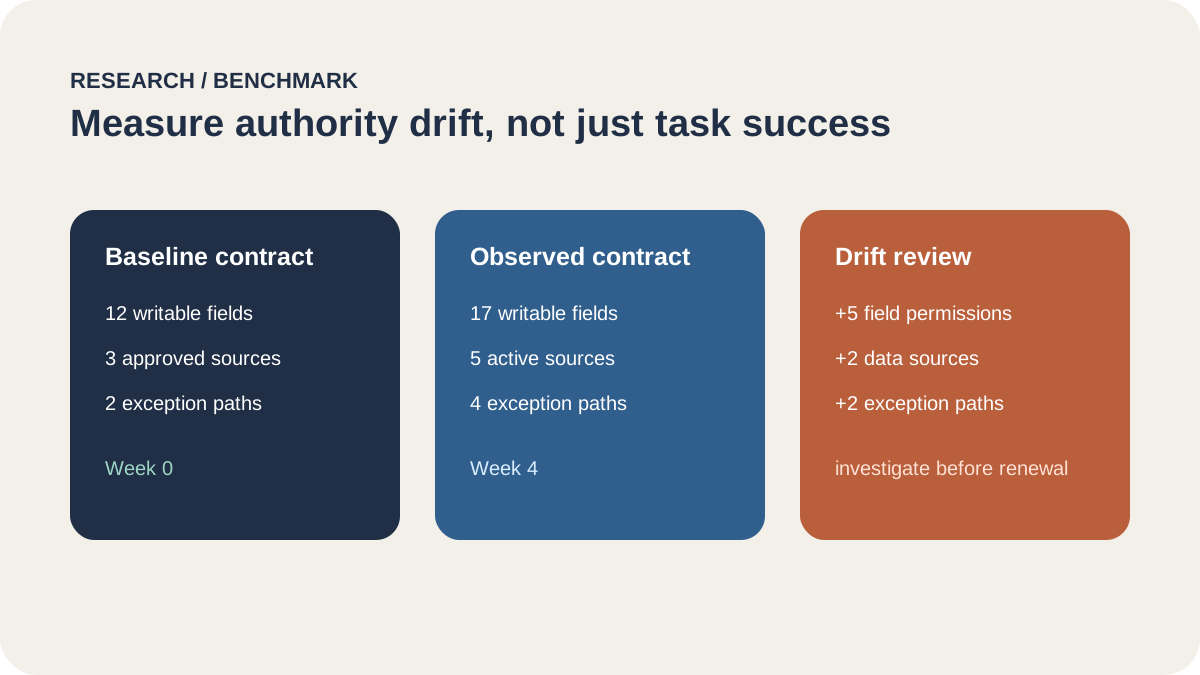
Reusable AI procedures can remain unchanged while their effective authority changes. Microsoft now offers 30 Dynamics 365 CRM skills in Copilot Cowork and distinguishes other host availability. Gainsight's Skilljar AI Tutor depends on eligible captions and enrollment context. Maxio's Wallet Product correction changes the destination classification produced by a billing sync. These releases supply concrete examples of environmental dependencies.
No reviewed source publishes a comparable cross-company benchmark for authority drift. This article therefore defines a local methodology. The result should be labeled for the measured organization, procedure set, consequence classes and observation window. It must not be presented as a vendor score or universal target.
Define authority drift
Authority drift is the difference between the approved operating boundary and the current effective boundary of a reusable procedure. It can expand when permissions or tools broaden, contract when a source disappears, or change semantics when a field, transcript, enrollment rule or destination classification changes. Drift exists even if the procedure file is identical.
Model four boundary types: data authority, action authority, host authority and outcome authority. Data authority covers eligible objects and evidence. Action authority covers read, propose, write, send and financial effects. Host authority covers the approved invoking experience and release state. Outcome authority covers the destination state that may be reported as complete.
Freeze the eligible population
Create a registry of active reusable procedures at the start of the measurement window. Include procedure ID and version, owner, host, tools, data objects, action class, last validation, expiry, consequence class and production use. Exclude drafts and disabled procedures, but publish those exclusions.
A procedure invoked through two materially different hosts counts as two evaluated contexts because effective tools, user interaction and release status may differ. A single skill with read-only and write-enabled configurations should also be split. The denominator must represent the authority contexts people can actually use.
Build the approved-boundary record
For each context, retain the approved fields and objects, allowed actions, identity model, review requirement, expected destination and accepted final-state check. Record prohibited actions and at least one intended denial. Add external dependencies: transcript provider, CRM schema, permission group, product family, workflow or billing classification.
If the prior approval lacks these details, classify the boundary as undocumented rather than reconstructing it from current behavior. The method should reveal governance gaps, not erase them. An undocumented item can still be tested, but it cannot receive a no-drift result because there is no stable baseline for comparison.
Detect environmental changes
Compare the current environment with the approved record. Inspect tool lists, permission scopes, group membership, host release status, CRM metadata, validation rules, source eligibility, source versions, destination mappings and downstream automation. Use platform evidence where available and manual review where semantics cannot be inferred.
Classify changes as none, bounded, material or unknown. Bounded means the change is within documented tolerance and has evidence. Material means it can alter the eligible data, action, host or outcome boundary. Unknown means the team cannot determine impact with available evidence. Unknown should not be scored as safe.
Run a minimum test pack
Use five cases per authority context where applicable: permitted clean record, missing evidence, ambiguous identity, intended denial and conflicting or already-completed destination state. Freeze inputs and expected outcomes. Execute under the production-equivalent identity without using administrator privileges merely to make the test pass.
For Microsoft-style CRM skills, verify recommendation, proposal, approval and destination read-back. For transcript-grounded tutoring, require a supporting segment and a controlled unsupported question. For a billing sync, verify stable source identity, destination classification and duplicate-safe recovery. The pattern changes by workflow, but every test needs observable acceptance criteria.
Score at the context level
Assign one of five results. Aligned: environment matches approval and all required tests pass. Narrowed safely: effective authority is smaller and the fallback works. Expanded with approval: authority grew, was reviewed and new tests pass. Drifted: effective authority or semantics changed without accepted evidence. Unknown: required comparison or test evidence is missing.
Do not convert these labels into a single average that hides consequential drift. Report the distribution by consequence class. An organization with ninety aligned read-only skills and one drifted financial writer should see the financial exception first, not a ninety-nine-percent green headline.
Calculate review measures
Useful local measures include aligned contexts divided by eligible contexts, material-change contexts reviewed before use, intended denials that still deny, consequential actions with verified destination state, drift age and time from detection to containment. Publish numerator, denominator, exclusions and collection window for every rate.
Also report the count of undocumented and unknown contexts. They are not failures of the vendor; they are evidence about the local operating system. Track recurrence by dependency so repeated schema, permission or host changes can improve the review process.
Separate detection from harm
Authority drift is a control finding, not proof that a customer or business was harmed. Preserve any affected actions separately and investigate them. Do not estimate saved revenue, avoided incidents or answer accuracy from the drift label alone. Those outcomes need their own populations and causal evidence.
Conversely, absence of observed harm does not make drift acceptable. A broadly permissioned procedure may not have used its excess authority during the window. The benchmark evaluates whether the workflow remains governed, not whether luck prevented an incident.
Set review and stop rules
Stop a consequential context when action authority expands unexpectedly, the host changes release status, required evidence becomes unavailable, destination read-back fails or a financial classification changes without owner approval. Read-only contexts may move to warning mode if the information risk is bounded and visible.
Assign every drifted or unknown result to an owner with due date, containment and next evidence. Retest the specific boundary after correction. Keep the prior result for trend analysis rather than overwriting history. A repaired procedure is evidence of recovery, not evidence that the original drift never existed.
Interpret results responsibly
This benchmark helps an organization compare its own procedure portfolio over time. It can show whether revalidation is keeping pace with environmental change and where critical authority contexts remain unknown. It cannot rank Microsoft, Gainsight, Maxio or any other vendor, because the procedures, permissions, data and implementation choices belong to different systems and customers.
Publish the registry date, evaluated hosts, consequence classes, test design and limitations with the results. Authority drift becomes useful when it opens a precise review queue and improves expiry rules. The goal is not a perfect score; it is a portfolio in which every consequential automated procedure still knows what it may read, what it may do, where it may run and which final state it may claim.
Source notes
These official sources support the workflow model and product concepts. They do not prove a specific retention outcome, benchmark, or vendor claim.
- Microsoft Dynamics 365 CRM skills: Official October 8, 2026 release for 30 pre-built CRM skills, with separate availability statements for Cowork, Autopilot and Code.
- Maxio October 2026 product release: Official release page documenting the October 7 Wallet Product sync and recurring Usage-item classification.
- Gainsight Skilljar October 2026 release: Official October 8 release for Wistia-caption and learning-path support in AI Tutor, including stated limitations.
- NIST AI Risk Management Framework: General risk-management context; not product evidence or a vendor benchmark.
Last updated: 2026-10-12