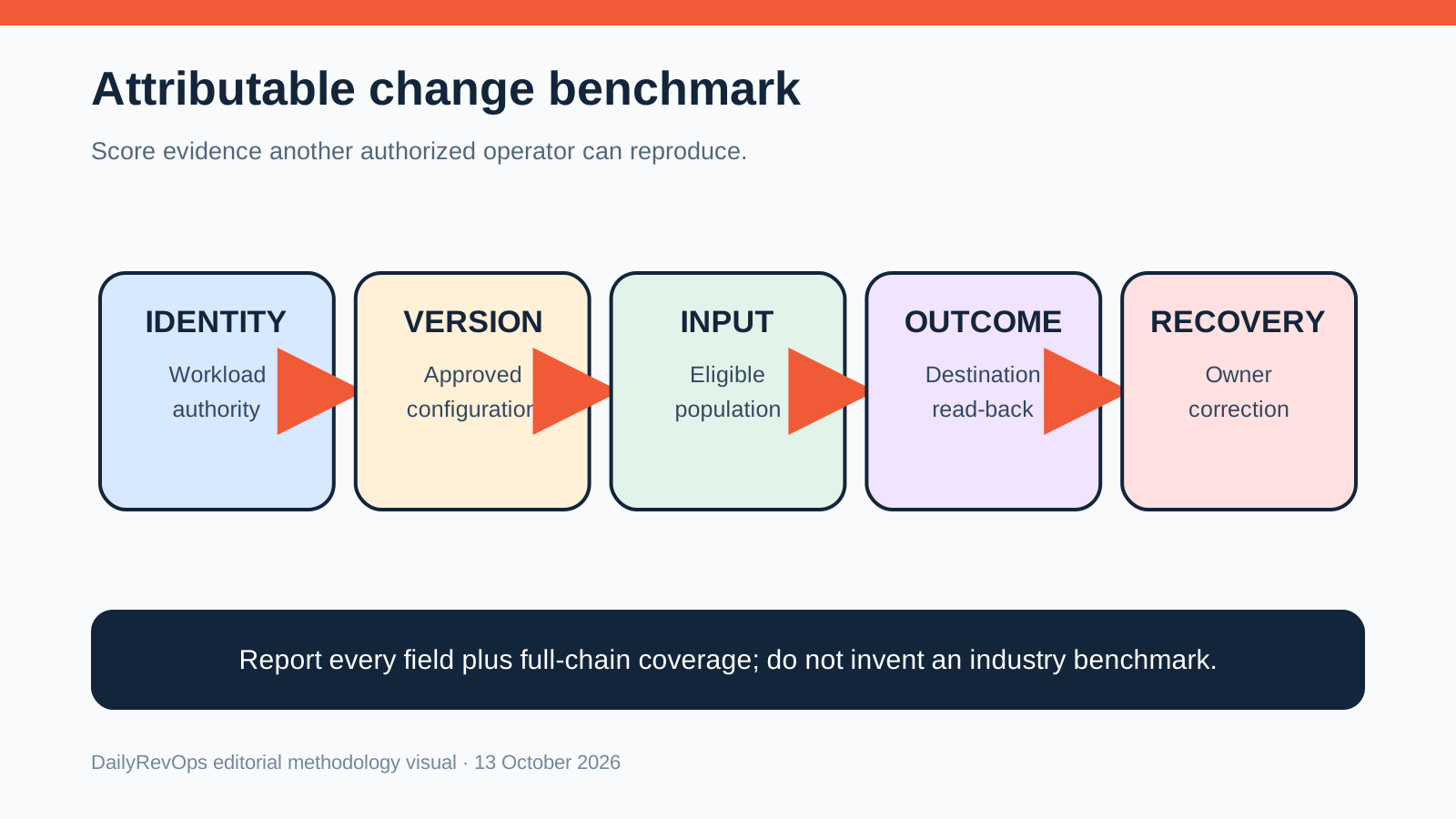
Customer-operations integrations are often benchmarked with uptime, task volume or average latency. Those measures describe transport and throughput. They do not show whether an operator can reconstruct a consequential change: which workload acted, which version was approved, which source population was eligible and what the authoritative destination showed afterward.
This research design measures attributable change. It is a local operating benchmark, not an industry average and not a vendor ranking. Teams should publish their own sample, exclusions, evidence and uncertainty. Intercom API 2.17, Snowflake named workload identities and Maxio's prepayment correction provide current examples of why identity, release and reconciliation evidence all matter.
Research question
For a frozen sample of production customer-operations changes, what proportion can another authorized operator reconstruct from trigger through verified outcome without asking the original builder to interpret an unstructured chat, screenshot or memory?
A change qualifies when it can alter customer-facing knowledge, connector configuration, data access, billing state, CRM state, audience or another consequential operating result. Read-only jobs may be sampled separately because their outcome evidence differs from writes and releases.
The benchmark unit is one eligible change or run, not one vendor, account or ticket. Publish the unit before sampling. Avoid mixing a content release, a warehouse authentication event and a payment sync in one denominator unless every rubric field has a defined equivalent.
Freeze the population
Choose a bounded observation window, such as the last 30 days, and enumerate changes from native systems, deployment history, connector runs and incident records. Deduplicate using stable identifiers. Record the extraction time and source query so another operator can reproduce the population.
Stratify by consequence: internal read, internal write, customer-facing release, commercial or financial write and access-control change. Sample enough items from each stratum to expose weak categories. Publish excluded tests, deleted sandboxes and unsupported historical records rather than silently shrinking the denominator.
If a source system cannot enumerate changes, that is a finding. Do not replace the population with the changes that happened to have tickets. Report population coverage separately from evidence quality.
Seven evidence fields
Score each item on seven binary fields. First, workload identity: a stable workload and owner are visible. Second, authority: the acting identity and relevant permission or approval are retained. Third, version: code, content or configuration version is immutable enough to inspect.
Fourth, eligible input: the source population or triggering object is defined. Fifth, execution: the request, run or publish event has a stable identifier and result. Sixth, destination verification: the authoritative final state was read after execution. Seventh, recovery: an exception owner, correction path and retained prior state exist.
A field scores one only when the evidence is accessible and specific to the sampled item. A template that says a read-back should occur does not prove it occurred. A connector marked healthy does not identify the eligible records. A shared service user without workload attribution does not satisfy identity.
Primary metrics
Report full-chain reconstructability: items with all seven fields divided by eligible sampled items. Also report each field's coverage separately. A single composite percentage can hide whether the main weakness is identity, release evidence or outcome verification.
Add verified-change rate: sampled items with a destination read-back matching the accepted proposal divided by items that attempted a consequential change. Classify mismatches as missing, duplicated, stale, denied, partial, wrong identity or unresolved. Do not force unresolved into failure or success until the review window closes.
Report median and maximum reconstruction time for a second operator. Time begins when the reviewer receives the stable change ID and ends when the evidence chain and outcome classification are complete. Publish the review environment and allowed access because those conditions affect the result.
Evidence examples
For an Intercom article release, evidence may include article ID, previous live version, draft version, reviewer, publish event and current live read-back. For a Data Connector, include configuration version, audience, acting identity, execution history and sampled output.
For a Snowflake workload migration, include service user, named workload identity, provider, roles, positive and negative tests, cutover runs and old-identity retirement. For a Maxio prepayment recovery, include eligible funded prepayment ID, destination query, repair action, balance and application verification.
These examples illustrate the rubric; they do not imply comparable product behavior. Keep vendor-native objects and semantics intact. The benchmark compares evidence completeness across locally operated workflows, not feature quality across vendors.
Quality controls
Have two reviewers independently score at least 10 percent of the sample. Reconcile disagreements by pointing to evidence, then refine the rubric. Publish inter-reviewer agreement and every rule change made after the pilot.
Blind the reviewer to the original operator where practical so personal familiarity does not substitute for documentation. Preserve unavailable evidence as unavailable. Do not backfill a missing approval after the fact and then score the historical item as complete.
Run sensitivity analysis with strict and practical thresholds. The strict view requires all seven fields. The practical view may allow one missing low-consequence field, but destination verification should remain mandatory for consequential writes. Publish both rather than choosing the friendlier result.
Interpretation
Low identity coverage suggests shared credentials or weak run attribution. Low version coverage suggests mutable configuration or content without release receipts. Low eligible-input coverage means denominators are being built from success. Low destination verification indicates that teams are treating acknowledgements as outcomes.
Recovery coverage is a leading signal of operational maturity. A workflow can be correct most days but unsafe to change if no one can restore prior state or own exceptions. Compare recovery evidence by consequence rather than averaging a low-risk read with a financial write.
Use trends only when sampling and scoring remain stable. If the population expands to new systems or high-consequence strata, annotate the break. An apparent decline can be healthy if it results from examining previously invisible work.
Reporting template
Publish observation window, systems, extraction queries, eligible counts, exclusions, sample method, consequence strata, rubric, field coverage, full-chain result, verified-change classifications, reconstruction time, reviewer agreement and known blind spots.
Link every conclusion to the local evidence. Do not claim an industry benchmark, adoption rate or vendor superiority. The result supports an operating decision: which control gap to fix next and how the team will know the evidence improved.
The operator takeaway
Attributable change shifts the benchmark from whether automation ran to whether consequential work can be explained. It respects the boundaries exposed by current releases: workload identity, staged publication and historical reconciliation are different evidence problems.
Freeze a local population, score the seven fields and publish the gaps. Improve the weakest field with one bounded workflow, then resample. The useful benchmark is the one another operator can reproduce without trusting the person who built the automation.
Source notes
These official sources support the workflow model and product concepts. They do not prove a specific retention outcome, benchmark, or vendor claim.
- Intercom API 2.17 changelog: Official October 12, 2026 release for Data Connectors, article drafts, version history and other API changes.
- Maxio October 2026 product release: Official October 12 entry describing direct-ID prepayment lookup and non-retroactive recovery.
- Snowflake new features: Official October 12 feature update for named workload identities.
- NIST AI Risk Management Framework: General governance context, not product evidence or a vendor benchmark.
Last updated: 2026-10-13