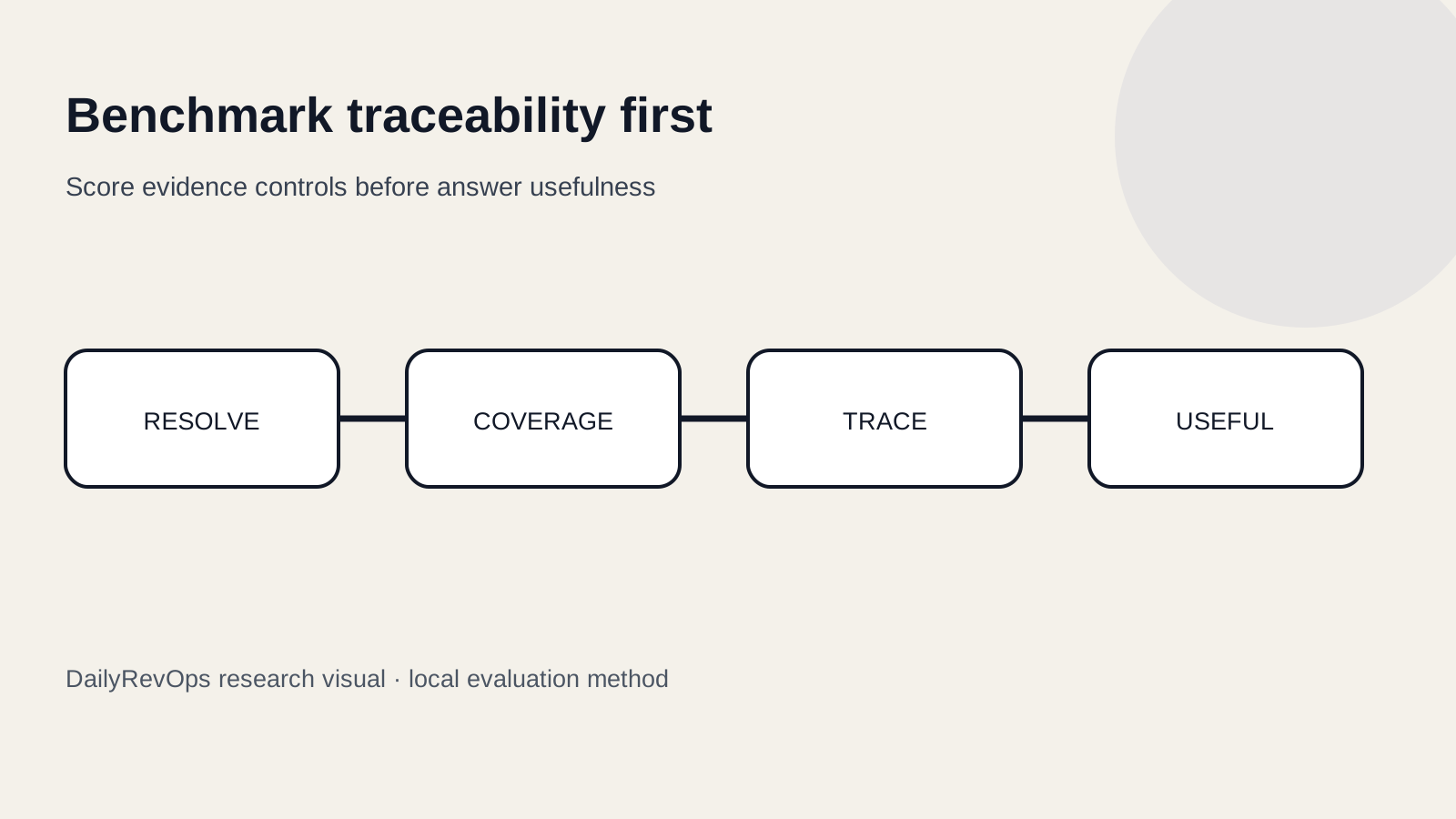
Teams evaluating an AI assistant for RevOps often start with answer quality: was the response useful, clear or correct? That is necessary but incomplete. Before scoring the answer, a team should establish whether the system resolved the intended business entity, used the required evidence, respected freshness and permissions, and left enough trace to reconstruct what happened. A polished answer built from the wrong account or stale source is not a lower-quality success. It is a control failure.
This benchmark is therefore a local operating method, not an industry score. It does not claim that every CRM assistant should meet one universal percentage. The purpose is to create a repeatable baseline for the jobs a specific team intends to delegate. Gainsight's broader customer context, Close's command-palette AI entry point and Mixpanel's programmatic analytics surface make the method timely because more evidence can now move through AI-assisted interfaces without a person manually opening every source screen.
Build the test set around business ambiguity
Start with at least 25 representative tasks if the workflow is important enough to evaluate formally. That number is a practical starting point for coverage, not a statistical industry standard. Include ordinary records and deliberately difficult cases: duplicate companies, several active opportunities, multiple product relationships, a recently changed owner, stale product activity, permission-limited data, missing associations, a customer with conflicting signals and a question whose correct result is unknown or insufficient evidence.
Each test should have a reference record prepared before the assistant runs. Record the intended company or object IDs, required evidence sources, blocking freshness rules, access assumptions and an expected answer shape. Avoid writing an exact prose answer when the task allows several valid summaries. The reference should define the business facts that must be present and the uncertainty that must remain visible, not force the model to mimic one phrasing.
Measure target-resolution accuracy first
The first metric is whether the assistant or script used the intended business entity. Count a test as a target-resolution pass only when the company, contact, opportunity, relationship, project or other primary object matches the reference. For cross-system questions, also verify the associations that join supporting evidence to that target. A response that uses a sibling account or old opportunity should fail this metric even if many individual facts are true.
Track ambiguous cases separately. If two records are plausible and the system stops for clarification or presents the candidates, that can be correct behavior. Do not penalize a safe refusal as if it were a retrieval outage. The benchmark should distinguish wrong resolution, explicit ambiguity, no match and successful resolution because those states lead to different remediation work.
Score required-source coverage and freshness
For each task, define which sources are required rather than rewarding the assistant for using many sources. A renewal review may require current contract timing and CRM ownership while product usage is optional context. A support escalation may require the latest ticket state and customer identity. Calculate required-source coverage as the number of required evidence classes successfully retrieved divided by the number defined in the reference case.
Then evaluate freshness only for material evidence. Set a maximum acceptable age by field or source for the test. A current opportunity stage may need to be re-read at execution time while a stable industry classification can be older. Report freshness failures separately from missing-source failures. That tells the team whether the problem is integration coverage, refresh cadence or the workflow using an old snapshot when it should have revalidated state.
Measure traceability claim by claim
Traceability is not simply whether the answer includes a link. Review the factual claims that would influence a decision and check whether an operator can reach the source record, event or query that supports each one. For structured data, preserve record and field identifiers. For conversations, keep message, meeting, ticket or transcript references. For analytical results, keep project, query definition, filters, date range and generated-at time.
A useful local metric is material-claim traceability: traceable material claims divided by all material factual claims in the answer. Define material before the evaluation so reviewers do not move the goalposts. Claims about owner, commercial timing, customer intent, risk, entitlement, suppression, product behavior and next action often qualify. Stylistic connective text does not need a citation merely because it appears in the answer.
Test permission denials as successful controls
Include tasks that the evaluator knows should be partially or fully denied. A user without access to a sensitive account should not receive the data through an assistant. A read-only integration should not mutate a feature flag or CRM field. The benchmark should count correct denials separately from operational errors so stronger controls do not make the system appear less reliable than a permissive implementation.
Record whether the assistant communicates the boundary accurately. No evidence found is different from evidence exists but is not accessible. An answer that silently omits restricted data can mislead an operator into treating a partial result as complete. The best outcome is often a bounded response that says which scope was evaluated and that additional restricted context was not used.
Add answer usefulness only after evidence checks
Once identity, required-source coverage, freshness, traceability and permissions are scored, evaluate the answer itself. Use a small rubric tied to the job: factual completeness, relevance to the requested decision, explicit uncertainty, actionable next step and unnecessary verbosity. Keep this score separate from the evidence metrics. Combining everything into one quality percentage hides whether a poor result came from weak reasoning or simply from the wrong source record.
Run the same test set before and after meaningful changes to prompts, model, connectors, permissions, schema, mapping logic or SDK version. Add new incident cases to the suite as they occur. Do not refresh all reference answers automatically from the system under test; that would let regressions redefine the benchmark. A human owner should review changes to the reference set and document why the expected business facts changed.
Expand to writes only after read-side reliability is understood
If the assistant will eventually take action, add a second phase rather than mixing writes into the initial answer benchmark. For a reversible mutation, record the target ID, current state, proposal, blocking fields, approval or policy, action key, execution identity and final destination state. Change one material field between proposal and execution to test stale-state rejection, and retry after an uncertain response to test duplicate prevention.
The resulting benchmark does not produce a universal claim such as this assistant is 94% reliable. It produces a more useful operating picture: which identities are resolved correctly, which evidence is consistently available, where freshness breaks, whether claims remain traceable, whether permissions fail safely and how answer usefulness changes once those controls pass. That is the baseline RevOps needs before a conversational interface becomes a production decision surface.
Source notes
These official sources support the workflow model and product concepts. They do not prove a specific retention outcome, benchmark, or vendor claim.
- Gainsight CS September 2026 release: Primary product context for relationship and conversation evidence exposed to AI workflows.
- Close: Ask Chloe from the command palette: Primary product context for a conversational CRM query entry point.
- Mixpanel Headless: Primary product context for programmatic analytics and agent-authored code.
Last updated: 2026-09-23