Gainsight Customer Communities announced on October 7 that its user export now includes total_gamification_points, the cumulative points earned by each member. The field makes community activity easier to inspect alongside other user attributes, but it does not define a universal measure of engagement, product adoption or retention. A defensible benchmark should therefore test the quality of the local evidence chain rather than compare point totals across customers or vendors.
This method asks a narrower question: for a sampled member row, can another operator reconstruct the source definition, identity match, time context, business decision and outcome? The result is a local operating benchmark. It measures whether the organization can use the export responsibly, not whether a particular level of points is good.
Define the eligible population
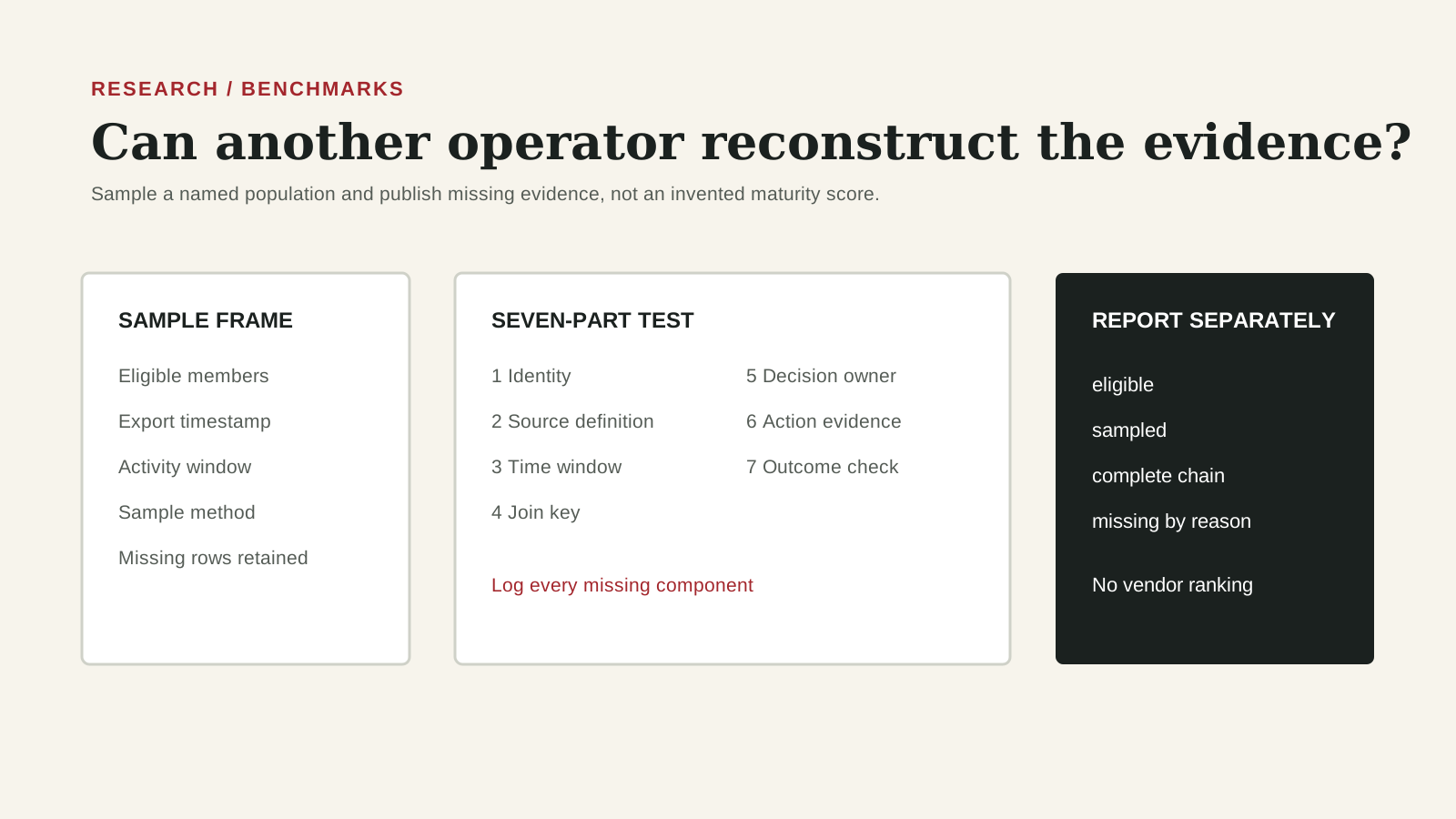
Choose one export produced at a named timestamp and retain the original file. Record the community, export type, field list, timezone and the point-definition version in force. The eligible population is every member row in that file, including rows with zero, blank or unexpected values. Do not remove unmatched or inactive members before sampling because those exclusions can hide the identity and completeness problems the benchmark is meant to find.
State the business question separately. Examples include preparing a community-program review, identifying members for qualitative outreach or validating a CRM synchronization. Do not frame the study as predicting renewal unless the organization has a separately designed and validated outcome study. The Gainsight release only establishes that cumulative points are present in the export.
Build a stratified sample
Create explicit strata that reflect operational risk rather than desired conclusions. Useful strata include high, middle and low point totals; new and long-standing members; matched and unmatched CRM identities; active and inactive customer accounts; and rows with recently changed profile data. Sample a fixed number or proportion from every stratum and publish both eligible and sampled counts.
Retain the sampling seed or ordered selection rule so the review can be reproduced. If the population is small, review every row. If a member appears more than once, record the duplication as evidence rather than silently deduplicating. The point of the sample is to reveal where the chain breaks.
Apply a seven-part reconstructability test
Score each sampled row only on evidence presence. First, identity: is there a stable community member identifier and a documented customer or contact match? Second, definition: can the reviewer find what actions earn points and whether the rules changed? Third, time: is the export timestamp known, and can the cumulative value be interpreted relative to membership and program history? Fourth, join: is the mapping to CRM or customer-success data reproducible?
Fifth, authority: is there a named owner for the business decision that may use the field? Sixth, action evidence: if the value triggered outreach or review, is that action recorded with its version and rationale? Seventh, outcome: can the reviewer see whether the intended follow-up happened and what final state was verified? Mark each component present, missing or not applicable with a reason. Do not average components into a vendor score.
Report results without inventing causality
Publish eligible count, sampled count and the number of rows with a complete seven-part chain. Then publish missing components by category: unresolved identity, undocumented point rule, unknown export time, ambiguous CRM join, no decision owner, unrecorded action or missing outcome. If a component is not applicable, explain the rule used. Keep high, middle and low point strata separate so one group does not hide another.
Do not claim that higher points caused retention, expansion or advocacy. A cumulative value can be shaped by tenure, program design, role, language, moderation rules and opportunities to participate. If the organization later studies an outcome, predefine the cohort, observation window, outcome definition, confounders and missing-data treatment. That is a different analysis from this evidence-quality benchmark.
Add change controls
Repeat the benchmark only after freezing the field definition and sampling method for the comparison period. Record changes to gamification rules, identity mappings, community structure and export behavior. A movement in completeness may reflect better controls or simply a narrower eligible population. Show both the metric and the underlying counts.
Create a remediation backlog from missing evidence. Identity failures go to the profile or CRM-mapping owner. Definition gaps go to Community Operations. Unowned decisions go to CS Operations or RevOps. Missing outcomes go to the workflow owner. Close a component only when the stated evidence exists; a plan to repair it is not evidence.
What this benchmark can establish
This method can show whether a local team can explain how an exported community field informed a customer operation. It can identify weak joins, undocumented definitions and unverified follow-up. It cannot establish a market benchmark, rank community platforms or infer customer health from points alone.
Validate identity before business use
For every sampled match, record the community member key, the CRM or customer-success key, the match method and the source that owns the relationship. Test changed email addresses, shared domains, duplicate contacts, former employees and members associated with more than one account. A plausible name or email match is not sufficient when the downstream action affects a customer record.
Measure match coverage separately from evidence-chain completeness. A row may be correctly matched but still lack a point definition or outcome record; another may have detailed activity but no safe customer join. Keeping those failure modes separate gives the right team a repairable queue and prevents an improved match rate from being reported as improved decision quality.
That boundary is a strength. Gainsight has made the cumulative value available in a convenient export. RevOps can now test whether the organization surrounding that field is ready to use it. Reconstructability turns a new column into an accountable operating asset without asking the column to prove more than the source supports.
Source notes
These official sources support the workflow model and product concepts. They do not prove a specific retention outcome, benchmark, or vendor claim.
- Gainsight CC: See Every Member's Gamification Points in Your User Export: Official October 7, 2026 release adding cumulative gamification points to the user export.
Last updated: 2026-10-08