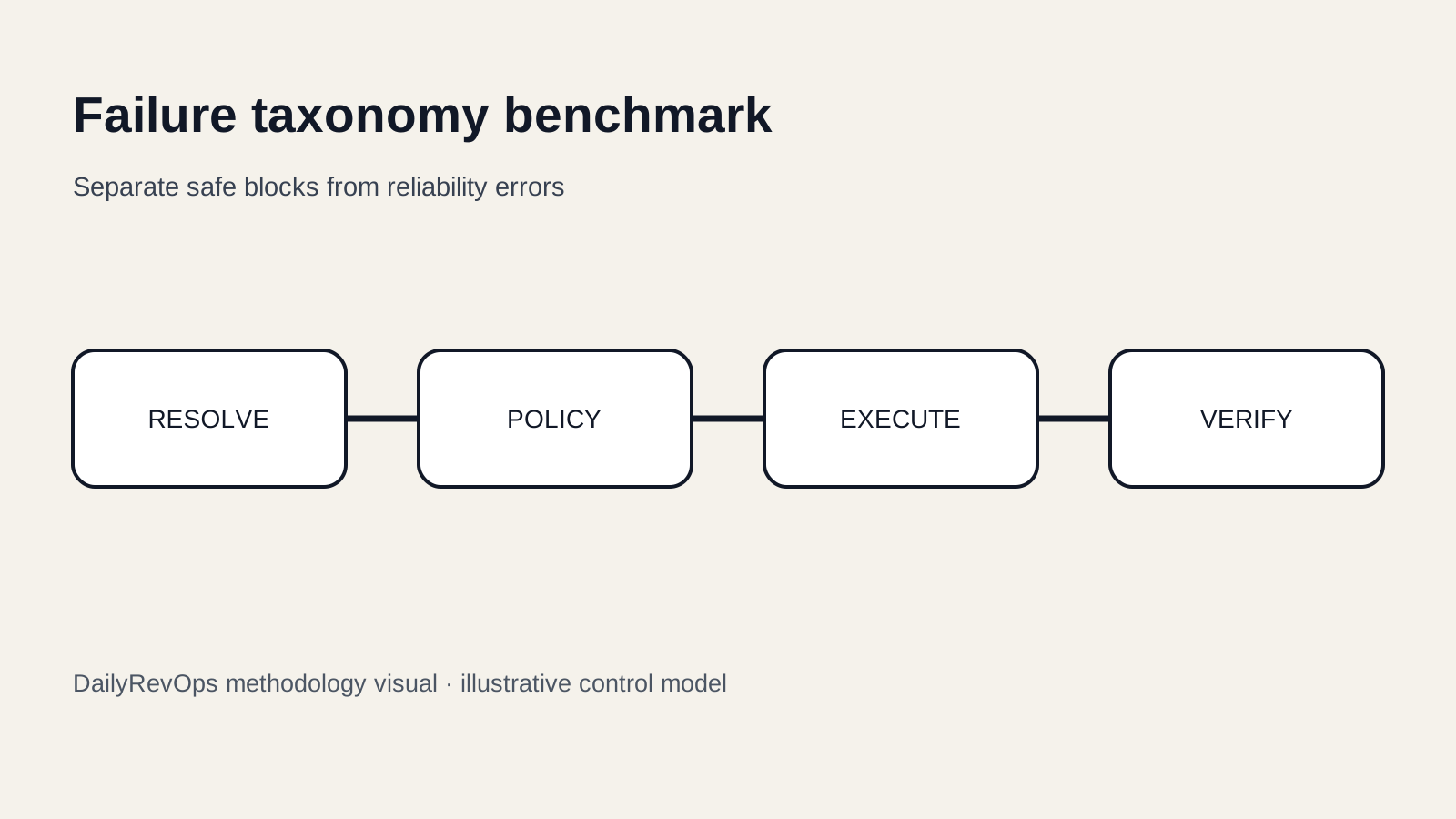
Automation success rate is one of the easiest RevOps metrics to publish and one of the easiest to make meaningless. If a workflow reports 95% success, the number says little unless the team knows what happened to the remaining 5% and what was excluded before execution. A system that safely blocks ambiguous identity can look worse than one that writes to the wrong record. A system that retries hidden duplicates can look better than one that records the first failure honestly.
Recent product changes make a useful measurement principle visible. Intercom is exposing distinct outbound-call failure reasons. Outreach is adding explicit confirmation before Omni changes CRM records. Hightouch is giving destination lookups additional match conditions. Each mechanism separates states that would otherwise collapse into generic success or failure. RevOps should do the same in local automation benchmarks.
Define the measurement population first
Start with every attempted business decision, not only requests that reached the destination API. Include records rejected during identity resolution, eligibility checks, current-state validation, policy, approval and permission checks. If those blocked cases disappear from the denominator, teams can improve reported success simply by moving failure earlier in the workflow.
Store a stable decision ID for each evaluated record or action. Link all later retries and destination attempts back to that ID. This prevents transport retries from inflating volume and allows the team to distinguish one business decision with several technical attempts from several genuinely separate business actions.
Use a layered failure taxonomy
A practical first taxonomy has seven layers: target resolution, source freshness, business-policy eligibility, collision or duplicate prevention, authorization or approval, transport or integration, and destination validation. Add an unknown category that cannot be silently normalized. These categories are broad enough to compare workflows while remaining specific enough to point toward an owner.
Target-resolution failures belong to identity or mapping. Freshness failures belong to source contracts and timing. Policy failures can be correct blocks, not incidents. Collision blocks show overlapping workflows. Permission failures belong to access design. Transport failures belong to integration reliability. Destination-validation failures mean the request completed but final state did not match what the workflow approved.
Separate safe blocks from errors
A safe block is a workflow working as designed under uncertainty or policy. Ambiguous account identity, expired approval or a newly suppressed contact can be healthy reasons not to execute. An error is a failure to perform an action that remained allowed, such as an authentication failure, provider outage or malformed payload. Reporting both as failed automation hides the purpose of controls.
Track blocked-safe, blocked-needs-repair and failed-unexpected separately. The first shows control activity. The second exposes upstream operational debt. The third measures reliability problems. A workflow can have more safe blocks after a governance improvement and still become operationally better even though a naive completion percentage falls.
Measure correctness after the API says success
Technical success is not enough. After a consequential write, sample or automatically verify the destination state. Confirm the target identifier, expected fields, campaign membership, routing rule or created object. A 200 response can still be a business failure if the wrong record matched or if another workflow immediately overwrote the state.
For high-impact workflows, keep a destination-verification rate. The denominator is successful technical writes; the numerator is writes whose material final state matched the approved proposal. This local measure is more useful than a vendor-reported automation rate because it is tied to the organization's own objects, policies and integrations.
Keep latency by stage
Failure taxonomy becomes more useful when paired with stage timing. Record signal-observed, source-read, target-resolved, policy-complete, approved, dispatched, destination-confirmed and verified timestamps where the workflow supports them. A long total latency can come from human approval, a slow source system, a provider retry or destination reconciliation. One end-to-end number cannot tell the team which control or system is responsible.
Do not optimize every stage for minimum time. Identity resolution and changed-state verification can add latency deliberately. The research question is whether the added time reduces wrong-target or stale-state errors enough to justify the cost for the action class. That tradeoff should be evaluated locally rather than borrowed from another company's benchmark.
Normalize reasons without discarding raw evidence
Different platforms expose different status taxonomies. Intercom's invalid number and region-not-permitted outcomes are useful as source-specific evidence. Outreach may use different call or action states. Internal integrations can have their own exception names. Map these into shared categories for aggregate reporting while preserving the original code, label and payload reference.
A normalization layer should be versioned. When a provider adds a reason code, the system should first surface it as unknown until the team assigns meaning and policy. Automatically mapping a new value to the nearest existing category can create a false historical trend and trigger the wrong remediation path.
Compare workflows by action class, not one universal score
An internal notification, CRM field update, campaign enrollment and outbound call have different consequences and acceptable failure modes. Report them separately. A 99% technical completion rate for alerts cannot be compared directly with a 95% verified-correct rate for customer-facing actions. The denominator and verification burden are different.
For each action class, publish a compact set of local metrics: evaluated decisions, safe-block rate, repair-block rate, unexpected-failure rate, verified-correct rate, duplicate-prevention count and p50/p95 stage latency where sample size supports it. Do not turn these into public cross-company benchmarks without consistent definitions and comparable populations.
Review the tail, not only the average
Sample the most common failure category and the rarest high-consequence category each operating cycle. Common failures usually reveal process debt worth automating away. Rare failures can reveal permission, identity or rollback problems with a larger blast radius. Averages hide both when the overall volume is high.
The purpose of a failure taxonomy is not to make dashboards more elaborate. It is to stop the organization from rewarding automation that merely produces clean success labels. Measure where the workflow refused work, where it broke, where the destination disagreed and where a retry repeated the same business action. Once those states are visible, a success rate can become a useful summary instead of a vanity metric.
Related reading: Benchmarks · AI workflows · Data quality
Source notes
These official sources support the workflow model and product concepts. They do not prove a specific retention outcome, benchmark, or vendor claim.
- Intercom outbound call failure reasons: Official update showing several operationally distinct failure outcomes.
- Outreach September 2026 release notes: Official September release describing confirmation before CRM-changing Omni actions.
- Hightouch September 2026 changelog: Official changelog describing more constrained destination lookup conditions.
Last updated: 2026-09-22