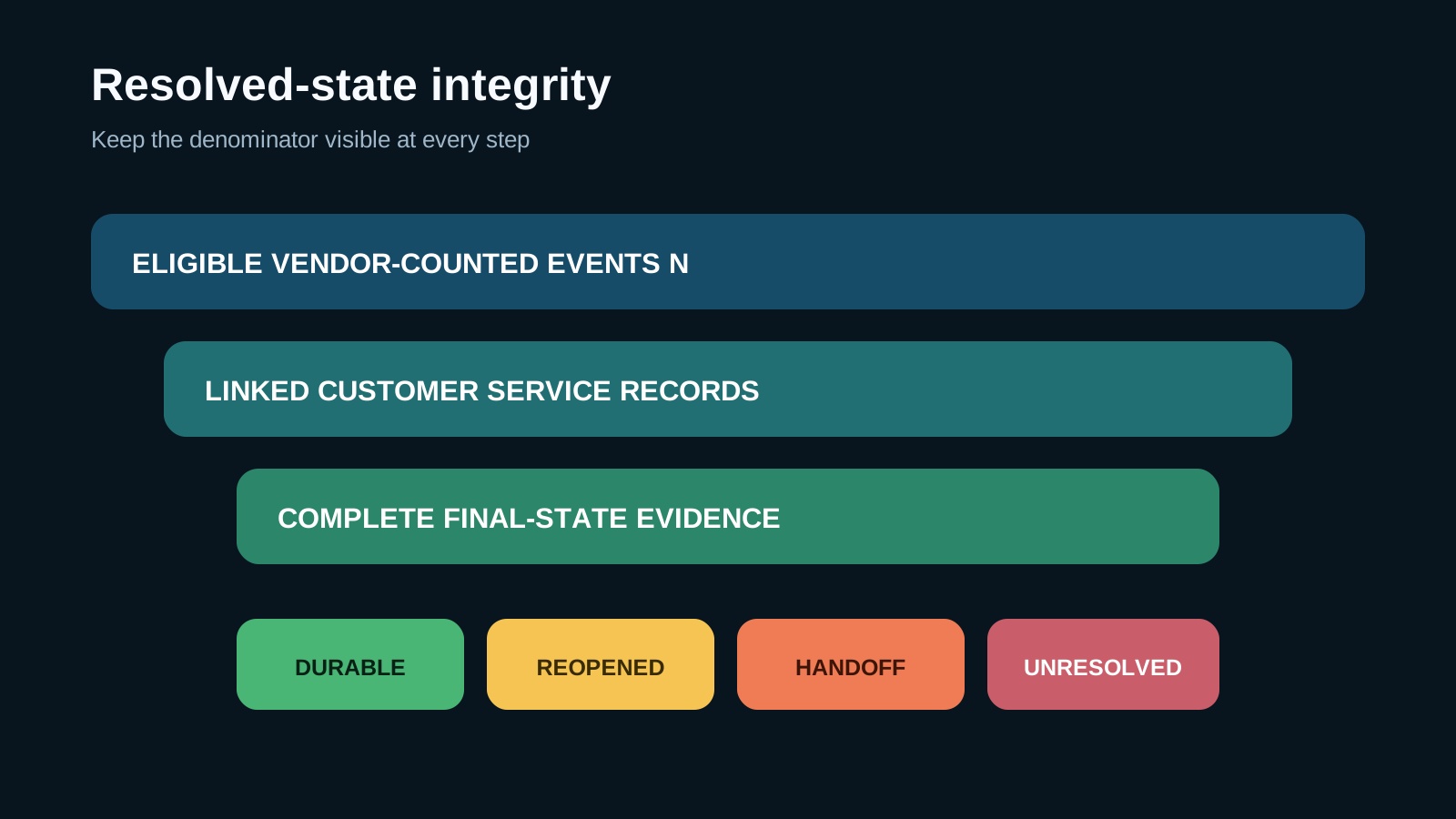
Zendesk's October 2026 update adds configurable email notifications for automated-resolution usage and says eligible accounts on its resolution-allowance model can increase an allowance from supported billing surfaces. That creates a useful trigger for local measurement: when usage becomes an operating and commercial input, teams need to know how reliably the counted state corresponds to a reconstructable customer outcome.
This article does not publish a cross-company Zendesk benchmark. No public source reviewed for this analysis supplies a comparable population, shared counting method and validated outcome set across customers. Instead, it defines a local benchmark operators can run against their own permitted data. Results should stay labeled as organization-specific unless the method and populations are demonstrably comparable.
Define the unit before the rate
Start with the vendor-defined automated-resolution unit in the applicable contract and documentation. Preserve its identifier or closest supported trace, measurement window and counted time. Do not rename it customer issue solved. Create a separate service outcome for the conversation or ticket: durable automated resolution, reopened, human handoff, still open, duplicate or unresolved evidence.
Choose one operating grain. A conversation is often safer than a message because several exchanges may belong to one problem. If the commercial system counts differently, keep the commercial grain and document the relationship. Many-to-one and one-to-many links must remain visible rather than being forced into a clean but false row model.
Establish the eligible population
The denominator is all usage events in the selected account, channels and observation window that meet the documented counting rule and for which the team is authorized to process the necessary evidence. Freeze it before sampling. Report excluded test traffic, deleted records, unsupported channels and events without accessible identifiers separately.
Use complete enumeration when feasible. If sampling is necessary, stratify by intent, channel, automation version, language, customer segment and time so rare but consequential cases are not erased by high-volume routine contacts. Publish the sample design, eligible count and achieved sample count with every result.
Measure resolved-state integrity
Resolved-state integrity asks whether a counted event has a clear, customer-visible final state supported by evidence. For each eligible event, require a linked conversation, automation disposition, final status at the chosen observation horizon and any reopen or handoff. Mark complete, conflicting, missing or not yet observable.
Calculate integrity as complete records divided by the frozen eligible population. Also publish the counts for conflicts and missing evidence. A high percentage can coexist with serious failures if the missing records are concentrated in financial disputes, security cases or high-value accounts, so results must be segmented by customer risk and intent.
Add durability, not a universal wait period
A resolution visible immediately after automation may not be durable. Choose observation horizons that fit the service: for example an initial state and a later state after enough time for common reopens. Do not copy a universal number from another organization. Document why the horizon captures the operating decision and how incomplete recent cases are treated.
Report the share of complete automated outcomes that reopen within the chosen horizon, alongside counts and cohort dates. A reopen is not automatically proof the original automation was wrong; the customer may raise a new issue. Review a sample and classify same-issue continuation, new issue, ambiguous and data error.
Evaluate handoff evidence
For cases that move to a person, measure whether the agent receives the prior transcript or summary, detected intent, identity status, attempted steps, source references and reason for transfer. Define the minimum evidence contract before measurement. Score each required element present, missing or conflicting rather than awarding a subjective overall grade.
Add owner-acceptance time: from handoff creation to an accountable person accepting the case. Keep queue delay, assignment and first customer response separate. Those clocks diagnose different constraints. Publish medians with tail counts rather than relying only on averages that can hide long unresolved cases.
Connect allowance decisions to evidence
When an alert or threshold leads to an allowance review, create a decision record. It should include measured usage, remaining capacity, forecast range, service-quality indicators, known incidents, requested action, approver and resulting account state. The benchmark asks whether the decision was reconstructable, not whether buying capacity was inherently right or wrong.
Calculate decision-receipt completeness for all allowance decisions in the period. Keep zero-decision periods visible. Do not calculate a rate over alerts when the business question concerns purchases, or over purchases when the question concerns alerts. The denominator must match the decision being evaluated.
Control for product and policy changes
Version the automation, intent taxonomy, counting interpretation and relevant service policy. A change in any of those can move the measures without changing underlying customer demand. Mark pre-change and post-change cohorts. Avoid joining them into a single trend until the team has tested comparability.
Also record incidents, campaigns and known demand shifts. Use these as explanatory annotations, not excuses to delete uncomfortable data. If a platform or contract changes the counted unit, end the old series or publish a bridged period with both definitions where possible.
Minimum output table
For each cohort publish eligible usage events; linked service records; complete, conflicting and missing final states; durable resolutions at the chosen horizon; same-issue reopens; human handoffs; handoffs meeting the evidence contract; unresolved handoffs by age; alerts; allowance decisions; and decisions with complete receipts. Every rate must display its numerator and denominator.
Add a short exception narrative for material outliers. A benchmark without an exception queue becomes reporting theater. Assign every high-risk conflict or missing record to an owner, next action and review date. Keep the evidence snapshot that supported closure.
Interpretation limits
Resolved-state integrity measures evidence quality and operating control. It does not by itself measure customer satisfaction, cost reduction, agent productivity or revenue impact. Those questions need additional methods and should not be inferred from a tidy join. Likewise, vendor-counted usage is authoritative for the contract only under the vendor's definition; it is not a neutral measure of customer value.
Use the benchmark to improve reconstruction, routing, alert ownership and commercial decisions. Compare periods only after checking population and definition stability. The strongest result is not the highest automation rate. It is a process in which the team can explain what was counted, what the customer experienced, what remained unresolved and why a commercial action followed.
Source notes
These official sources support the workflow model and product concepts. They do not prove a specific retention outcome, benchmark, or vendor claim.
- Customer.io release notes: Official October 6, 2026 release note for managing the Design Studio content lifecycle by API.
- Zendesk: What's new in October 2026: Official page edited October 7, 2026; it documents automated-resolution usage notifications and eligible allowance increases.
- Customer.io: consent records: Official October 1, 2026 release note for retaining consent changes, their scope and origin.
- NIST AI Risk Management Framework: Cross-sector framework used only as general risk-management context; it is not evidence about the vendors.
Last updated: 2026-10-11