AI usage is becoming measurable in product-specific units, but the availability of a number does not make it a business benchmark. Gong's documentation, updated September 27, describes credits consumed by selected AI features, including question-based trackers, some APIs, MCP usage and deep research. It also publishes examples of how emails, calls and web searches consume credits. Those figures are useful for Gong capacity planning. They are not a cross-vendor measure of productivity, quality or revenue impact.
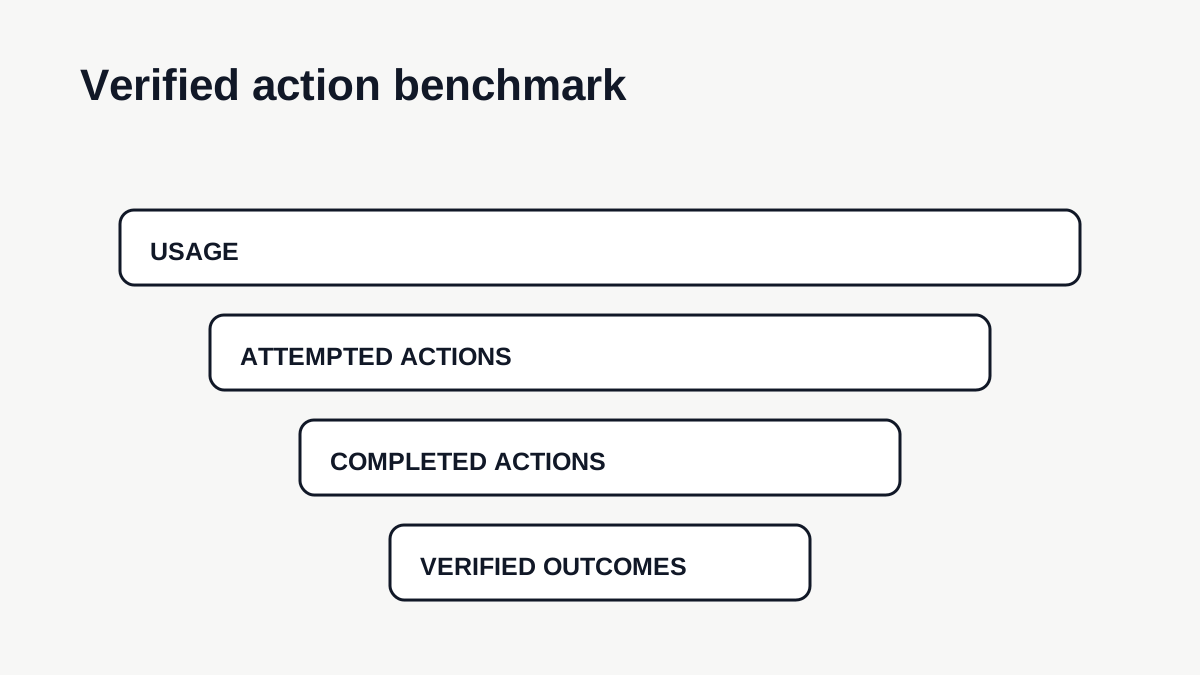
RevOps can build a better local benchmark by separating four layers: usage, attempted business actions, completed actions and independently verified outcomes. Usage tells the team how much platform capacity was consumed. Attempts show what the automation tried to do. Completion shows which action reached a technical terminal state. Verification checks whether the business system or responsible operator confirms that the intended state actually exists.
Start with one workflow rather than aggregating every AI feature. A question-based tracker, an account-research workflow, a CRM update agent and a voice-support agent have different units and consequences. Combining them into one cost-per-agent-action figure produces a clean number with weak meaning. Define the workflow, population, business object, action and verification rule before calculating any ratio.
For a CRM mutation workflow, one action might be a proposed contact creation or field update. Record the initiating identity, target record, proposed change, source evidence, platform usage, approval state, execution response and post-write destination value. The verified action count includes only records where the destination state matches the approved intent. Rejected proposals, duplicate protections, permission denials and failed writes remain visible as separate classes.
For a research or summarization workflow, verification needs another definition. A technically completed brief is not automatically useful. A local benchmark can count briefs accepted without correction, accepted after correction, rejected for missing evidence and abandoned because the source was stale. The goal is not to create a universal acceptance target. It is to make the organization's own quality and rework visible alongside usage.
For voice or customer-service automation, define terminal states that can be checked. Zendesk says its generally available voice AI agents can use procedures, integrations and real-time data and can escalate to a human with context. A local benchmark might separate fully resolved calls, verified system actions, escalations with complete handoff context, escalations missing required context, and calls whose outcome could not be reconciled. Cost per call alone cannot distinguish these cases.
The first useful ratio is usage per verified action. Divide the product-specific usage consumed during the measurement window by the number of actions that passed the verification rule. Keep the native unit visible: Gong credits, API calls, model tokens, workflow runs or another documented unit. Do not translate different vendor units into a fake common currency unless the actual commercial cost and entitlement model are known.
The second ratio is verification yield: verified actions divided by completed actions. This exposes workflows that look technically healthy while producing uncertain or incorrect business state. A low yield can come from stale source data, ambiguous identity, unsupported action scope, destination failures or an overly weak completion definition. Investigate the failure class before changing prompts or buying more capacity.
The third measure is rework per verified action. Count material human corrections, duplicate cleanups, reopened tasks or reversed writes caused by the workflow. This is especially useful when automation appears inexpensive. A low usage cost paired with high cleanup work can be more expensive operationally than a slower process with higher first-pass correctness. Record rework in the same business object so it can be traced back to the original run.
The fourth measure is freshness coverage. Gong's documentation says some credit-based processing stops when the shared pool is exhausted and dependent features can become stale. For any workflow that relies on asynchronously generated evidence, calculate the share of decisions made from inputs inside the approved freshness window. A workflow that continues operating on old signals can show normal execution counts while the evidence quality deteriorates.
Segment the benchmark by risk and workflow version. Low-risk internal summaries should not be mixed with customer-facing writes or commercial state changes. A major prompt, model, source, permission or integration change creates a new comparison period because the underlying system has changed. Preserve both versions long enough to see whether the new configuration actually reduces failure or rework rather than only changing usage.
Sample independently. If the workflow itself decides that its action succeeded, the benchmark can become circular. For material writes, read the destination state. For summaries, use a reviewer who can inspect source evidence. For customer conversations, reconcile the ticket, account, order or other authoritative record. Automation can collect the sample, but the verification rule should not depend exclusively on the same model being evaluated.
Report distributions instead of one average when volume permits. Usage can be highly skewed by long calls, large accounts, deep-research requests or unusually broad prompts. Show median and upper-tail usage, failure classes and the largest consumers. This helps operators find a workflow configuration that is expensive because of its scope rather than because every run is costly.
Keep commercial cost separate until the entitlement is understood. Gong notes that default credits are tied to paid core seats and shared across the company, while purchased credits have contract-term behavior. Another vendor may bundle AI differently. A unit-consumption benchmark can still be useful before converting it to money, because it shows which workflows compete for constrained capacity and which verified actions that capacity supports.
A weekly benchmark review can remain compact: usage consumed, attempted actions, completed actions, verified actions, rework events, stale-evidence holds and the top failure class. Add one sentence describing any material configuration change. After several consistent periods, the team has an internal baseline grounded in its own workflow. That is more defensible than importing an external claim about how many tasks an agent should complete or how much one AI action should cost.
The point is not to reduce every AI workflow to a financial ratio. It is to stop treating raw activity as evidence of operational value. Usage is capacity. Completion is technical state. Verification is business evidence. RevOps can compare them without pretending that one vendor's credit, call or token is equivalent to another's.
Related reading: Benchmarks · AI & Automation · Data Quality · Gong · Zendesk
Source notes
These official sources support the workflow model and product concepts. They do not prove a specific retention outcome, benchmark, or vendor claim.
- Gong: About Gong credits: Official usage-unit, allocation and exhaustion documentation updated September 27, 2026.
- Gong: Create AI trackers: Official AI Tracker documentation updated September 27, including credit-consumption behavior and pause behavior when credits run out.
- Zendesk: Announcing voice AI agents: Official product announcement used for customer-facing workflow and escalation context.
- Common Room: Claude Connector & Plugin: Official read/write agent-interface documentation used for action-verification examples.
Last updated: 2026-09-28