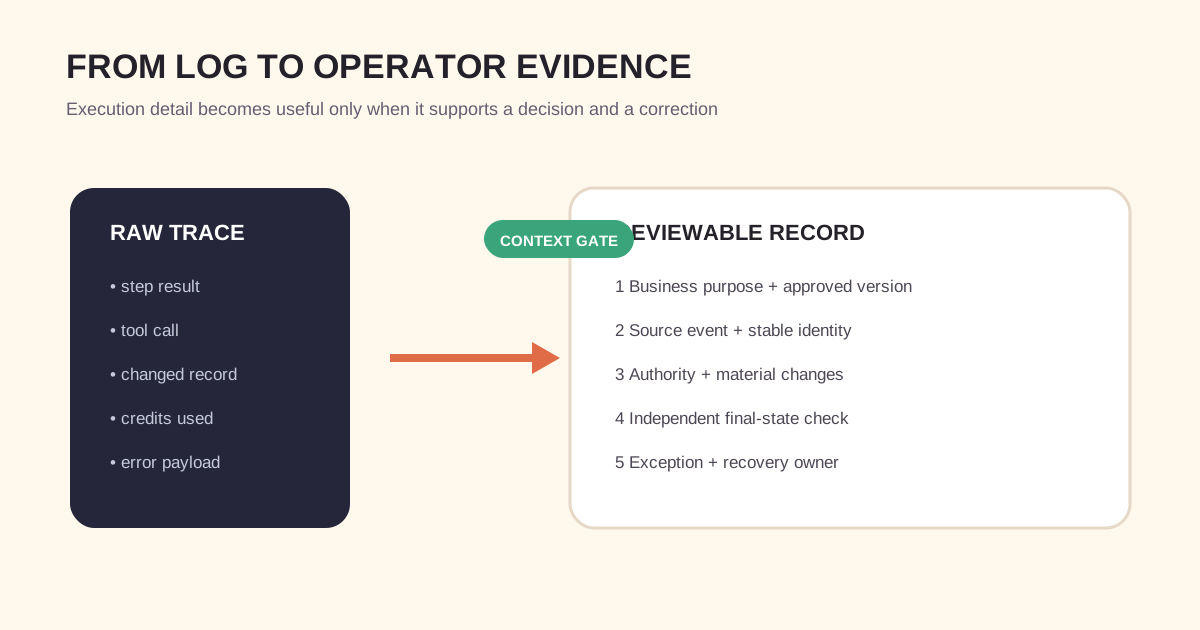
Attio's September 23 changelog says workflow history now shows every step of a run, what it changed and its result, while an agent log records tools called, records changed and credits used. That is a welcome direction because automation operators need more than a green check. My view is that this evidence should be treated as part of the operating record, not as temporary debugging exhaust available only after something breaks.
A debugging log is optimized for the builder. It contains technical detail, often assumes platform knowledge and may disappear behind retention or access limits. Operator evidence is optimized for accountable review. It identifies the business purpose, source record, approved version, material changes, exception, human decision and final outcome. The same underlying telemetry can support both views, but the operating layer must preserve the subset needed to explain a customer or commercial consequence months later.
This distinction matters more when agents choose tools and make several writes. A list of tool calls shows activity, not authority. The agent may have used the expected CRM action and still updated a field that another system owns. It may have selected the correct record but acted on stale information. Credits tell an administrator what the run consumed, not whether the result was worth doing. The log becomes operator evidence only after the organization attaches its own decision contract.
That contract should name which observations the automation may use, which decisions it may propose, which fields it may write without review and which consequences require human approval. It should also define stop conditions: conflicting identity, missing owner, old source data, unsupported geography, suppressed contact, changed contract state or an unexpected jump in volume. The runtime trace then shows whether the run stayed inside the contract rather than merely whether each platform step returned success.
Customer.io's polygon-geofence release makes the same point from the trigger side. A precise boundary can improve the relationship between a physical venue and an entry or exit event. The trace should preserve the shape version, SDK version and event time. Without them, an operator cannot tell whether an unexpected message followed a stale circle, a new polygon, a delayed device event or a later journey rule. Trigger evidence belongs with execution evidence.
Braze's September 28 announcement extends the argument to customer contact. Operator can build journeys in Canvas, while available threshold alerts and messaging observability expose volume anomalies and reasons messages were sent, held or dropped. These surfaces are operationally valuable, but they should not create a fragmented investigation where one person checks journey construction, another checks delivery and a third tries to infer the source event. A shared correlation key should connect the layers.
Operator evidence must be legible to a reviewer who did not build the automation. Present the customer or account, business purpose, initiating event, approved workflow version, decisions, material writes, communication result and open exception in chronological order. Keep raw vendor logs accessible for technical investigation, but do not force a renewal manager, privacy reviewer or support lead to interpret internal function names before they can understand what happened.
The record should include rejected and held actions, not only successful ones. A hold can prove that a safety rule worked. A rejected CRM write can reveal a permission or schema mismatch before it creates silent divergence. A dropped message can be the correct outcome under a channel rule. When teams retain only successful steps, their operating history overstates automation health and removes the evidence needed to tune controls.
Retention should follow consequence. A low-risk enrichment preview may need a short evidence window. An automation that changes commercial ownership, sends a regulated message or affects entitlement may need evidence aligned with the relevant business and legal retention policy. The answer is not to keep every debug line forever. It is to classify runs, preserve the minimum reconstructable packet and document when raw telemetry expires.
Access should also be split. Builders may need detailed payloads and tool responses; operational reviewers may need customer-level summaries; auditors may need immutable approvals and outcomes. Least privilege is easier when the evidence model is designed rather than copied wholesale from a platform log. Redact secrets and unnecessary personal data while retaining stable record references and the facts required to evaluate the decision.
A weekly review should sample normal runs, not only incidents. Select completed, held, failed and manually overridden cases. Ask a reviewer to reconstruct why the subject entered, what changed, whether the result matched current business state and how recovery would work. If that cannot be done promptly, the automation is not operationally mature even when its success rate is high.
Evidence quality should affect release scope. When a team cannot link tool calls to an approved version or cannot read the final destination state, reduce the cohort and consequence until those links exist. This is not a demand for perfect observability before any useful work. It is a proportional control: low-risk proposals can tolerate lighter review, while automatic customer contact, ownership and entitlement changes require a complete packet before scale.
Vendor observability is becoming more useful, as these September releases demonstrate. Teams should take advantage of it without outsourcing accountability. A platform can show its own steps, calls, records and delivery status. Only the organization can connect those facts to field authority, consent, commercial policy, customer promise and the named person who owns a correction.
The standard should be simple: every consequential automation run must leave evidence that another operator can understand, verify and act on. A log that proves code execution but cannot support a customer review is incomplete. A polished summary without stable links to source events and changes is equally weak. Good operator evidence joins both, preserves exceptions and makes recovery a normal part of automation design.
Related reading: GTM Operations · Data Quality · Marketing Operations
Source notes
These official sources support the workflow model and product concepts. They do not prove a specific retention outcome, benchmark, or vendor claim.
- Attio: Workflow history and agent log: Official changelog dated September 23, 2026; describes step-level workflow history and agent logs covering tool calls, record changes and credits.
- Customer.io: iOS SDK 4.9.0 polygon geofences: Official stable iOS SDK changelog dated September 25, 2026; states that polygon geofences follow the drawn venue shape while existing circular geofences continue to work.
- Braze: Forge 2026 product announcements: Official product announcement published and last edited September 28, 2026; describes journey building, Content Optimizer, threshold alerts, messaging observability, data ingestion and account objects.
Last updated: 2026-09-30