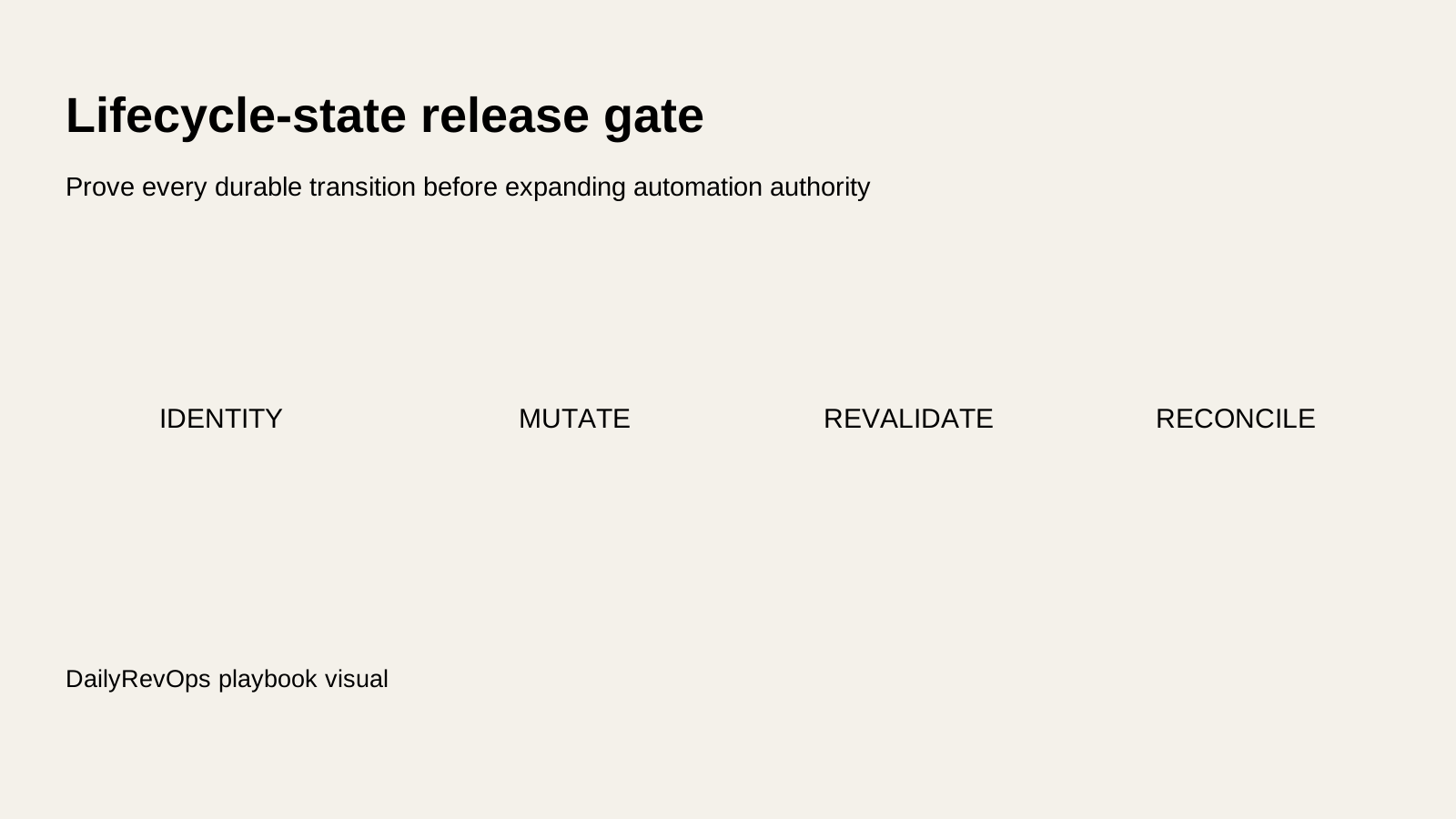
Problem
Most workflow testing proves that a happy-path action can be created. It often does not prove what happens when source state changes, configuration is superseded, a synchronized object is deleted, or a previously valid action is no longer permitted.
Why it matters
Customer.io's reusable AI brand context, Front's explicit synchronized-template deletion and Salesloft's adaptive-workflow direction make lifecycle controls more important. RevOps needs a repeatable gate that tests the full state lifecycle instead of treating the first successful write as production readiness.
1. Pick one durable object and one authority
Start with one object type that survives beyond a single request: a template, CRM assignment, audience, generated message, policy document, routing rule, task or playbook state. Name the authoritative system for that object and the destination systems that may carry copies. Do not begin with a whole platform. Lifecycle behavior is usually object-specific.
Write the stable source identifier, destination identifier if one exists, current owner and consequence class. A customer-facing template, an internal summary and an entitlement record should not share one generic release standard. The gate becomes stricter as a wrong or stale object can change customer communication, commercial interpretation, access, consent or money.
2. Prove creation provenance
Create the object through the path the production workflow will use. Capture the triggering record or request, service identity or human actor, created-at time, policy or workflow version and destination ID. If an AI system generated content, record the durable business context that governed the draft, such as the approved brand-policy version and source customer workflow.
The creation evidence must be readable without reopening the original builder session or chat. A screenshot is not enough. Another operator should be able to join the trigger to the resulting business object and identify which configuration version was effective. If that join is impossible, stop before testing scale; the team cannot reliably investigate later changes.
3. Exercise an ordinary update and a policy update
Change one low-scope field and one higher-scope rule. For a message workflow, edit a single component and then change a reusable brand or template rule. For CRM automation, edit one record and then change the routing policy. Confirm that the evidence distinguishes an object-level edit from a shared configuration change that can affect many future actions.
Record prior value, proposed value, reviewer when required, effective time and resulting value. If the product supports drafts, preserve the difference between proposed and active state. If the workflow can overwrite existing styles or configuration, test that choice explicitly rather than assuming the operator will understand the blast radius from the interface.
4. Test retirement from the authoritative source
Delete, archive or invalidate the object in the system that owns its lifecycle. Then observe the destination. Front's September 24 Channel API update provides a concrete example: an external application template can now be deleted in Front through an explicit endpoint when the source deletion webhook fires. Your workflow may use a different mechanism, but it needs a deliberate equivalent.
Define the acceptable terminal state before running the test. Some objects should be deleted. Others should remain for audit but become unavailable for future actions. Some should be superseded by a new version. The important requirement is that the source's retirement intent reaches every destination that can still act on the object.
5. Repeat the retirement action
Run the same delete, disable or archive action again using the same business key. The second attempt should be safe. A destination may return already absent, not found or no change. Classify those results deliberately. Idempotent retirement prevents retries, duplicated webhooks or operator repetition from turning cleanup into a new incident.
Also test a partial failure: the source is retired but one destination call times out. On retry, reconcile current destination state before blindly issuing another mutation. Store the final state and the attempt count. This pattern matters because deletion frequently occurs after an object's active life, when fewer operators are watching and stale copies can persist unnoticed.
6. Break a live reference on purpose
Create a controlled dependency on the object and then retire it. A workflow may reference a message template, a routing rule may reference a queue, or an agent may reference a reusable policy. Observe whether the product blocks deletion, removes the reference, substitutes a fallback or leaves an orphan. None of those behaviors should surprise the team in production.
If an orphan is possible, add a pre-retirement dependency check or a post-retirement reconciliation. Record which workflows still reference the object and who owns repair. Do not count an API-level deletion as complete when active customer-facing work can still try to use the removed configuration.
7. Change material state between proposal and execution
Create a proposed action and then change one material source fact before execution. Change owner, stage, consent, template status, audience membership or another field the action depends on. The workflow should re-read required state, compare a version or timestamp, or hold the action as stale. Pick the mechanism that fits the product, but make the freshness contract explicit.
This is especially important for longer-running or adaptive workflows. Salesloft's September 24 product vision describes an upcoming direction where workflows respond as signals change. DailyRevOps treats that as roadmap, not shipped evidence. The release-gate lesson is independent of vendor: a workflow that can adapt also needs a rule for when an earlier action proposal has expired.
8. Test a policy-version transition
Change reusable content or decision policy while keeping an existing object alive. Customer.io's new Design Studio capabilities can generate brand rules from a website, logo and files and can use that brand document during AI-assisted message creation. In a controlled test, approve a new policy version and confirm new drafts use it while historical evidence still points to the version that governed earlier messages.
Do not retroactively relabel old content as compliant with a rule that did not yet exist. If a policy change requires correcting active templates, make that a separate migration with scope, owner and verification. Version transitions are operational changes, not just editor preferences when reusable guidance affects customer communication.
9. Verify final state independently
For every create, update and retirement path, read the destination after the action and compare it with the intended business state. A success response is transport evidence. A destination query showing the correct object, version, active status or absence is stronger operational evidence. Use a separate read path where possible so the same transformation does not validate itself.
Capture checked-at time, destination identifier and result. For customer communication, verify the approved content or template that the active workflow will actually use. For CRM writes, verify the intended record and association. For retirement, verify the object is no longer selectable or referenced according to the defined terminal state.
10. Expand only the state transitions that passed
Approve the exact object type, action verbs, population and consequence class covered by the test. Passing create and update does not automatically approve delete. Passing draft generation does not automatically approve send. Passing one internal workflow does not automatically approve cross-workspace changes. Release authority should follow observed lifecycle evidence.
During the first production cycle, sample normal successes and retirement events together. Review stale-state holds, duplicate-prevention events, orphaned dependencies and policy-version changes. The gate is successful when operators can reconstruct how a durable object entered the system, why it changed, why it stopped being usable and how the final state was verified.
Step-by-step workflow
- Choose one durable automation-managed object and name its authoritative source.
- Classify the consequence of wrong or stale state.
- Create the object through the production path and capture stable provenance.
- Run one object-level update and one reusable-policy update.
- Retire the object from the authoritative source and observe every destination.
- Repeat the retirement action with the same business key to test idempotency.
- Retire an object that still has a controlled live reference and inspect dependency handling.
- Change material source state between proposal and execution and require revalidation.
- Move to a new policy version without rewriting the historical policy record.
- Verify resulting destination state after create, update and retirement actions.
- Record held, denied and no-op outcomes alongside successful writes.
- Expand only the lifecycle transitions and populations that actually passed.
CRM fields and signals needed
- Object type, stable source ID and destination IDs
- Source authority, current owner and consequence class
- Workflow version, policy version and effective timestamp
- Prior state, proposed state and resulting state
- Dependency references and active workflow usage
- Retirement reason, request ID, attempt count and idempotency key
- Material-state version or checked-at timestamp before execution
- Final verification result, verifier and verified-at timestamp
Common mistakes
- Testing only creation because it is the easiest path to demo.
- Assuming an archived source object cannot still be used by a destination copy.
- Treating a successful delete request as proof every active reference disappeared.
- Overwriting reusable policy without an effective version or change record.
- Retrying destructive actions without checking current destination state.
- Letting an old action proposal execute after owner, consent or lifecycle state changed.
- Using screenshots or transient agent conversations as the only audit evidence.
- Expanding customer-facing authority after only read-side or draft-side tests.
Example operating rhythm
- Before launch: run the complete lifecycle cohort from create through verified retirement.
- Daily during the first production week: sample successful mutations, stale-state holds and retirement events.
- After policy, schema, permission, API or workflow changes: rerun the affected lifecycle transitions.
- Weekly: inspect orphaned references, repeated deletes, no-op retirement events and unknown terminal states.
- Monthly: review unused reusable configuration, active policy versions and destinations that still carry retired copies.
- After a vendor changes lifecycle behavior: add the new case to the release-gate regression set.
Tooling options
- Use authoritative source IDs rather than names as lifecycle join keys.
- Use versioned policy or configuration records for reusable AI and messaging guidance.
- Use destination reads or reconciliation queries after consequential writes.
- Use an exception queue for stale proposals, broken dependencies and ambiguous retirement state.
- Use idempotency keys or stable business-action keys where the API supports or permits them.
- Keep lifecycle test cases in version control near the workflow they govern.
Source notes
These sources support the workflow model and product concepts. They do not prove a specific business outcome, benchmark result, or vendor claim.
- Customer.io: Design Studio AI-first email creation: Official September 24 release used for reusable AI brand-context and content-generation examples.
- Front: Channel API template deletion: Official September 24 developer update used for explicit synchronized-template retirement semantics.
- Salesloft agentic revenue vision: Official September 24 product-news post used only as roadmap context for adaptive workflow state.
Last updated: 2026-09-25
Decision frameworks to read next
FAQ
Does every automation need hard deletion?
No. The correct terminal state may be archive, disable, supersede or delete. The gate requires a deliberate retirement state and proof that retired objects cannot keep affecting active work unintentionally.
Is a 204 response enough to prove deletion?
It proves the request succeeded at the protocol level. For consequential state, verify the destination no longer exposes or uses the object and check active dependencies.
Should old messages be regenerated after a brand-policy change?
Not automatically. Preserve which policy governed historical content. Migrate active templates only when the new policy requires it, with explicit scope and review.
How should stale action proposals be handled?
Re-read material source state or compare an expected version before execution. If the state changed outside the approved tolerance, hold or regenerate the proposal.