Three official product updates published between October 7 and October 9 point in the same operational direction. Clay says builders can describe a workflow in natural language, trace a run visually, fix the play and rerun it in bulk. Workato's September community-connector roundup adds an agent-oriented web stack while also documenting authentication, schema, error-reporting and stability changes. Talkdesk is progressively rolling a redesigned Studio experience to all accounts with search, validation, version-oriented controls, context management and reusable node operations.
These products serve different jobs. Clay is a GTM data and workflow environment; Workato coordinates integrations; Talkdesk Studio designs contact-center routing. They should not be treated as interchangeable. Their shared signal is that automation is becoming something an operator can inspect as a program rather than accept as an opaque sequence of clicks.
The builder is no longer the whole control surface
Natural-language construction lowers the effort required to express a workflow. It does not remove the need to identify the eligible population, authoritative inputs, allowed actions, writer permissions or stop conditions. In fact, faster construction increases the number of plausible variants a team can create. The control surface must therefore move beyond the builder to include the release record around it.
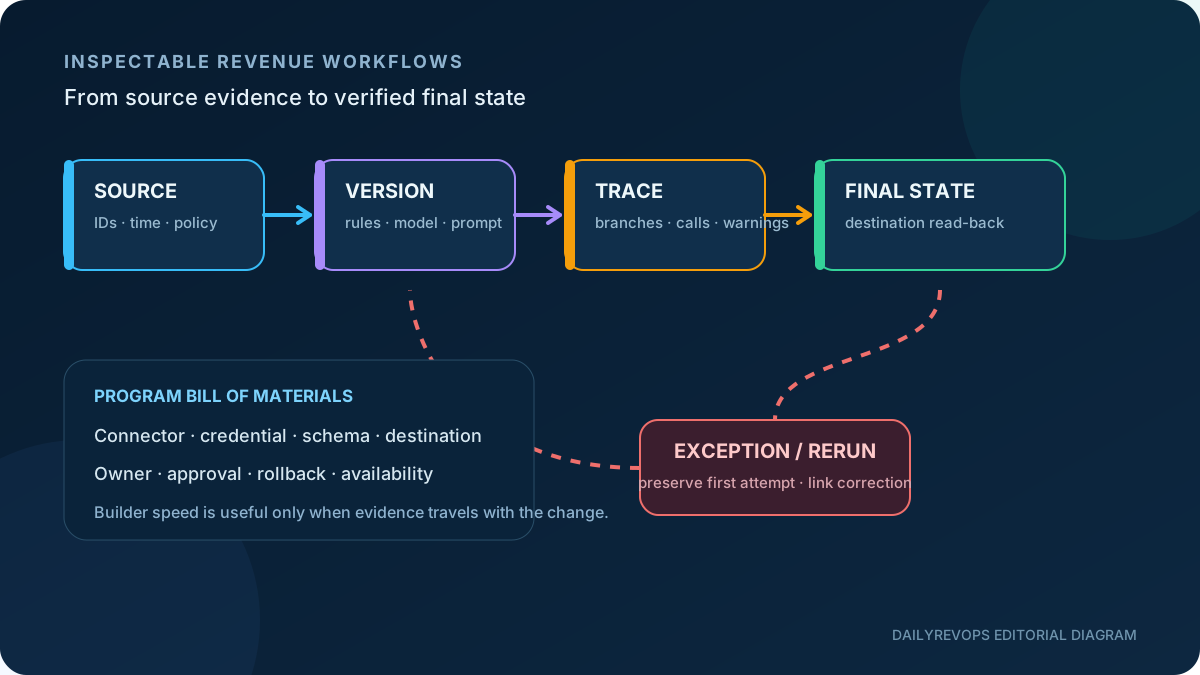
Clay's description is useful because it joins generation with a visual trace and rerun. A trace can show the path one record followed; a rerun can apply a correction. RevOps still has to preserve the prior version, the affected record set, the reason for the change and the destination results. Otherwise a corrected rerun can erase the evidence needed to explain the first outcome.
Connectors become executable dependencies
Workato's connector roundup illustrates why an automation inventory must extend below the visible recipe. A connector determines which actions, triggers, payload shapes, authentication methods and error details the workflow can use. The update covers tools for web extraction, research, voice calls, databases, storage and vector search, alongside improvements to schemas, authentication and failure reporting.
A connector's presence is not proof that a production use case is safe or complete. Operators need the exact action and trigger, credential scope, pagination behavior, asynchronous status model, payload limits, retry semantics and version. A new connector can widen capability while also adding another dependency whose changes must be tested. The connector registry is part of the program's bill of materials.
Validation should identify risk, not manufacture approval
Talkdesk's general-availability release brings several previewed capabilities into the revamped Studio experience, including a Flow Validation Panel, Context Manager, copy and paste, search and manual positioning. The associated release notes distinguish warnings from blocking errors: a warning can expose an inconsistency without preventing publication.
That distinction matters outside contact routing. Automated checks can find missing references, invalid arguments or uninitialized variables, but a successful validation does not authorize a customer promise, pricing decision, territory change or contact action. Machine validation establishes that declared rules are structurally coherent. A named business owner must still establish that the rules are permitted and appropriate.
Version evidence needs a record population
A workflow version is only actionable when the operator can connect it to the records that ran through it. Store a durable run identifier, version, source-record identifier, input observation time, branch decisions, external calls, proposed writes, destination responses and final verification. This creates a chain another operator can reconstruct without opening the builder and guessing.
For bulk reruns, freeze the candidate population before execution. Separate never-run records, successful records, failed records and records whose prior result may be overwritten. Give the rerun its own identifier and link it to the superseded attempt. The ability to rerun at scale is valuable precisely because the team can correct a pattern; it is risky when the corrected state is the only state retained.
Availability is part of the program specification
Clay says Workflows is in beta for all Clay users, while its Inbound SDR Agent remains a pre-beta preview with a waitlist. Talkdesk describes a progressive rollout to all accounts. Those labels affect operating design. A beta feature can support a bounded pilot, but teams should not write a critical service promise as though availability, behavior and support terms were already identical to a mature production capability.
Record product availability, account enablement, region, edition, dependencies and last verification date beside the workflow version. When the feature crosses from preview to general availability, run the same release checks again. A label change does not prove the current configuration, permissions or downstream behavior are correct.
Build a five-record release packet
The minimum packet contains a scope record, dependency record, test record, approval record and outcome record. Scope names the population and decision. Dependencies list sources, connectors, credentials and destinations. Tests contain representative happy paths and exceptions. Approval names the person or policy authorizing the release. Outcome records what the destination actually accepted.
Keep those records portable enough to review outside the builder. The goal is not paperwork for its own sake. It is to let RevOps answer which version ran, why it was allowed, what changed, which records were affected and whether the intended final state exists. That is the practical difference between a fast automation and an inspectable operating program.
The operator advantage is controlled iteration
The common opportunity across these releases is shorter distance between an observed problem and a corrected workflow. Clay emphasizes building and rerunning, Workato widens executable connections, and Talkdesk improves navigation and validation. RevOps can use that speed only if evidence moves with the change.
Treat every automation as a small production program: named owner, bounded population, versioned logic, declared dependencies, least-privilege credentials, representative tests, visible exceptions and a verified final state. Teams that adopt those controls can iterate faster because they know where to look when a route changes. Teams that skip them merely make unowned changes faster.
Source notes
These official sources support the workflow model and product concepts. They do not prove a specific retention outcome, benchmark, or vendor claim.
- Clay: Recapping the products announced at Sculpt 2026: Official October 8, 2026 recap. Clay says Workflows is in beta for all Clay users and the Inbound SDR Agent is a pre-beta preview with a waitlist.
- Workato: Community Connectors—what's new in September 2026: Official October 7, 2026 changelog describing new community connectors plus schema, authentication, error-reporting and stability changes.
- Talkdesk Orchestration & Routing release notes: Official release notes for the progressive October 9, 2026 general-availability rollout of the revamped Studio experience.
Last updated: 2026-10-09