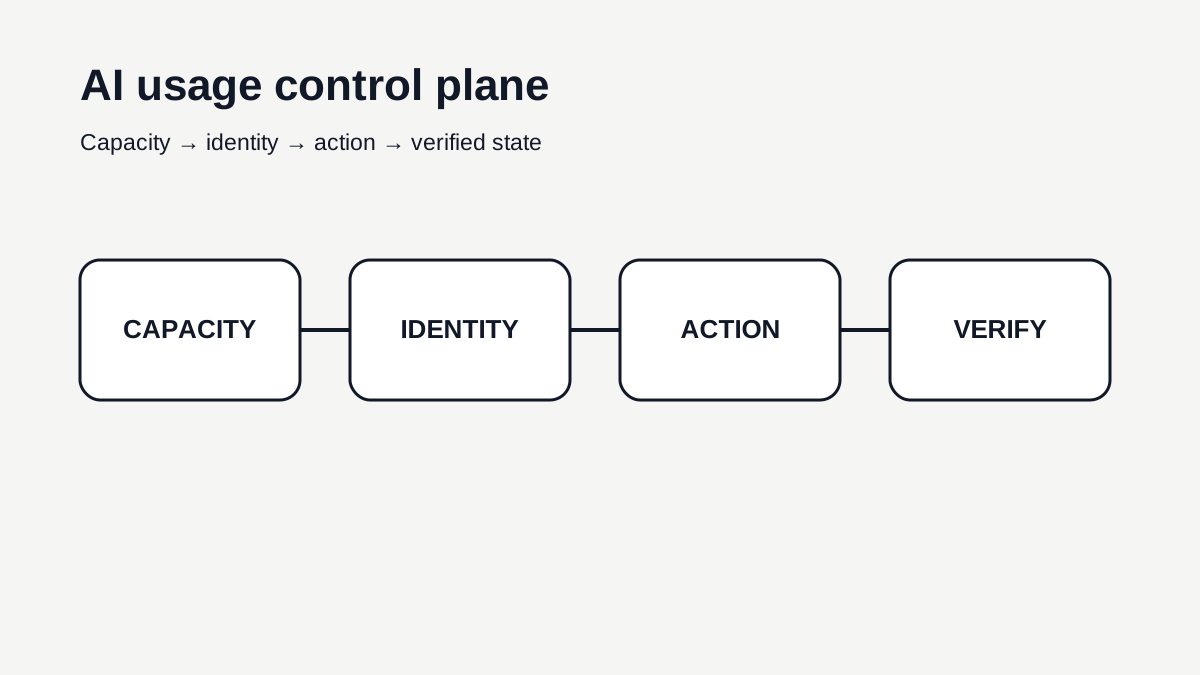
Three current product changes point to the same operational shift. Gong's documentation, updated September 27, describes a shared company credit pool for selected AI capabilities, monthly user limits and workspace allocation. Zendesk announced general availability for voice AI agents on September 1, following its February early-access program. Common Room's Claude integration guide, updated September 23, describes an MCP connector and a sales-oriented Claude Plugin that can both query and update workspace records. These are different products, but together they move AI from an optional assistant into a governed production resource.
For RevOps, the important boundary is no longer only whether an AI feature has permission to read or write a record. A production workflow can also consume a metered resource, execute in the background, cross system boundaries and create customer-facing consequences. Cost, identity, permission, action and verification therefore have to be reviewed as one operating chain. Treating them as separate admin settings leaves gaps exactly where automated work becomes hard to explain.
Gong makes the resource boundary explicit. Its credit documentation says credits are consumed by selected high-processing features including question-based AI Trackers, certain APIs, its MCP server and deep research. The same documentation says admins can monitor a shared company balance, receive threshold notifications, set monthly credit limits for user-initiated credit actions and allocate portions of the pool to workspaces. When the shared pool is exhausted, credit-based processing stops and some dependent data becomes stale over time.
That last behavior matters more than the headline concept of credits. A revenue workflow can remain visible while the information feeding it stops refreshing. An operator may still see an existing tracker result, brief or downstream view and assume the automation is healthy. The correct control is therefore not simply a spend ceiling. It is a freshness contract: which outputs depend on metered processing, when they were last updated, what happens when the pool is exhausted, and which business decisions must pause when the evidence is stale.
Zendesk puts the action boundary in a different place. Its voice AI announcement says generally available voice AI agents can handle phone conversations, use generative procedures, integrations and real-time data, and escalate to a human while carrying context into Agent Workspace. A phone interaction is not just model inference. It is a live customer workflow with identity, intent, policy, system access, escalation and a durable service record. A successful call therefore needs a broader completion definition than the AI agent reaching the end of a procedure.
RevOps and support operations should define the business checkpoints around that call. Confirm which customer or account the conversation belongs to, which data sources the agent may access, which actions it may take without human approval, which facts require verification, and how the escalation carries the relevant context. After a material action, inspect the destination state. The business system should confirm the result rather than treating the conversation transcript as the final authority.
Common Room expands the interface boundary. Its September 23 Claude guide says the MCP connector and sales-focused plugin can query and update a Common Room workspace from Claude, including researching accounts, logging activities, creating contacts and updating segments. The value is obvious: operators can work from a conversational interface while accessing buyer intelligence. The governance consequence is equally clear: the command surface is no longer the same thing as the system that owns the record.
That separation creates a useful design rule. Conversational interfaces should be treated as proposal and execution surfaces, while durable business state remains attributable to the underlying system. For every material write, preserve the target record, the initiating user or service identity, the proposed change, the source evidence, the permission used and the resulting record state. A chat transcript can help explain intent, but it should not become the only audit trail for a customer, account or opportunity mutation.
The three products also expose different failure modes that a single AI-enabled control cannot capture. Gong can hit a shared resource ceiling. Zendesk can encounter ambiguity or escalation during a live customer interaction. Common Room can execute a natural-language request against workspace data. One fails through resource exhaustion, one through conversation and action semantics, and one through interface-to-system translation. RevOps should classify these failures separately so the recovery owner and evidence are clear.
A practical control plane starts with five fields for every significant AI workflow: business owner, execution identity, resource or usage boundary, allowed action surface and verification method. Add a sixth field when the workflow depends on derived or asynchronously refreshed data: evidence freshness. These fields are intentionally small. The purpose is not to create a bureaucracy around every AI interaction; it is to make the production consequence legible before the organization scales the workflow.
Resource controls should distinguish user-triggered work from background work. Gong's documentation notes that company-wide background features can sit outside individual monthly limits even while they consume from the shared pool. A per-user cap can constrain interactive experimentation while recurring automations continue consuming organization-level capacity. The monitoring view therefore needs both actor-level and system-level usage, plus an owner for recurring jobs that no individual is actively watching.
Action controls should be proportional to consequence. Reading a report or drafting an internal summary can run with a lighter review path. Creating a contact, updating a segment, changing a customer record or carrying out a live service procedure deserves stronger target checks and a post-action read. High-impact commercial or customer-state actions deserve the strongest controls because a technically successful tool call can still produce the wrong business outcome.
The operating review should connect cost to verified work rather than celebrate raw usage. Credits consumed, agent calls or conversations processed are capacity measures. They do not establish value. Pair them with locally defined outcomes such as verified records updated, qualified exceptions resolved, accepted summaries, customer issues completed or workflows that reached a correct terminal state. This does not create a universal benchmark; it makes the organization's own spend and action history reviewable.
The next phase of agentic RevOps will look less like buying isolated AI features and more like administering a production system. Admins will allocate usage, define identities, constrain actions, inspect stale dependencies, review exceptions and reconcile destination state. Gong, Zendesk and Common Room are exposing different pieces of that model. The durable lesson is that usage governance and action governance now belong in the same operating design.
Related reading: AI & Automation · Revenue Operations · Data Quality · Gong · Zendesk
Source notes
These official sources support the workflow model and product concepts. They do not prove a specific retention outcome, benchmark, or vendor claim.
- Gong: About Gong credits: Official documentation updated September 27, 2026 covering shared credits, feature usage, thresholds, monthly user limits and workspace allocation.
- Zendesk: Announcing voice AI agents: Official September 1, 2026 general-availability announcement.
- Common Room: Claude Connector & Plugin: Official guide updated September 23, 2026 describing the MCP connector, sales plugin and supported workspace actions.
Last updated: 2026-09-28