AI-assisted message creation is crossing an important line. It is no longer only a writer that produces a draft from a one-off prompt. Lifecycle platforms are starting to hold durable context that shapes many future messages: brand rules, business context, reusable components, safety settings and examples of previous content. Once that context influences repeated customer communication, it is policy whether the interface calls it policy or not.
Customer.io's September 24 Design Studio update makes the shift explicit. The product can generate brand rules from a website, logo and other files, then use that brand document and existing emails while an agent builds a new message. An inline agent can make smaller edits to a selected component, including rewriting text or generating image alt text. This is useful because more of the design context can travel with the creation workflow. It also means RevOps and lifecycle teams should stop treating the prompt as the complete record of why a message looks and sounds the way it does.
The prompt is an instruction, not a policy record
A prompt is usually transient. It can say make this shorter, sound warmer or emphasize a product benefit. A policy should be durable enough that another operator can inspect the rule later and understand whether it was current when the message was approved. Brand tone, required disclaimers, prohibited claims, accessibility requirements, localization rules and channel-specific restrictions should not disappear into a conversation history if they materially constrain what can be sent.
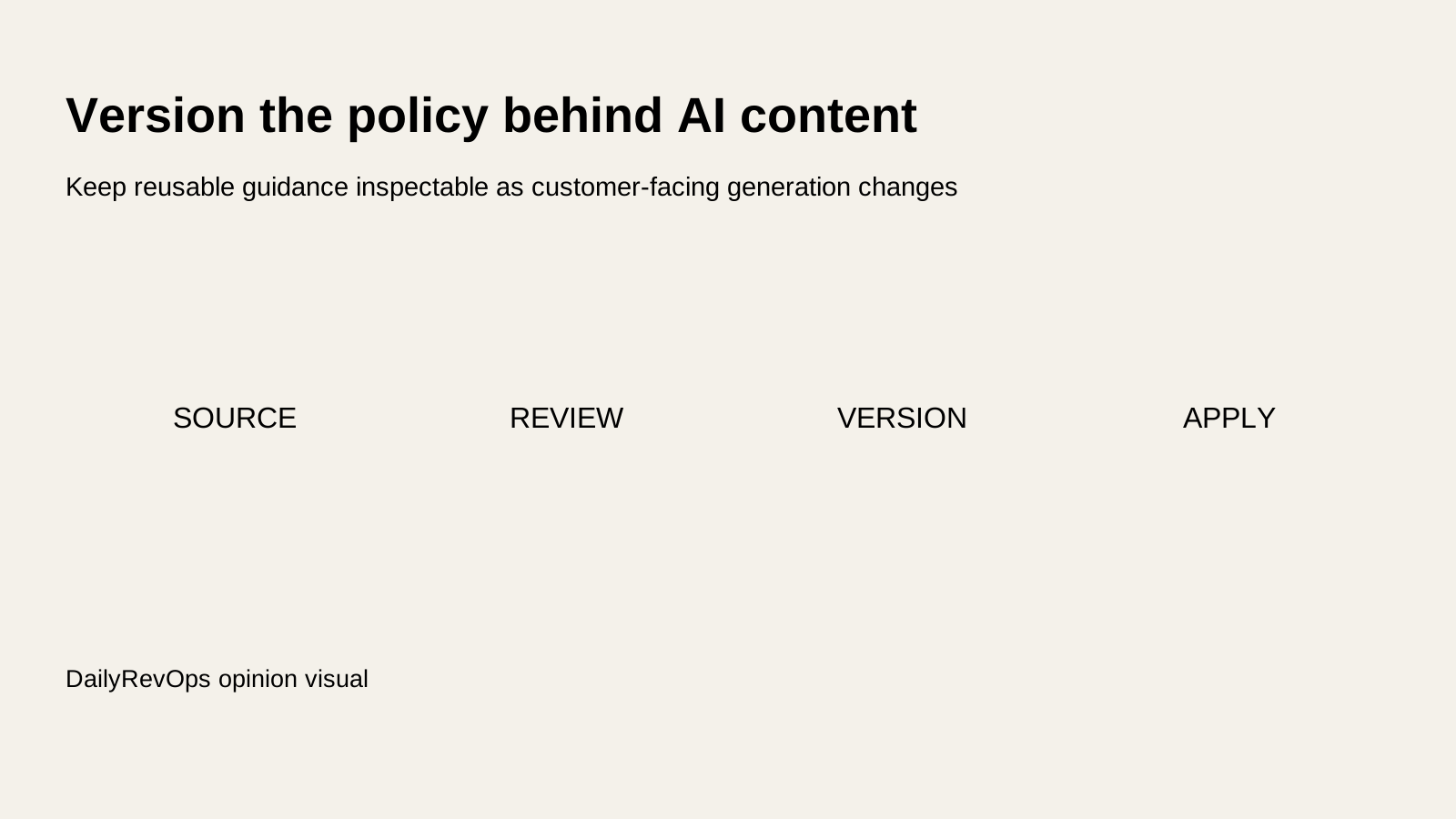
The simplest fix is a versioned content-policy object. It does not need to be a new platform. A repository file, approved brand document or governed workspace setting can work. Give it an identifier, owner, effective date and scope. State which channels and business units it covers. Separate rules that are mandatory from examples that are merely helpful. Then store the policy version with the message review or publishing evidence.
Generated brand rules should begin as a proposal
Customer.io says operators can generate brand rules from sources that demonstrate a brand's look and content standards and can choose whether to overwrite existing styles. That is a powerful setup shortcut, but the act of extraction is interpretive. A website contains campaign copy, experiments, legacy pages and exceptions. A logo tells the system little about legal language, accessibility, regional terminology or which tone should apply to support versus promotional messages.
Treat generated rules as a draft policy. Review the source set and ask whether each source is authoritative for the thing being inferred. A design system may be authoritative for color and spacing but not for regulated wording. A corporate homepage may be useful tone evidence but a poor source for transactional communication. Existing emails can show established practice, but they can also encode old mistakes. Generation reduces setup effort; it does not transfer policy ownership from the team to the model.
Safety settings and brand rules solve different problems
Customer.io separately documents workspace-level AI safety settings and a compliance prompt. Those controls illustrate a useful distinction. Safety filtering addresses categories of generated content and a compliance prompt can provide additional instructions. Brand rules address presentation and voice. Neither control proves that a particular message is factually correct, properly targeted, legally permitted or appropriate for the recipient's current lifecycle state.
RevOps should map controls to consequences instead of stacking them into one vague idea of AI guardrails. Content policy governs what the message may say and how it should appear. Audience policy governs who can receive it. Data policy governs which profile or behavioral attributes may be used. Approval policy governs which actions require a reviewer. Delivery policy governs rate, channel and suppression behavior. When these are separate, a team can change one boundary without pretending the others changed too.
Reuse increases the cost of a silent policy change
Reusable context creates leverage because one update can improve many messages. The same property increases blast radius. If a brand rule changes globally, new drafts can inherit it immediately. If a reusable component is edited, many future messages may change. Customer.io's earlier Design Studio API release also allows content and components to be created, updated and deleted programmatically, which means policy changes can arrive through API-driven workflows as well as a human editor.
Every reusable rule should therefore have a change path: proposed change, reviewer, effective time, affected surfaces and rollback or supersession behavior. For high-consequence content, sample at least one real draft after a policy change before widening it. Do not use historical sends as proof that the new policy is safe; they were generated under a different configuration. Conversely, do not rewrite the historical record by claiming an older message was governed by a rule that did not exist yet.
Inline AI needs smaller authority, not weaker evidence
The inline agent is useful precisely because it can work on a narrower component. That suggests a good permission model. A small text edit can be reviewed against the current message and policy. A workspace-level agent that can create an entire automation or change reusable configuration should carry a broader review boundary. Authority should follow the size and durability of the state change, not the conversational convenience of the interface.
For a button-label change, capture the before and after text and the policy version. For a newly generated email, retain audience, purpose, offer or claim source, policy version and reviewer. For a reusable component or brand-rule update, add affected templates or workflows and an effective date. This is enough evidence for most teams to reconstruct why the customer-facing result exists without turning every copy edit into a compliance ceremony.
A policy version makes AI output easier to improve
Versioning is sometimes framed as bureaucracy, but it makes iteration faster. When a message performs poorly or creates confusion, the team can distinguish a prompt problem from a policy problem, an audience problem or a source-data problem. If several messages generated under the same policy need correction, the team can change the shared rule once. If only one message failed, the shared policy may be fine.
The operating stance should be straightforward: AI can draft from policy, but it should not silently become policy. Customer.io's Design Studio update makes durable brand context easier to create and use. The next step for RevOps is to make that context inspectable. Give reusable AI guidance a version, owner and effective date; keep audience and action controls separate; and make every material policy change visible enough that a customer-facing message can be explained after the fact.
Source notes
These official sources support the workflow model and product concepts. They do not prove a specific retention outcome, benchmark, or vendor claim.
- Customer.io: Design Studio AI-first email creation: Official September 24 release for generated brand rules and AI-assisted Design Studio creation.
- Customer.io: Add guardrails to the content AI creates: Official documentation for workspace-level safety settings and compliance prompts used as additional governance context.
- Customer.io: Import content with Design Studio APIs: Official API release showing that Design Studio content can also be created, updated and deleted programmatically.
Last updated: 2026-09-25