Three October releases look unrelated at first. Microsoft made 30 Dynamics 365 CRM skills generally available in Copilot Cowork. Gainsight expanded Skilljar AI Tutor so published Wistia captions and learner-path progress can support answers. Maxio corrected a Wallet Product sync so an invoice no longer blocks the queue and the product enters Maxio Core as a recurring Usage-revenue Item.
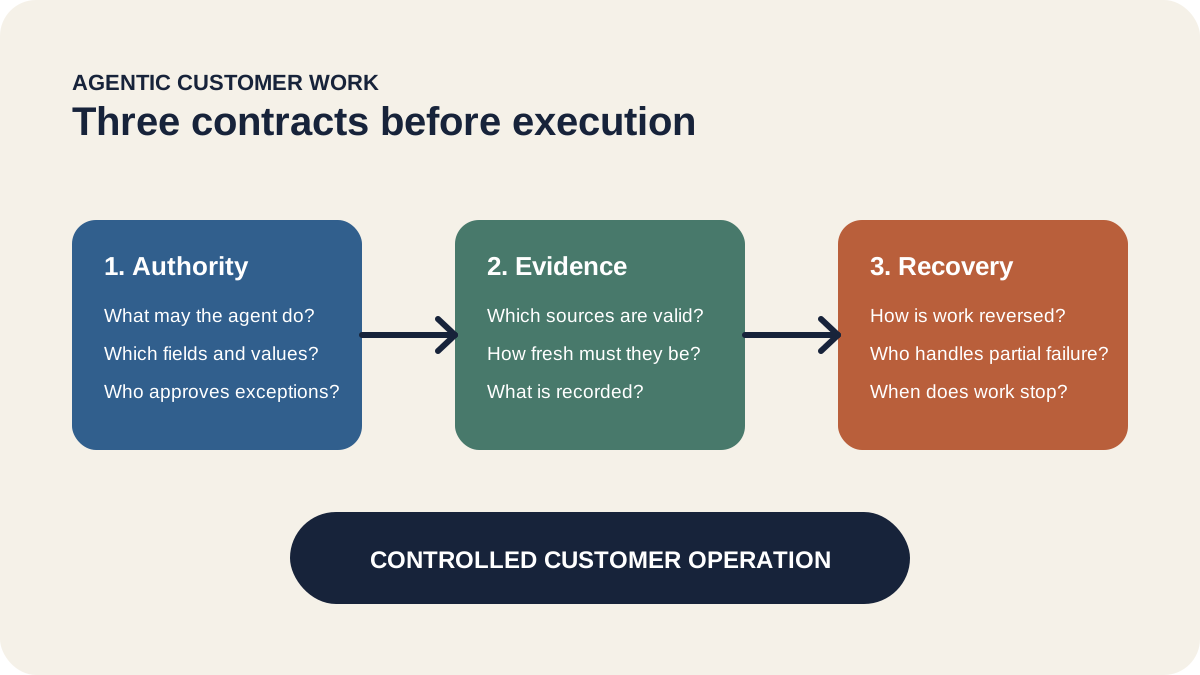
Together they show why agentic customer operations need three contracts. The procedure contract defines how a task should be performed. The evidence contract defines which source records can support the output. The commercial contract defines how an accepted result is classified, counted or reported. RevOps creates risk when one successful AI answer, tool call or sync response is allowed to stand in for all three.
The procedure contract says what the work is
Microsoft's skills are a clear example of a procedure layer. A skill can guide pipeline prioritization, deal rescue, case triage or drafting. It tells the invoking experience which CRM tools to use and how to structure an answer or proposed action. Microsoft also distinguishes a recommendation from a proposed change and a proposed change from a completed business action.
RevOps should formalize that distinction for every reusable skill. Record its purpose, owner, inputs, allowed objects, decision rules, output shape, human review and prohibited actions. Name the host and availability state too: Microsoft says Cowork is generally available while Autopilot remains private preview and Code uses Frontier access. One procedure cannot be assumed to behave identically in every host.
The evidence contract says what may support the work
Gainsight's Skilljar release exposes a useful evidence boundary. AI Tutor can answer from a Wistia video when the lesson uses a Wistia link and the video has a published caption. It can answer learner-path questions when the person is enrolled and the applicable progress record exists. A video without the supported caption or an unenrolled person sits outside that promise.
This is the evidence contract in practice: eligible sources, freshness, identity, retrieval context and treatment of missing evidence. RevOps should inventory source coverage before publishing an answer-quality rate. A correct answer from an eligible transcript cannot justify a claim about every course. A course-completion record cannot be promoted into product adoption, account health or renewal intent without separate evidence and a defined join.
The commercial contract says how accepted state is counted
Maxio's Wallet Product correction concerns a different boundary. The product now reaches Maxio Core as a recurring Usage-revenue Item in a new family. The destination classification can feed MRR, ARR and other management reporting. Yet a recurring vendor label is not a universal accounting conclusion, and a successful latest sync does not prove that the previously blocked interval is complete.
Finance Ops needs the commercial contract: unit, item type, family, subscription relationship, period, currency, metric treatment, authority and reconciliation path. It should distinguish vendor application state, internal management reporting and accounting policy. The contract also defines how a blocked historical window is reprocessed without duplicates and which unresolved exceptions are disclosed at close.
One receipt should connect the contracts without merging them
The three contracts belong in one operating receipt but retain separate states. The procedure portion names the skill or sync logic and version. The evidence portion names the source records, eligibility and observed gaps. The commercial portion names the destination classification and reporting consequence. Actor, approval, execution response, final read-back, exception and recovery connect the chain.
Do not flatten the receipt to success. A CRM skill can follow the intended procedure but lack sufficient record evidence. An AI Tutor answer can be grounded in a transcript while the transcript itself is stale. A Maxio sync can complete while one recovered Item is mapped to the wrong family. Each failure requires a different owner and correction path.
Ownership follows the contract, not the interface
The person who invokes an agent should not automatically own source quality, CRM authority and financial classification. The workflow owner maintains the procedure. Data or content owners maintain evidence. System administrators maintain permissions and connectivity. Finance owns commercial definitions. RevOps owns the joins, exception routing and review rhythm.
Small teams may assign several responsibilities to one person, but the receipt should still show which role was exercised. This matters in an incident: disabling a publisher should not prevent investigation, and correcting a caption should not silently change an invoice classification. Clear role labels make containment and recovery more precise.
Test contract disagreements deliberately
A credible pilot includes cases where the contracts disagree. Run a CRM skill against a record the user may read but not update. Ask AI Tutor a question absent from the caption and another contradicted by a newer lesson. Reconcile a Wallet Product invoice already represented through another recovery path. The expected outcome may be refusal, escalation or no-op.
Retain those negative tests. They show that the workflow can preserve uncertainty and stop at authority boundaries. A system tested only on clean eligible records will look reliable until real production data introduces missing identity, stale knowledge, denied fields or duplicated financial state.
Measure each contract locally
For procedures, track eligible runs with the intended version, correct tool path and complete review. For evidence, track eligible sources, supported answers, freshness and missing-source handoffs. For commercial state, track complete source-to-destination populations, correct classification, duplicates and unresolved close exceptions. Publish counts, denominators and observation windows.
Avoid one blended automation score. A high average can hide a critical financial mismatch or an unsupported customer answer. Review distributions by consequence class and keep the underlying exceptions visible. No current vendor source reviewed here supplies a cross-company benchmark that would justify a universal target.
A practical operating model
Create a registry of consequential automated workflows. Give every entry a procedure owner, evidence owner and commercial or outcome owner where applicable. Link the latest accepted contract versions, permissions, test pack, production receipt and recovery route. Review the oldest unresolved contract break before celebrating new volume.
The new product capabilities are useful because they expose clearer building blocks: reusable CRM procedures, grounded education evidence and explicit billing classification. RevOps should preserve those differences. Agentic customer work becomes governable when the procedure, evidence and commercial contracts can be inspected separately and reconciled at the decision that truly matters.
Source notes
These official sources support the workflow model and product concepts. They do not prove a specific retention outcome, benchmark, or vendor claim.
- Microsoft Dynamics 365 CRM skills: Official October 8, 2026 release for 30 pre-built CRM skills, with separate availability statements for Cowork, Autopilot and Code.
- Maxio October 2026 product release: Official release page documenting the October 7 Wallet Product sync and recurring Usage-item classification.
- Gainsight Skilljar October 2026 release: Official October 8 release for Wistia-caption and learning-path support in AI Tutor, including stated limitations.
- NIST AI Risk Management Framework: General risk-management context; not product evidence or a vendor benchmark.
Last updated: 2026-10-12