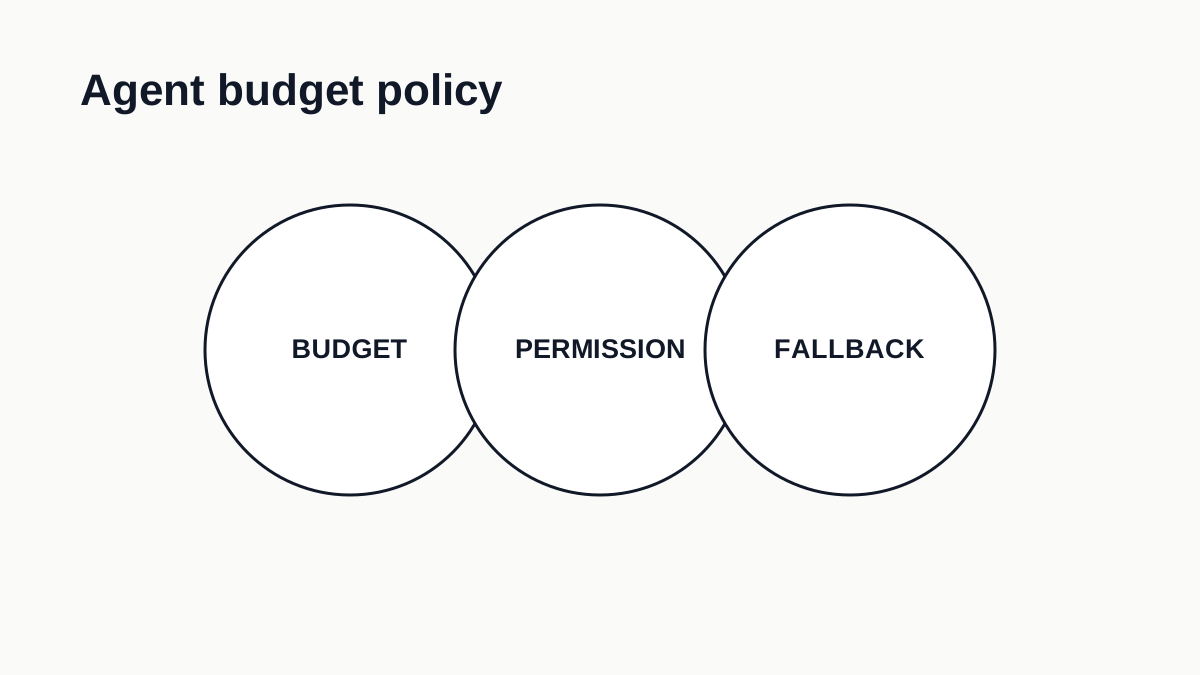
AI budgets are usually introduced as a finance or platform-administration problem: allocate a pool, watch consumption and buy more when the balance gets low. That framing is incomplete once AI features can run continuously, use customer context or trigger operational work. The budget is then part of the workflow's permission model. It determines which processing can continue, which evidence remains fresh and which automated actions can still be supported by current context.
Gong's credit documentation makes this unusually visible. The page, updated September 27, describes credits for selected AI-powered features, a shared company pool, user-level monthly limits and workspace allocations. It also describes what happens when credits run out: selected processing stops, API and MCP requests that require credits fail, question-based trackers stop processing new conversations, and dependent features can become stale. That is not merely a billing event. It is a change in the operating state of the revenue system.
A RevOps team should review an AI budget the way it reviews a permission or integration dependency. Ask which workflows consume the resource, which records or decisions depend on the resulting data, who owns the recurring process and what safe behavior applies when the resource is unavailable. A budget alert without this dependency map tells an administrator that something is nearly exhausted but does not tell the business what must stop or be rechecked.
Per-user limits are useful, but they can create false confidence if the largest consumption comes from background work. Gong notes that user-initiated credit actions can be capped while company-wide background features are not counted against individual monthly limits. The exact product mechanics are vendor-specific, yet the operating principle is general: distinguish interactive consumption from scheduled or autonomous consumption. Both should have an owner, a ceiling and a reason to exist.
The same logic applies to non-metered systems. A workflow may be constrained by API limits, model tokens, warehouse compute, external search calls or licensed action counts rather than named credits. RevOps does not need one universal unit. It needs an attributable resource boundary. A workflow should state what scarce capacity it uses, what the expected business action is and what should happen when the capacity is unavailable or unexpectedly expensive.
Cost controls belong beside action controls because the cheapest automated work can still be wrong. Common Room's current Claude integration guide says its connector and sales plugin can query and update workspace records from natural language. That creates a different control problem: the interface can move from research to mutation. A team should not trade review quality for lower interaction cost. The right question is whether the proposed action is within the user's authority and whether the resulting record is correct.
Zendesk's voice AI rollout makes the stakes more immediate. A voice agent can handle a live conversation, use procedures and integrations, and escalate with context. A usage budget may cap how much automation the organization can afford, but the customer cares whether the agent understood the request, used the correct account context, completed the authorized task and handed off cleanly when it could not. Spend and correctness are separate controls that have to meet at the same workflow.
This is why cost-per-token or cost-per-conversation should not become the default RevOps KPI. Those numbers can help capacity planning, but they reward efficiency without measuring whether the business state improved. A cheaper workflow that creates duplicate contacts or stale tasks is not efficient. A more expensive workflow may be justified if it resolves a high-value exception with strong evidence. The denominator should be a verified business action appropriate to the process.
Define that action locally. For a research agent, it might be a completed account brief accepted by the seller. For a CRM agent, it might be an approved and verified record update. For a support agent, it might be a resolved request with the correct destination state and no unnecessary escalation. For a tracker, it might be a qualified signal that survives human review. None of those should be presented as a universal benchmark; they are the organization's own operating definitions.
Budget governance should record the stop behavior. When a resource is exhausted, the system may fail loudly, degrade silently or continue showing old output. Gong's documentation explicitly notes several of these states. Other vendors will differ. RevOps should test the actual target environment and decide whether downstream workflows pause, fall back to deterministic logic, route to a human queue or continue only for low-risk reads. A stale AI-derived signal should never masquerade as a current one.
Procurement and RevOps should share the same usage map. Procurement needs to know which features consume paid capacity and which teams depend on them. RevOps needs to know whether those features support a critical action or optional convenience. The combination helps distinguish predictable production demand from experimentation and makes renewal conversations more concrete than a total consumption chart.
One useful artifact is a small agent budget register. For each production AI workflow, record the owner, feature, unit of consumption, recurring or user-triggered mode, monthly or contract limit, alert threshold, business action, fallback and verification method. Link to the vendor's current official documentation rather than copying assumptions into a spreadsheet that becomes stale. Review the register when the workflow, vendor packaging or action scope changes.
The broader point is organizational. AI usage is moving closer to production work, so spend controls can no longer live only in Finance and permissions can no longer live only in IT. RevOps sits at the intersection because it understands the business object, the workflow and the operating cadence. It should help turn credits, limits and action permissions into one reviewable contract.
A mature team will know not only how much AI it used, but why that usage existed, which customer or revenue workflow it supported, what happened when the limit was reached and whether the resulting business action was verified. That is a stronger operating model than optimizing for maximum agent activity or minimum unit cost.
Related reading: AI & Automation · Revenue Operations · Gong · Zendesk
Source notes
These official sources support the workflow model and product concepts. They do not prove a specific retention outcome, benchmark, or vendor claim.
- Gong: About Gong credits: Official documentation updated September 27, 2026 on shared credits, user limits, workspace allocation and exhaustion behavior.
- Common Room: Claude Connector & Plugin: Official September 23 documentation for read/write workspace actions from Claude.
- Zendesk: Announcing voice AI agents: Official September 1, 2026 general-availability announcement.
Last updated: 2026-09-28