Two recent releases put the same operating question in different parts of the revenue stack. Clay's September 29 Skills Marketplace packages repeatable GTM methods for coding agents. Mixpanel's October 1 Mixpanel AI announcement describes an Agent, Context Engine and Verified Mode for questions and proactive product analysis. Clay starts with an executable method; Mixpanel starts with governed analytical context. Both can make a useful result travel farther and faster than the operator who first assembled it. The handoff to a CRM field, campaign, customer conversation or commercial decision is where RevOps has to reconstruct the evidence.
The first mistake is to treat a reusable instruction as a verified source. A Clay skill can specify an input, a sequence of tool calls and an output. Clay says skills are free to install while runs using its data consume credits. The listing and review process help a team discover and reuse a method. Neither a published skill nor a successful run proves that a person matches the correct account, that a provider's signal is current, or that a generated message can be sent under this organization's preference rules. Those questions depend on the actual records and the team's authority model.
The second mistake is to treat a contextual answer as an authoritative business state. Mixpanel says Context Engine uses organizational metrics and project history. Verified Mode lets administrators designate events and properties that AI can query. That is a meaningful way to reduce ambiguity in the analytical input. An approved event name, however, does not prove that every event was emitted once, that anonymous activity belongs to the chosen account, or that a product funnel's denominator matches a billing cohort. The distinction matters when an alert proposes a renewal intervention or a forecast adjustment.
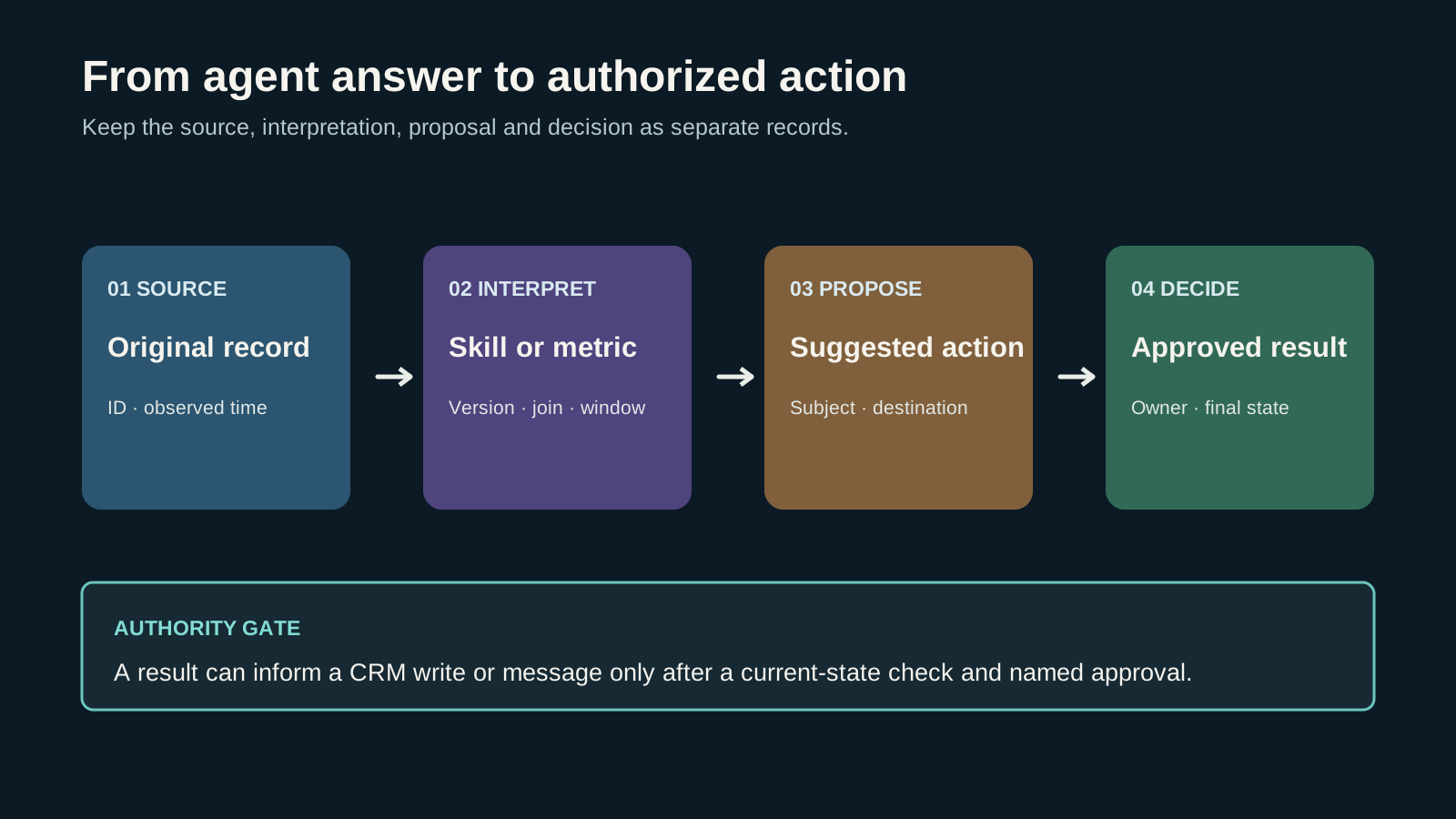
Build a trace with four linked records. Preserve the source observation with its source ID, event or retrieval time, origin, relevant properties and quality state. Preserve the interpretation with the exact skill or metric definition, version, run ID, query window and any identity join. Preserve the proposal with its intended subject, destination field or channel, expected effect and reason. Preserve the decision with an owner, approval time, current-state check, execution ID and terminal result. A dashboard screenshot or agent transcript may help a reviewer, but it cannot replace those links.
For a prospecting example, imagine a Clay skill that researches a named account and drafts outreach. The source set may contain a recently changed job title, an old company domain and a product-interest signal. The instruction can produce a coherent draft even if the CRM has a different account owner or the contact has a suppression flag. Before the send, the operating contract should require a stable contact and account match, source date, permitted claim, current preference and named approver. A no-match result should remain a no-match rather than being repaired with plausible prose.
For a product-analytics example, imagine Mixpanel Agent surfacing a change in onboarding completion. The operator should first ask which event versions, cohort window, eligibility rule and identity key produced the observation. Then compare a small sample with raw events or governed warehouse records, inspect instrumentation changes and check whether the alert reflects ingestion lag or a changed release. The question is not whether the AI can draw a chart. It is whether another analyst can reproduce the comparison and explain who, if anyone, may act on it.
A useful authority table has separate columns for read, propose, approve and write. Clay may enrich a profile or assemble a campaign proposal; Mixpanel may analyze product behavior and recommend a question. A CRM may own opportunity stage and account assignment. A subscription or billing system may own plan, payment and renewal state. A preference service may own communication permission. The same person can appear in all of them, but a cross-system join does not transfer write authority. Give each consequential field one named authoritative source and an exception path for conflicts.
Versions are important because agents can change without a visibly new screen. Store the skill file or revision and connector scope used for a Clay run. Store the Mixpanel metric, event allowlist, project context and alert configuration used for an analytical result. If a source table, identity rule or admin-approved event changes, compare the next output to the previous definition before calling it a trend. An operator should be able to explain whether a changed result came from customer behavior, instrumented data, analytic context or the agent's method.
The rollout should be bounded by consequence. Begin with read-only research and a fixed set of test accounts or product cohorts. Sample outputs, count unmatched entities, inspect contradictory evidence and record human correction time. Then permit a drafted message or recommendation with review. Only later consider a guarded CRM write or automated activation, with idempotency, explicit field authority and a final read from the destination. These are local acceptance measures; Clay and Mixpanel do not publish a benchmark showing what a particular team's error rate should be.
Cost and attention belong in the trace too. Clay says data-consuming skill runs spend credits. A team can measure credits per reviewed usable brief, rather than celebrating cheap executions that create cleanup work. Mixpanel's proactive monitoring can surface more questions, but a team should measure how many alerts led to a reproducible investigation, a documented decision and a resolved outcome. If a signal has no owner or action threshold, adding more notification surfaces can increase workload without improving decisions.
Finally, design for a changed world between proposal and action. A prospect may have left the company, an account may have a new owner, a customer may have opted out, an onboarding event may be backfilled, or a billing exception may be corrected. Put an expiry on sensitive recommendations and re-read mutable state just before execution. Once the action occurs, inspect the terminal destination record. A successful agent invocation is evidence that a method ran; it is not evidence that a customer-facing or financial consequence ended correctly.
Clay's marketplace and Mixpanel's AI surfaces deserve testing because they make methods and analytical context more accessible. Their RevOps value depends on preserving the path from evidence through interpretation to authorized action. The practical design is simple to state and demanding to maintain: every important answer carries its source and version; every proposed action names the authority that can approve it; every execution ends with an independently verified state. Related reading: AI workflows · Clay profile · Mixpanel profile.
Source notes
These official sources support the workflow model and product concepts. They do not prove a specific retention outcome, benchmark, or vendor claim.
- Clay Skills Marketplace announcement: Official Clay announcement dated September 29, 2026; describes installation, skill contents, review and credit use.
- Mixpanel AI announcement: Official Mixpanel announcement dated October 1, 2026; describes Agent, Context Engine, Verified Mode and connected surfaces.
Last updated: 2026-10-02