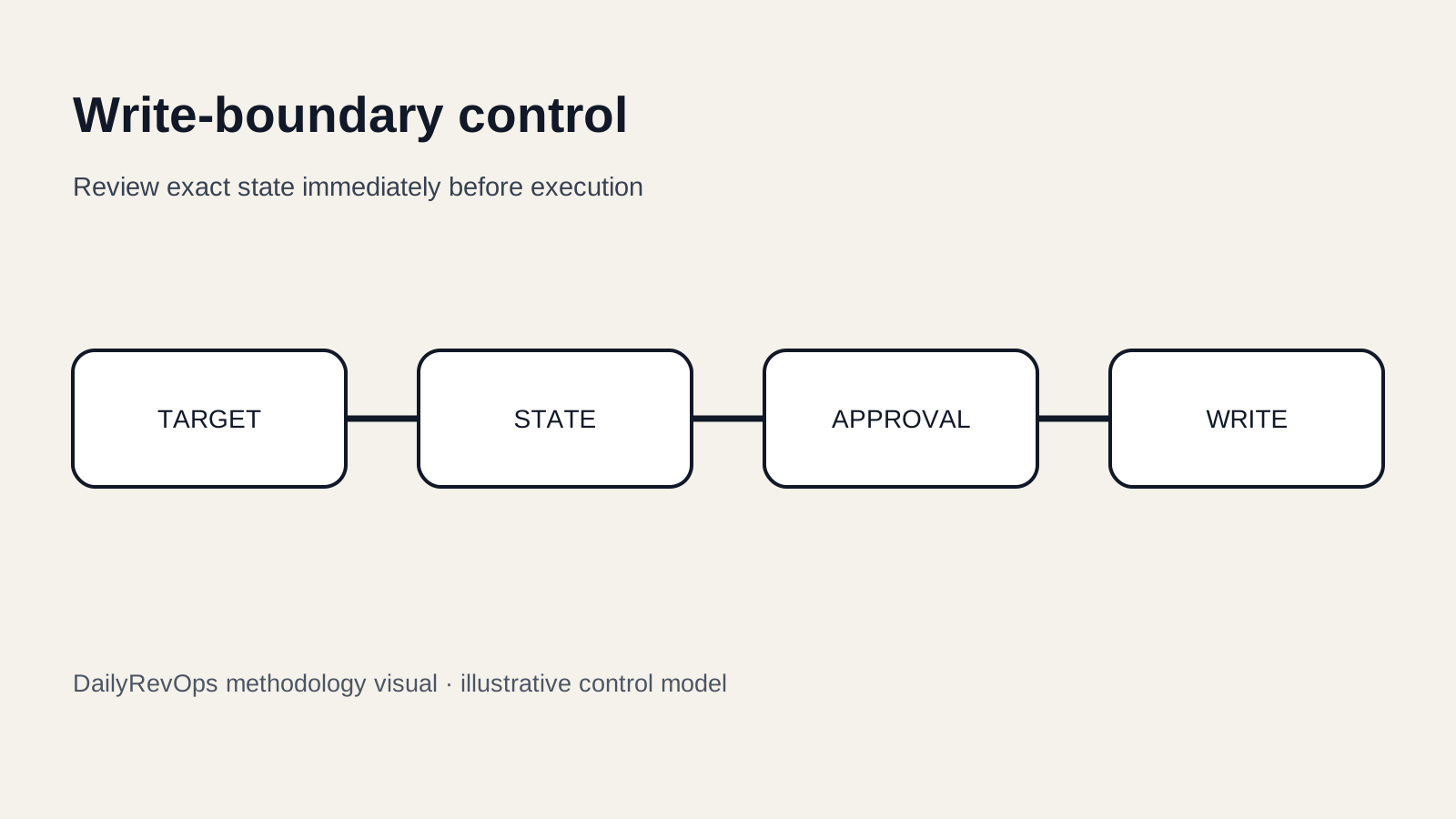
The safest place for human review in an agentic revenue workflow is not the prompt. It is the write boundary: the moment after the system has resolved the target record and proposed the exact change, but before that change becomes business state. Outreach's September release makes this visible by adding confirmation widgets before Omni changes Prospect, Account or Opportunity records. Hightouch's September changelog points in the same direction from a data-integration angle by allowing Salesforce object-ID lookups to include fixed-value conditions such as active-user or record-type filters. Both changes are small product mechanics with a larger operating lesson.
A prompt can express intent, but intent is not enough to approve a write. The same sentence can resolve to a different target after a record merge, owner change, lifecycle update, new suppression rule or permission change. Review that happens only at the beginning of a conversation validates what the user wanted in the abstract. Review at the write boundary validates what the system is actually about to do to a specific record under current conditions.
The proposal needs a concrete target
A useful approval surface should show the stable target identifier, current values that matter, proposed values, the rule or evidence that produced the proposal, the effective execution identity and the downstream consequence. For a CRM mutation, that can mean account ID, opportunity ID, owner, stage, existing value, new value and the source used to justify the change. For an audience sync, it means the resolved destination object, qualifying membership and the mapping that will determine the write.
That is materially different from asking a user whether an agent may 'update this account.' The phrase sounds precise to a human while remaining underspecified operationally. A record can have several account representations across CRM, warehouse, billing and customer-success systems. The write boundary is where the application should prove it has resolved the same entity the operator intended and that the destination still satisfies the rule that made it eligible.
Match conditions are part of authority
Hightouch's additional lookup conditions are a useful example because matching is often treated as plumbing rather than governance. If a sync looks up a Salesforce object by one field, two records can be technically valid matches even when only one should receive the change. Adding a fixed condition such as active equals true or record type equals a named value narrows the resolution rule before the destination ID is chosen.
RevOps should make those conditions explicit in the release record. The team needs to know which field is the primary key, which fixed conditions qualify a record, what happens when zero records match, what happens when several records match and whether the workflow creates, skips or raises an exception. A successful API response after an ambiguous lookup is not evidence of a correct business action. Correctness begins with target resolution.
Human-in-the-loop is not a checkbox
Outreach describes a confirmation widget that previews a CRM change and lets the user approve or cancel it. That is closer to useful human review than a generic confirmation because the operator sees the proposed action. The quality of the control still depends on what the preview contains. If the user sees only polished natural language, the approval can validate presentation rather than state. The strongest review surfaces include the target object, prior state, proposed state and the missing information that was collected before the action became executable.
Teams should also distinguish between policy approval and per-action approval. A low-impact, reversible task creation may be approved once through a deterministic policy after testing. A customer-facing message, ownership transfer, stage change or commercial-field mutation may need current-state review each time. Human review should be assigned according to consequence and uncertainty, not because an action happens to use AI.
Changed state is the test most teams skip
The most valuable acceptance test is to change a material field after the proposal is generated and before execution. Reassign the account, close the opportunity, add a suppression flag, archive the destination user or alter the record type. The workflow should either re-read the blocking state or reject the stale proposal. If the original proposal executes unchanged, the approval model is tied to old context rather than current business state.
This is where write-boundary review earns its place. It reduces the time between verification and mutation. The system does not need to re-fetch every field in every connected application. It needs a small contract naming the facts that can invalidate the action and a maximum age for each. The write boundary becomes a deterministic checkpoint around the material state rather than a second full reasoning pass.
Cancellation needs durable semantics
Outreach also says users can cancel a running query. RevOps should test what cancellation means at each phase. Cancelling before a destination request is sent is straightforward. Cancelling after the destination committed a write but before the response returned is not. A user can reasonably believe the action stopped while the system of record already changed. The workflow therefore needs an execution state that distinguishes proposed, approved, dispatched, committed, reconciled and rolled back where relevant.
The same principle applies to retries. If a network timeout hides a successful write, a retry can create a duplicate task, campaign member or downstream action. Give each business action a stable execution key and check the destination before repeating a consequential operation. Human review controls intent; idempotency controls transport uncertainty. Both are required when an agent can mutate production state.
Review failure evidence as carefully as successful writes
Intercom's new outbound-call failure reasons illustrate why operational systems improve when they preserve specific failure state. Invalid number, line busy, recipient decline, carrier block and region restriction demand different follow-up. A generic 'failed' result pushes interpretation back onto the operator. The same is true for agent writes: ambiguous identity, stale state, denied permission, policy block, destination timeout and duplicate prevention should remain separate outcomes.
Those outcomes make the control layer measurable. A high number of ambiguous-target blocks suggests identity or mapping problems. Repeated stale-state rejections suggest the proposal-to-execution window is too long. Permission denials can reveal overly broad assumptions about service identities. Duplicate blocks can reveal overlapping automations. The goal is not to minimize every block; some blocks are evidence that the system refused unsafe work correctly.
The write boundary should survive interface changes
Agent surfaces will change quickly. A workflow may start in a CRM assistant, move into Slack, become accessible over MCP or appear on mobile. The control contract should not need to be reinvented for each interface. Keep target resolution, current-state checks, policy, approval, execution identity, idempotency and audit evidence in a shared service or workflow layer where possible.
That design lets teams adopt faster interfaces without making governance dependent on the interface. A prompt can become shorter, a visual builder can become easier and a mobile approval can become more convenient while the actual business action still passes through the same reproducible boundary. For RevOps, that is the practical definition of agentic control: more ways to request work, but one inspectable place where intent becomes state.
Related reading: AI workflows · CRM data quality · GTM operations
Source notes
These official sources support the workflow model and product concepts. They do not prove a specific retention outcome, benchmark, or vendor claim.
- Outreach September 2026 release notes: Official release notes describing Omni confirmation widgets and the September 10-24 rollout window.
- Hightouch September 2026 changelog: Official changelog describing additional Salesforce object-ID lookup match conditions and other September changes.
- Intercom outbound call failure reasons: Official September 21, 2026 changelog entry exposing specific outbound call failure reasons.
Last updated: 2026-09-22