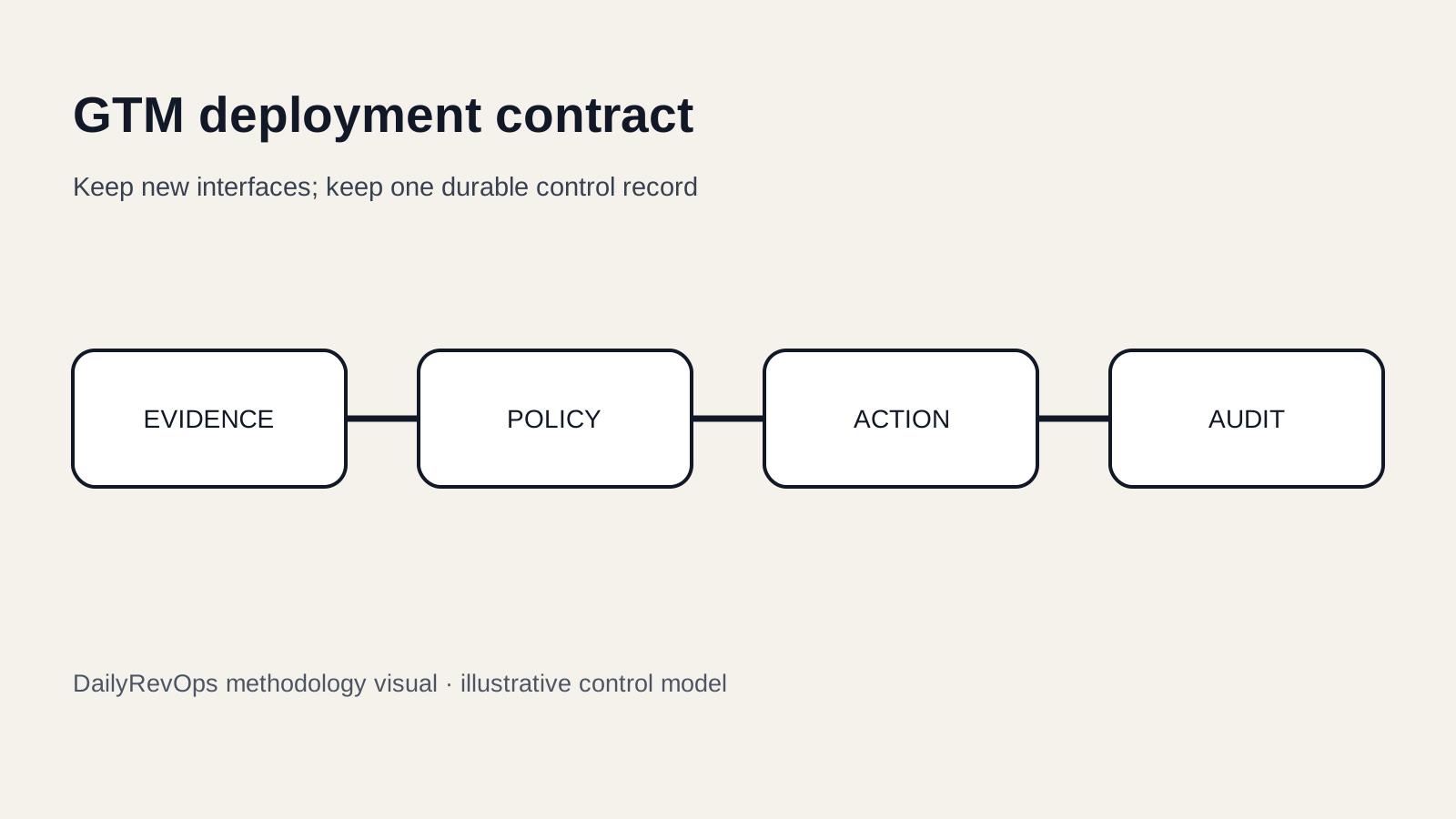
MCP and orchestration products are shrinking the distance between a natural-language request, a buying signal and a production GTM action. UserGems can now expose campaign-building capabilities to Claude or ChatGPT; Demandbase is expanding a signal-driven execution layer; Close is making phone-number permissions and routing more flexible. The shared operating problem is not AI itself. It is that more control surfaces can now request work against the same customer, campaign and CRM state.
A RevOps team should treat every conversational or signal-driven interface as a deployment surface. The interface may be new, but the underlying business objects still need stable identity, authority, versioning, current-state checks and an audit trail. Moving configuration into a prompt or visual builder does not remove those requirements. It makes them easier to overlook because fewer screens separate intent from execution.
Define the object being deployed
Start with a durable object: campaign, play, sequence, audience, routing rule or agent action. Give it a stable identifier and version. Record the business owner, technical owner, target population, source systems, allowed channels, start condition, stop condition and rollback path. A chat thread is not the deployment record because it describes an interaction rather than the durable configuration that another operator has to support.
For a campaign built conversationally, preserve the generated configuration as a reviewable artifact before activation. For an orchestration play, preserve the trigger and branch definitions. For a calling change, preserve number membership and routing state. The implementation can differ, but the control principle is the same: another operator should be able to inspect exactly what will run without recreating the original conversation.
Separate evidence, policy and execution
A buying signal is evidence. A scoring threshold is policy. Enrolling a person, changing an audience or writing a CRM record is execution. Keep those layers separate in logs and permissions. If a system collapses them in one interface, reproduce the separation in the operating record so a later review can distinguish what was observed from what the team decided to do.
The same split applies to natural-language interfaces. A model can interpret a request and construct a proposed configuration, but the proposal should still pass deterministic checks for required fields, protected populations, suppression, identity and channel authority. Model fluency is not a substitute for a policy gate, and a plausible explanation does not prove that the target record or audience is correct.
Revalidate current state at the boundary
The highest-risk moment is between proposal and action. Another workflow may have changed the owner, lifecycle stage, customer status, opportunity, suppression or campaign membership after the original context was retrieved. Re-read the small set of fields that materially determine whether the action is still allowed immediately before execution, especially when the action is customer-facing or changes commercial state.
Do not re-query every system indiscriminately. Name the blocking facts in the deployment contract and give each a maximum age. A campaign enrollment may need current customer status and suppression. A CRM write may need record version and owner. A phone-routing change may need current number membership and active fallback configuration. This turns freshness from a vague quality concern into an explicit release rule.
Treat cross-system collisions as a first-class state
A person can simultaneously qualify for an outbound play, sit in a lifecycle campaign, own an open support issue and belong to a customer account. When separate systems can act, define a shared collision rule. The rule can prioritize one action, defer another or route to review, but it should not depend on which automation happened to execute first.
Store an action key that makes equivalent work detectable across retries and surfaces. For customer communication, that key can include person, purpose, channel and time window. For CRM changes, use record, field or action type and execution ID. The goal is to recognize the same business action even when it is requested from different interfaces or triggered from different source systems.
Version the control plane with the workflow
Prompts, scoring models, branches, integrations, permissions and source mappings can all change behavior. Record those dependencies on each release. If a campaign was built from one scoring model and later the model changes, an operator needs to know which policy produced the original audience rather than assuming the current configuration explains historical actions.
A practical release note names the changed dependency, affected workflows, expected behavior, representative test records and rollback owner. This is especially important for agentic systems because the visible prompt may stay identical while a tool, model or data source changes underneath it. Versioning only the prompt creates a false sense of reproducibility.
Make observability answer operational questions
Logs should tell the team which source evidence was read, which rule matched, which records were selected, what action was requested, which identity executed it and what the destination returned. A generic successful-run counter is not enough for customer-facing or revenue-changing automation because it cannot distinguish the right action from a successful write to the wrong record.
Sample both successful and blocked executions. Repeated blocks for stale or ambiguous identity are upstream data problems; repeated policy denials show a mismatch between automation scope and business rules. Those exceptions are useful telemetry because they show where the control plane is doing real work instead of simply maximizing throughput.
Use a small deployment contract
For each new conversational or signal-driven workflow, require a stable object ID, business owner, source authority, target grain, eligibility rules, exclusions, action permissions, current-state checks, duplicate protection, rate limits, approval rule, execution evidence, exception owner and rollback procedure. Keep the contract small enough to review but precise enough to test.
The current product releases make GTM systems easier to operate from new surfaces. That is useful. The safe architecture is to let interfaces multiply while the decision and execution contract stays singular, inspectable and durable. The interface can become faster without making the underlying business state harder to reconstruct.
Related reading: AI workflows for RevOps · GTM operations · CRM data quality
Source notes
These official sources support the workflow model and product concepts. They do not prove a specific retention outcome, benchmark, or vendor claim.
- UserGems MCP launch: Official September 18, 2026 launch announcement.
- Demandbase Orchestration release: Official September 18, 2026 product announcement.
- Close phone management: Official September 17, 2026 product update.
Last updated: 2026-09-21