Salesforce outlines a 2027 roadmap for life-sciences agents and content controls
Regulated Content Management, Command Center and Life Sciences MCP are announced on different availability timelines. Commercial operations teams should use the roadmap to prepare evidence and ownership, not assume a live replacement.
Three announcements, different availability dates
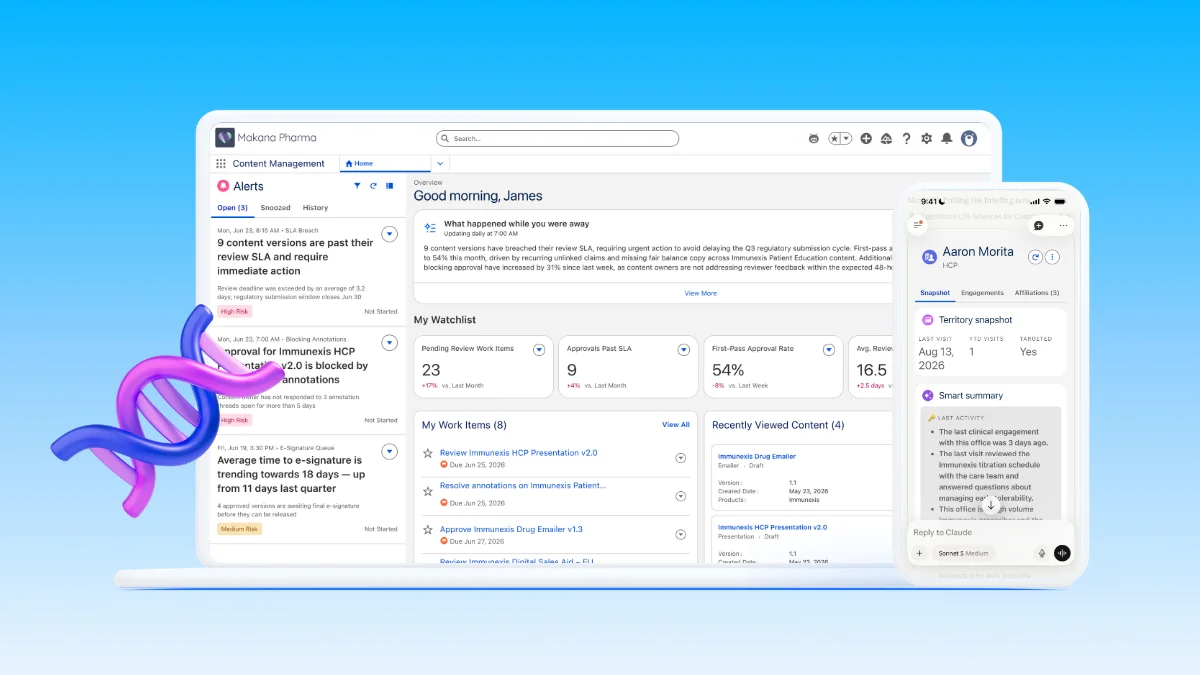
Salesforce announced Regulated Content Management, Command Center for Life Sciences and Life Sciences MCP on September 8. It describes connected claim evidence and content review, operational signals with recommended actions, and access to governed workflows through other applications and agent environments.
The availability section is important: Regulated Content Management is planned for early adopters in October 2026 and general availability in 2027. Command Center and Life Sciences MCP are planned for 2027. Salesforce separately says headless capabilities are already generally available; that does not make the newly announced life-sciences products generally available today.
These are vendor roadmap statements, not independent evidence of regulatory compliance, clinical benefit or commercial performance. DailyRevOps examines the commercial-operations implications below and does not provide medical or legal advice.
Prepare the commercial evidence model first
DailyRevOps analysis: a commercial content workflow depends on more than the latest file. An operator needs to know which claim was approved for which use, which version of an asset includes it and who owns the next review when the underlying evidence changes. A future platform can help organize this work, but it cannot resolve conflicting internal definitions without accountable decisions.
Inventory the customer-facing assets that support a real sales motion. Link each to its business owner, approval status, intended audience and current distribution locations. Keep market or channel restrictions under the responsible review function. Where the organization cannot establish an asset's permitted use, treat that as an unresolved operating question rather than allowing an automation to infer permission from availability in a folder.
The critical join is between evidence and distribution
A useful preparation exercise starts with a hypothetical change to one approved statement. Ask which presentations, emails, portal pages and partner copies would need inspection. Then ask who can find those copies and who can actually withdraw or replace them. The difference between knowing a reference changed and controlling every downstream use is an implementation requirement worth discovering before procurement.
Preserve stable identifiers for the claim, asset version, review decision and distribution endpoint. A filename is often inadequate as the only connection because people can rename or duplicate a document without changing its substance. Define how exceptions are recorded when a downstream system cannot preserve the preferred identifier. The aim is a traceable operating process, not a promise that all content must move to one repository.
A recommended action still needs a responsible role
Commercial signals can originate in several teams and have different levels of reliability. An unexpected revenue movement, a territory issue and a content-review dependency should not enter the same queue with identical urgency. Identify the business decision each signal is allowed to influence and the person who can verify the supporting records.
When a system recommends an action, retain the triggering observation, its time window and the relevant source. Distinguish a suggested follow-up from an approved commercial commitment. An account manager may own customer coordination while another function owns the underlying interpretation. Make that division explicit so that a cross-functional workflow does not accidentally grant a sales role authority it does not have.
Do not mistake a new surface for a new permission
Access through a familiar collaboration tool can make a workflow easier to reach. The implementation review should still ask what information is exposed, which identity is acting and where approval happens. A person being able to see a summary does not necessarily mean that person may change the underlying record or distribute the associated asset.
Prepare a small permission matrix organized around actions rather than applications. Include viewing evidence, drafting an asset, requesting review, approving distribution and withdrawing obsolete content. For each action, record the authoritative system and expected audit evidence. Use representative roles to test allowed and denied cases. The responsible security and compliance teams should validate their own requirements; a product announcement cannot replace that review.
Turn the roadmap into questions for a bounded pilot
Before committing to an early-adopter program, ask which named capabilities are included, which integrations are supported and how changes to the roadmap will be communicated. Request a demonstration using a realistic version-change scenario rather than only a clean new asset. The demonstration should show the handoff, the evidence retained and what happens when an external system is unavailable.
Keep a register of assumptions that depend on unreleased functionality. Assign an owner and a decision date to each, and maintain a workable current process until the replacement is verified. Do not retire an approval queue or promise a delivery date on the strength of a future availability statement. The immediate RevOps opportunity is to make content ownership, commercial evidence and review boundaries clear enough that any later platform can be evaluated against them.
Original source
This DailyRevOps article is written in our own words from the source signal and adds RevOps context, workflow analysis, and operator interpretation.
- Original source: Salesforce
- Original publication date:
- Source link: Read the original article