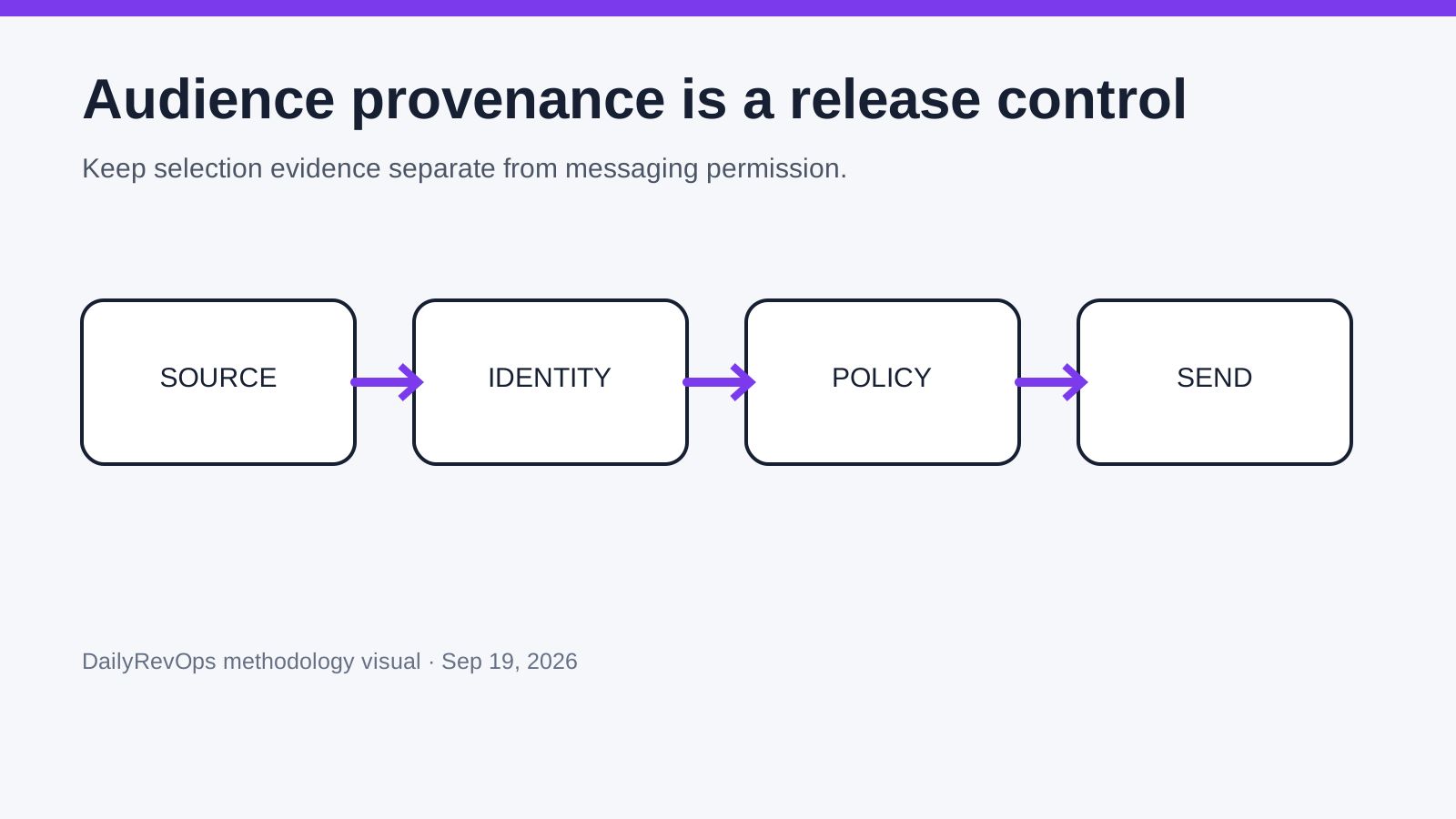
Customer.io's September 17 release makes a useful architecture choice visible: the audience for a one-time send can now be defined outside the messaging platform and handed in as a CSV. The platform still owns message construction and execution, but the membership decision may come from a warehouse query, finance export, event registration list, migration analysis or another operating process. That separation is convenient precisely because it creates a new control boundary.
A file is easy to mistake for evidence. It is only a container. The business still needs to know which system produced it, which query or rule selected the rows, when that logic ran, who approved the purpose, which identifier was exported and what population was intentionally excluded. If those facts are lost, the team can reconstruct the message but not the reason each person entered the audience.
Customer.io narrows the import contract by requiring a single email or id column that refers to existing people. That is helpful because it prevents an audience upload from silently becoming a profile-enrichment job. It does not eliminate identity risk. Existing records can still be duplicated, merged incorrectly, associated with the wrong account or carry addresses that no longer represent the intended recipient. Audience selection and identity resolution remain separate controls.
The most important pre-send number is therefore not the source file's row count by itself. It is the reconciliation from source rows to resolved candidate recipients to policy-eligible recipients to actual deliveries. Each step can legitimately change the count. Unknown IDs may be skipped, duplicate addresses can be suppressed, subscription rules can remove people, and the final audience can change if the platform evaluates current state at send time. A release record should preserve those count transitions.
That same logic applies when the audience originates from a data warehouse or analyst notebook. A sophisticated query does not make the output self-governing. Record the query version or model reference, data freshness, identity key, business owner and exception handling. If a person is missing because a join failed, that should be distinguishable from a person who was intentionally excluded by a consent or lifecycle rule.
Messaging permission must remain downstream of audience construction. Customer.io documents subscription-topic behavior and an explicit option for certain important notices to include unsubscribed users. Those are execution controls with legal and trust consequences. The external file should never be treated as proof that the sender has permission to communicate. Candidate membership answers who the upstream process selected; policy answers who the messaging system may actually contact for this purpose.
A mature release process also separates content approval from audience approval. Marketing or legal may sign off on the message while RevOps validates the source population, and lifecycle operations may own the send configuration. Put those approvals under one release identifier so a future operator can see which message version, audience artifact, subscription rule and delivery schedule belonged together. Otherwise a correct content approval can be paired with the wrong file without anyone technically violating their own step.
One-time communications are especially exposed to stale state because they often begin as urgent exceptions. A list exported on Monday can be wrong by Friday after customers churn, change plans, merge accounts, update preferences or resolve the issue that justified the message. For high-consequence sends, revalidate the fields that matter at activation time or keep the delay between export and send intentionally short. The right freshness threshold depends on the decision, not on what the file format allows.
Rate limits and staged delivery are useful control surfaces when a message can create downstream load. An operational notice may send customers to Support, Billing or a migration portal. A slower initial cohort can reveal broken links, mistaken eligibility or unexpected ticket volume before the entire audience receives the same instruction. Treat the send rate as part of release design rather than only a deliverability setting.
The broader RevOps lesson is that external audience files should be governed like any other production input. They need provenance, identity, reconciliation, permission and a named owner. Customer.io's new CSV route reduces the mechanical work required to send to an externally defined cohort. Teams should use that saved friction to improve the evidence around the handoff, not to remove review from the customer-action boundary.
There is also a retention and access question around the audience artifact itself. A recipient file can contain identifiers that are harmless in a controlled messaging workspace but risky when copied into tickets, chat threads or personal folders. The release record should point to a governed storage location with the narrowest practical access, a retention period and a clear deletion path. Keep the evidence needed to reconstruct selection without turning every one-time campaign into a permanent shadow customer database.
This is where an external-audience path can actually improve architecture. Instead of copying every temporary selection attribute into the messaging platform, a team can keep the authoritative logic in the system that owns it and pass only the resolved membership needed for the send. That is cleaner when the handoff is versioned and auditable. It is dangerous when the CSV becomes an undocumented escape hatch around the normal data model.
Source notes
These official sources support the workflow model and product concepts. They do not prove a specific retention outcome, benchmark, or vendor claim.
- Customer.io release notes: CSV recipients: Official September 17, 2026 release note for CSV-defined recipients in one-time sends.
- Customer.io one-time sends: Official implementation documentation for recipient conditions, CSV requirements, subscriptions, scheduling and rate limits.
- Intercom Table-view co-viewing: Official September 17, 2026 changelog describing live teammate viewer avatars in Inbox Table view.
- Zendesk Specialized AI Agents: Official September 14, 2026 launch of Industry Agents and Custom Agents.
Last updated: 2026-09-19