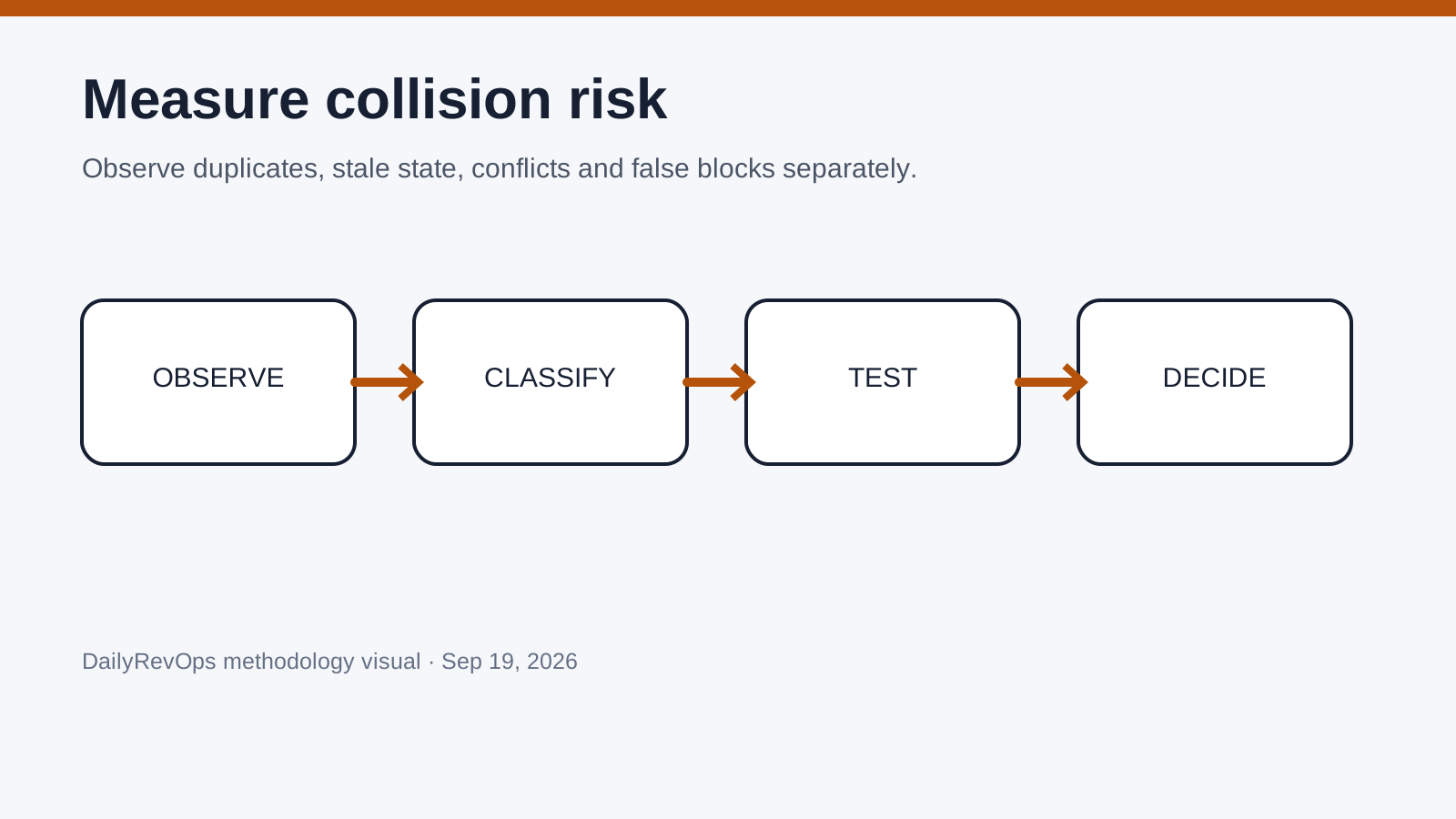
Customer-action collision risk is measurable without inventing an industry benchmark. The useful question is local: when two people, automations or agents can act on the same customer state, how often does the organization create a duplicate, conflicting or stale action? Intercom's new co-viewing signal, Customer.io's externally defined one-time-send audiences and Zendesk's cross-system agents provide three different reasons to measure the same underlying control problem.
Start by defining the unit of observation. A customer action should be a consequence that another operator would reasonably want to know about before acting: a reply, refund, credit, CRM task, lifecycle enrollment, suppression change, ownership change, booking, cancellation or commercial-status update. Do not count passive reads or internal summaries as actions unless they change downstream behavior. This keeps the denominator tied to work that can actually collide.
Choose a bounded observation window and population. A practical first pass might use one support queue, one lifecycle program and one CRM task workflow for two weeks. Record the number of customer actions in each workflow and sample enough records to reconstruct what was visible immediately before execution. The goal is not statistical generalization to the market. It is to create an inspectable baseline for the organization's own release decisions.
Classify collisions into at least four types. Duplicate actions create the same consequence twice. Conflicting actions send incompatible instructions or write competing values. Stale actions were valid when proposed but wrong by execution because material state changed. Ownership collisions occur when more than one actor proceeds because each believes it controls the next step. Keep these categories separate because the fixes differ.
For every observed collision, capture the actors involved, systems touched, customer identifier, timestamp, current owner, action key, source evidence, whether a pending action was visible and whether duplicate prevention existed. Avoid writing a narrative first. The structured fields make patterns easier to compare and reduce hindsight bias when a team later debates what an operator should have known.
Then calculate mechanism-level rates. Duplicate-action rate is duplicated consequences divided by all relevant actions. Stale-execution rate is actions executed after a material source change divided by actions where changed state could matter. Unresolved-ownership rate is cases with no unambiguous next-action owner divided by reviewed cases. These are local diagnostic ratios, not universal performance targets.
Pair the collision measures with false-block measures. A strong duplicate-prevention control can also stop legitimate repeated actions, such as a second follow-up after a customer replies or a new refund on a separate order. Record blocked actions that required manual override and determine whether the action key, time window or identity scope was too broad. Safety that prevents normal work is still an operational defect.
Use changed-state tests to validate causality before changing tooling. Reproduce a collision in a test account, add one control such as visible ownership, a stable action key or pre-execution refresh, and repeat the same sequence. If the collision disappears while the intended action still succeeds, the team has evidence about mechanism. A before-and-after production trend alone can be distorted by volume, staffing or case mix.
Report the benchmark with its scope attached. State the dates, queues, channels, number of actions, number of reviewed records, exclusions and known blind spots. If data from an external system could not be reconciled, say so instead of treating the missing action as a non-event. A small transparent sample is more useful for operating decisions than a large denominator assembled from incomparable logs.
Finally, connect the result to release authority. If collisions cluster around one workflow, narrow automation there until ownership and idempotency improve. If the rate is low because the team has strong visible state and duplicate prevention, that is evidence for expanding the bounded action. The benchmark should decide which control to strengthen next, not provide a vanity score for how autonomous the stack appears.
Add severity to the observation without collapsing it into one score. A duplicate internal task and a duplicate refund are both collisions, but the operational consequence differs dramatically. Record the action class, reversibility, customer visibility and financial or compliance consequence separately. That lets a team prioritize controls where a rare error is expensive while still improving high-volume low-impact workflows through ordinary product iteration.
The denominator also deserves scrutiny. If a workflow logs only successful commits, blocked duplicates and failed writes disappear from the dataset and the apparent collision rate can look artificially clean. Build the observation table from attempts where possible, then label committed, blocked, failed and abandoned outcomes. A healthy idempotency control may increase the number of blocked attempts while reducing duplicated consequences, which is exactly the mechanism the benchmark should expose.
For comparisons over time, freeze the measurement contract before interpreting movement. Keep the same action definition, observation window, inclusion rules and collision taxonomy for at least two review cycles unless a documented change requires a reset. When the contract changes, show the break explicitly. That makes a reduction in collisions evidence of a better operating mechanism rather than an artifact of counting fewer risky actions.
Source notes
These official sources support the workflow model and product concepts. They do not prove a specific retention outcome, benchmark, or vendor claim.
- Customer.io release notes: CSV recipients: Official September 17, 2026 release note for CSV-defined recipients in one-time sends.
- Customer.io one-time sends: Official implementation documentation for recipient conditions, CSV requirements, subscriptions, scheduling and rate limits.
- Intercom Table-view co-viewing: Official September 17, 2026 changelog describing live teammate viewer avatars in Inbox Table view.
- Zendesk Specialized AI Agents: Official September 14, 2026 launch of Industry Agents and Custom Agents.
Last updated: 2026-09-19