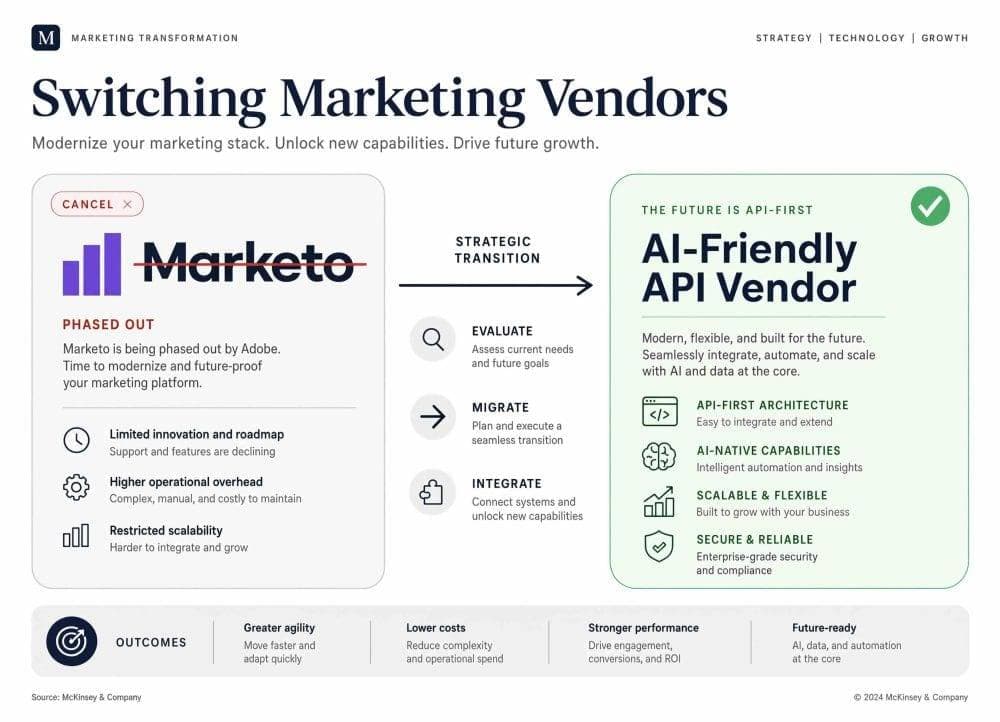
Your Agents Are About to Start Firing Your Vendors. Ours Fired Marketo.
We just moved 10+ years of data off Marketo into Salesforce Marketing Cloud. It took us years to get there. The final straw was the rate-limiting in their API made it unusable for 10K, our AI agent for marketing and…
What the source signals
SaaStr published this item on July 28, 2026. DailyRevOps treats it as a high-signal for ai workflows operations and links to the original article below. The source is the factual starting point; the workflow interpretation on this page is DailyRevOps editorial analysis.
The source preview says: We just moved 10+ years of data off Marketo into Salesforce Marketing Cloud. It took us years to get there. The final straw was the rate-limiting in their API made it unusable for 10K, our AI agent for marketing and revenue. The renewal came up, they raised prices 12%-20% again with no new features, it
SaaStr founder Jason Lemkin reports that his company moved more than ten years of data from Marketo to Salesforce Marketing Cloud after an internal AI agent repeatedly hit Marketo API limits. The article says the API was usable for roughly one hour a day before stalling, which blocked the agent's marketing and revenue analysis. Lemkin says he asked the agent what to do, and it recommended leaving Marketo with three alternatives. This is a first-person account of SaaStr's own stack and decision; DailyRevOps has not inspected the API logs, contracts, agent prompts, data export, destination configuration, or production results.
The source connects the technical limit with a commercial renewal. It says Marketo sought another 12% increase after several years of price rises, and that SaaStr would have considered staying at $20,000 with higher API limits or paying $25,000 for a workable arrangement. The article also criticizes the support experience. Those prices, increases, service judgments, and negotiation details are claims from one customer account, not published rate-card data or a representative customer sample.
Lemkin reports that the migration took about a week of elapsed time and that the agent's heavy work took about an hour and cost roughly $14. The same article says a team member spent two solid weeks acting as the infrastructure person and that the team kept hitting the old platform's API ceiling during the move. These details matter together: low model-compute cost does not equal low total migration cost. Planning, mapping, human review, waiting, remediation, and operational disruption still belong in the change record.
The source argues that API quality has become a retention surface because agents can generate far more queries than periodic human analysis or nightly integrations. It also says switching remains draining and offers a practical opinion that a team may manage about one core-vendor swap a year. That is the author's interpretation based on this experience, not a benchmark for API demand, migration speed, switching capacity, renewal risk, or return on investment across other companies.
The first review question is whether the signal changes work in Renewal and customer health reviews, CRM data quality and reporting, AI-assisted operator workflows, Tool administration and implementation. A headline can be relevant without being implementation-ready. Confirm the product scope, affected users, data requirements, and actual release or availability details in the original source.
Why this matters to RevOps
This is a direct RevOps and Marketing Operations signal because a marketing automation platform sits between audience consent, campaign execution, engagement history, lead capture, scoring, lifecycle movement, attribution, and CRM reporting. If an API limit blocks analysis or orchestration, the operational question is not simply whether the vendor feels modern. It is which approved workflow misses its service level, which decision is delayed, and whether the limit is architectural, contractual, configurable, or caused by inefficient request design.
The agent recommendation should be treated as evidence for a vendor review, not as the decision maker. A model can summarize errors, compare published alternatives, or estimate effort, but it may not know negotiated entitlements, support commitments, security conditions, consent duties, custom objects, hidden dependencies, historical reporting needs, or the real capacity of the team doing the cutover. Procurement, Marketing Operations, RevOps, security, privacy, finance, and the business owner still need named decision rights.
The report also exposes a measurement trap. An agent can make extraction and transformation look cheap while the expensive parts move into human verification and downstream repair. RevOps should compare total operating cost and decision quality: API usage, vendor fees, human migration time, failed campaigns, reporting breaks, duplicate or lost activity, training, monitoring, and the cost of reversing a bad cutover. A small inference bill is useful evidence, but it is not a business case by itself.
AI-workflow signals matter when they change how revenue teams research, summarize, recommend, route, or update records. RevOps should define the bounded task, source inputs, reviewer, system of record, and failure path before judging the feature by its demo output.
The useful operating question is whether AI reduces repetitive work while keeping important decisions inspectable. Customer communication, ownership, forecasting, and record changes need stronger controls than low-risk drafting or internal summarization.
Workflow impact
The affected workflow areas recorded for this item are Renewal and customer health reviews, CRM data quality and reporting, AI-assisted operator workflows, Tool administration and implementation. Relevant source and operating terms include CRM, Customer Success, AI Workflows, Renewals, Product Updates. Use those labels to find the current owner, system, report, queue, or recurring meeting where the signal would create a decision.
Start by reconstructing the constraint from logs rather than from frustration. For each blocked job, retain the integration or agent identity, endpoint, request count, response code, retry count, time window, payload size, records requested, records returned, and business task. Separate a published API quota from concurrency limits, rate windows, bulk-export rules, pagination mistakes, duplicate polling, permission errors, query complexity, and timeouts. One hour of useful access could describe several different failure modes that need different remedies.
Map every workload that shares the allowance: CRM sync, campaign creation, list updates, form and lead ingestion, enrichment, engagement export, attribution, warehouse extraction, compliance jobs, monitoring, and the agent itself. Assign a priority and service level to each. Interactive analysis should not silently starve lead capture or consent updates, while an inefficient agent loop should not be allowed to exhaust capacity merely because it can ask more questions than a person.
Run the renewal review as a documented operating decision. Compare the current entitlement, observed demand, peak demand, failed jobs, support response, planned automation, required headroom, proposed price, remediation options, and credible alternatives. Ask the incumbent for a written capacity and support path. In parallel, create a migration estimate with data volume, object and field mappings, custom logic, integration rebuilds, identity and consent handling, campaign freeze, validation sample, rollback window, and named owners. Keep the agent's recommendation and assumptions in the record, but require humans to approve the commercial and production change.
For a cutover, inventory the source before export and reconcile the destination before activation. Freeze or tightly control configuration changes, capture counts and hashes where practical, and test representative records including suppressed contacts, duplicates, merged identities, custom activities, campaign membership, scoring history, bounced addresses, subscription changes, and records near date boundaries. Use parallel or shadow runs where the platforms allow it. Do not declare success because files imported or the destination UI displays a campaign; prove that production triggers, CRM writes, audience exclusions, and reports behave as intended.
Trace the workflow from approved source data through the model output, human review, final action, and audit record. Identify where sensitive data enters, where generated content can be edited, and which step writes back to production systems.
Start with one narrow use case and a representative test set. Record accepted outputs, corrected outputs, false confidence, missing context, and the amount of reviewer effort required before expanding scope.
What to inspect in the system of record
Use the checklist below as an inspection sequence, not as an instruction to enable a feature immediately. Capture the current state before changing fields, automation, routing, scoring, alerts, or reporting.
For each exception, save the source record, evidence, owner, due date, and expected close condition. That makes the test reviewable and prevents a promising update from becoming an unowned experiment.
Inspect the marketing person or lead, account or company association, email and communication subscription, consent and lawful-purpose evidence, suppression and bounce status, campaign, program, list or segment, form, landing page, activity, score, lifecycle stage, routing state, CRM campaign membership, opportunity association, and attribution record. Record the authoritative system, stable identifier, current owner, allowed writers, retention rule, and downstream uses for each object.
For API governance, inspect the service user, OAuth client or credential, scopes, token rotation, endpoint, quota, rate window, concurrency, batch and pagination settings, retry and backoff behavior, caching, webhook coverage, request history, error queue, and support entitlement. Confirm whether the agent uses a dedicated identity and budget. A shared credential makes it difficult to distinguish agent demand from normal synchronization and can give a recommendation workflow more access than it needs.
For migration continuity, compare source and destination counts by object and meaningful state, not only total rows. Reconcile created and updated timestamps, archive status, custom fields, campaign membership, activity type, subscription status, suppression reason, score inputs, lead or contact ownership, CRM IDs, and opportunity links. Preserve a read-only archive or export with a retention and access plan when the destination cannot represent every historical detail.
Inspect reports and automations that depend on source-specific IDs, timestamps, stage logic, activity names, campaign hierarchies, cookie or tracking behavior, and sync timing. A technically complete data move can still reset attribution, change lifecycle dates, reopen suppressed people, duplicate CRM tasks, or make pre- and post-cutover performance incomparable. Version the metric definitions and mark the cutover date in reporting so analysts do not mistake a system change for a demand change.
- Define the source inputs, proposed output, human reviewer, and final system of record before enabling an AI-assisted workflow.
- Keep customer-facing, routing, forecast, and ownership changes behind a review step until the output is reliable in the current process.
- Test one bounded use case first and record what changed, who approved it, and how errors are handled.
- Reproduce one blocked agent or integration workflow from request logs and identify the exact quota, endpoint, error response, retry pattern, and business consequence.
- Measure API demand by service identity and workload for a normal day and a peak window; confirm that critical lead, consent, and CRM sync jobs retain reserved capacity.
- Compare incumbent remediation, entitlement change, query redesign, caching, webhooks, warehouse access, and migration options before treating replacement as the only answer.
- Reconcile source and destination counts for people, subscriptions, suppressions, campaigns, memberships, activities, custom fields, owners, CRM IDs, and opportunity links using stable identifiers.
- Send an internal seed through capture, consent, scoring, routing, CRM sync, campaign execution, suppression, reply or engagement capture, and reporting in the cutover environment without contacting a real prospect.
- Prove rollback for one configuration and one data batch, and document which post-cutover writes cannot safely be reversed once real campaigns or customer records change.
A 15-minute operator action
Choose five records or workflow examples from Renewal and customer health reviews. Do not start with the cleanest examples. Include at least one stale record, one ownership or data exception, and one case where the current process required manual follow-up.
Use 15 minutes to open the API-usage report, integration logs, or vendor support case for one high-value marketing workflow. Write the service identity, endpoint, quota window, attempted requests, successful requests, throttle or error response, retries, records affected, delayed decision, and current owner. Then list every other workload using the same credential or allowance. Do not ask an agent to rerun the job repeatedly during this inspection.
Choose the first controllable exception: wasteful polling, missing backoff, an oversized query, a shared identity, absent usage alerts, no capacity reserved for production sync, or an entitlement that no longer matches approved demand. Assign one owner and decision date. Escalate to a vendor or migration review only when the log evidence, business impact, and available remediation are documented.
Write down the trigger, source evidence, current owner, next action, due date, and expected outcome for each example. Then ask whether the source signal would make one of those fields clearer, reduce a manual step, or surface an exception earlier.
If the answer is yes, define one bounded test with a process owner and rollback path. If the answer is unclear, keep the item on a monitored list and wait for stronger documentation, product access, or a more concrete operating problem.
Risks and limits
Generated output can be plausible but wrong, incomplete, outdated, or based on data the operator should not use. Automation can make those errors faster and less visible if approval and audit steps are weak.
Do not let a model silently change customer-facing messages, routing, ownership, forecast fields, or commercial records. Keep a human decision and a reversible write path for high-impact actions.
The source is a first-person SaaStr article with a strong point of view, not an independent product test. It does not publish raw request logs, exact quota terms, endpoint mix, record volume, destination architecture, field-level reconciliation, campaign tests, security review, post-cutover observation period, or a complete labor and vendor-cost calculation. Its reported speed and cost should not be used as a migration estimate for another stack.
An agent recommendation can become overconfident when it sees repeated errors but lacks commercial and operational context. Public product comparisons may omit negotiated capabilities, edition limits, data residency, deliverability, partner integrations, support quality, or migration restrictions. A model can also favor options whose documentation is easier to retrieve rather than those that fit the data model and team.
Moving more than ten years of marketing data can expose weak identity, consent, retention, and purpose controls. Historical contacts may be duplicated, stale, suppressed, deleted, or governed differently by region and collection source. RevOps and Marketing Operations should involve privacy, security, and legal owners in the actual implementation; DailyRevOps does not infer that a successful export makes every reuse permissible.
A cutover can create silent revenue-reporting changes. New tracking, campaign IDs, activity types, lifecycle timestamps, scoring rules, and attribution logic may change conversion rates or pipeline credit even when customer behavior is unchanged. Keep old and new definitions visible and avoid performance claims until the team can reconcile a stable period across the system boundary.
The incumbent's API limit may be real while the proposed destination has different quotas, cost controls, bulk behavior, retention, or agent-access limits. Test the future workload with representative volume and failure conditions before signing or switching. Otherwise the team may spend its migration capacity only to reproduce the same bottleneck in another product.
DailyRevOps does not treat a source announcement as proof of revenue impact. Outcomes depend on process design, data quality, adoption, manager behavior, customer context, and the baseline used for comparison.
Decision and follow-up
A production change should have a named owner, a narrow scope, a documented current state, a success measure, and a way to reverse the change. The owner should also define when the team will review the result and which evidence will decide whether to keep, expand, change, or stop the test.
Approve an incumbent remediation when the root cause is known, the revised entitlement or design supports measured peak demand with headroom, critical workloads are protected, support and alert paths are explicit, and the commercial terms are acceptable. Approve a migration pilot only when source inventory, destination mappings, consent and suppression treatment, integration rebuilds, report definitions, validation samples, cutover ownership, rollback, and total labor are documented.
Keep the first move bounded. Test one campaign family, business unit, region, or non-customer-facing data flow before transferring broad automation. Require evidence that records reconcile, production sync remains stable, communication controls work, operators can explain differences, and the destination sustains the expected agent and integration load without hiding failures behind retries.
After one complete operating cycle, compare blocked requests, API latency, critical-job completion, manual intervention, support resolution, campaign errors, CRM sync exceptions, consent or suppression mismatches, report variance, operator hours, vendor cost, and rollback events with the prior path. Expand only when the new setup improves dependable workflow capacity and evidence quality. Pause or reverse when identity or consent cannot be reconciled, critical jobs lose priority, reporting shifts remain unexplained, or the migration case depends mainly on the agent's confidence or low compute cost.
Track acceptance rate, correction rate, review time, blocked high-risk actions, source coverage, failure categories, and production changes that required rollback.
Scale only when the workflow saves real operator time without lowering evidence quality or moving accountability away from the named process owner.
Keep the original source attached to the decision record. If later documentation changes the product scope or operating assumption, the team should be able to trace why the test was started and which version of the source information informed it.
Original source
This DailyRevOps article is written in our own words from the source signal and adds RevOps context, workflow analysis, and operator interpretation.
- Original source: SaaStr
- Original publication date:
- Source link: Read the original article