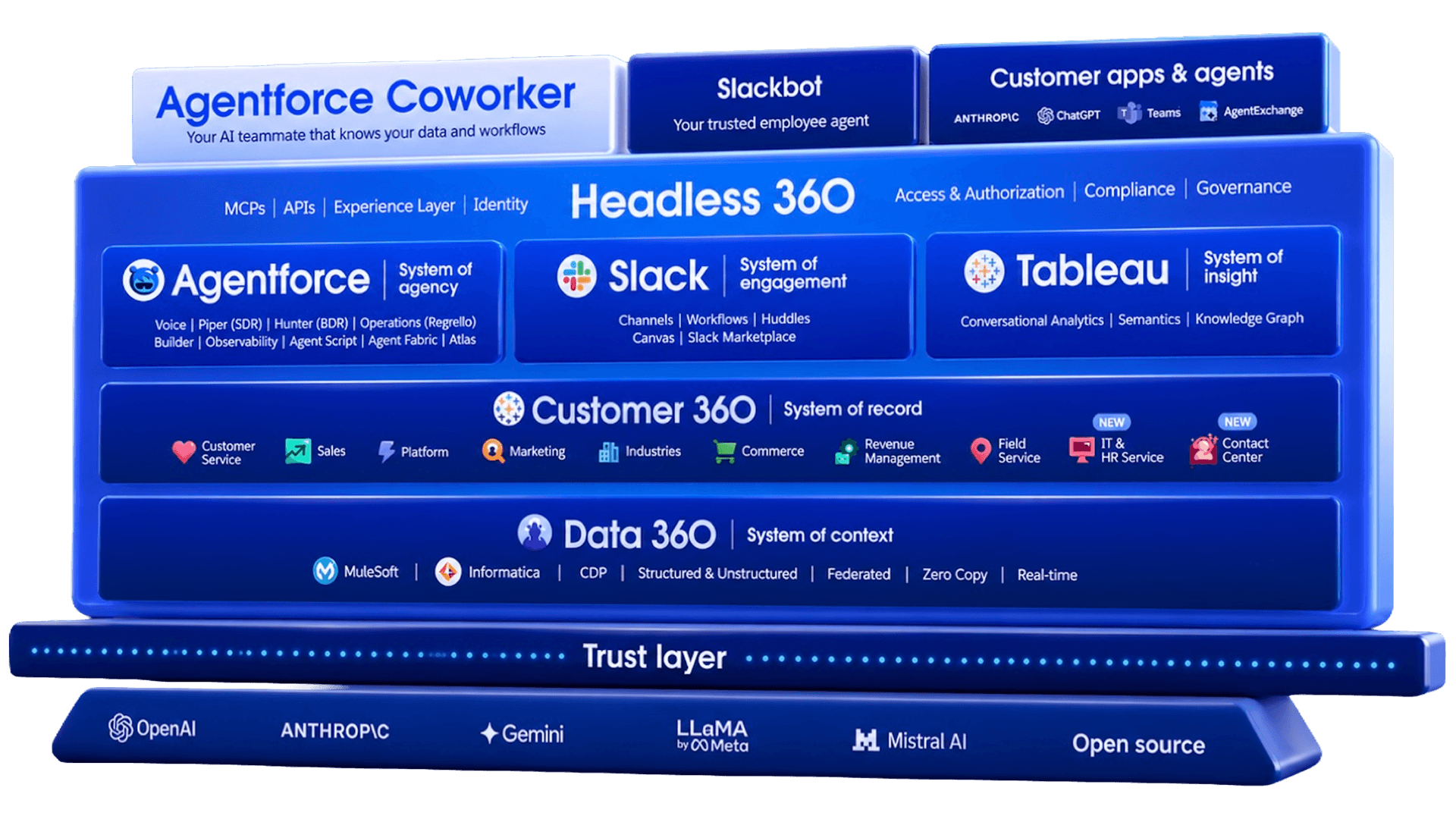
Meet Agentforce Coworker: your AI teammate everywhere. And it actually does the work.
Agentforce Coworker is Generally Available. It’s 8:47 a.m. A top-tier customer wants a custom renewal proposal — based on their case history, account data, and usage metrics — by end of day. You
What the source signals
Salesforce Blog published this item on August 4, 2026. DailyRevOps treats it as a high-signal for customer success operations and links to the original article below. The source is the factual starting point; the workflow interpretation on this page is DailyRevOps editorial analysis.
The source preview says: Agentforce Coworker is Generally Available. It’s 8:47 a.m. A top-tier customer wants a custom renewal proposal — based on their case history, account data, and usage metrics — by end of day. You
Salesforce's August 4 article introduces Agentforce Coworker as an AI teammate that can retrieve business context and then orchestrate actions from one conversation. The source says it can use opportunities, forecasts, accounts, pipeline, cases, entitlements, service history, contracts, Slack conversations, files, knowledge bases, and more than 270 connected enterprise sources. These are Salesforce's descriptions of its own product. DailyRevOps has not enabled Coworker in a Salesforce org, inspected a response, or independently tested a source connection, permission decision, agent handoff, or production action.
The article gives a concrete renewal example: review support history, account data, and usage history; check whether a discount was promised; then draft a renewal proposal. It also gives sales examples that identify slipped deals, chart dropped revenue by segment, draft prospect follow-up, summarize an opportunity, and schedule re-engagement messages. For service, it describes summarizing cases, escalating open priority cases, notifying an account owner in Slack, and drafting a customer update. For marketing, it describes finding unengaged target accounts, summarizing touchpoints, drafting a sequence, and adding people to a nurture campaign.
Salesforce says Coworker can call Agentforce agents, custom agents, CRM actions, Salesforce Flows, third-party APIs, and external systems. It also says built-in observability gives teams visibility into what is happening and why, and that the product inherits Salesforce permissions, governance, security controls, business rules, and company-defined guardrails. The source does not show the underlying audit event, approval record, retry behavior, rollback method, permission matrix, field-level write policy, or evidence trail for any of the published examples.
The source contains an important availability ambiguity. Its opening says Agentforce Coworker is generally available and that an administrator can turn it on in minutes, while its availability section says Coworker is in beta for Salesforce today and that web, Microsoft Teams, ChatGPT, Claude, and the desktop app are coming later in 2026. DailyRevOps therefore does not treat every described surface, orchestration path, or action as generally available. Operators should confirm current status, edition, region, entitlement, connected products, limits, and terms in their own org before planning a rollout.
The article quotes one customer executive who reported setup in about 20 minutes and described navigating an org with 1,300 custom objects more quickly than the prior screen-by-screen process. It also includes a statement from OneUnited Bank about replacing tab hunting with real-time insight. These are selected customer statements published by Salesforce. The source does not provide a test protocol, complete workload, comparison period, correction rate, reviewer time, security evaluation, operating cost, or measured renewal, pipeline, service, or revenue outcome.
The first review question is whether the signal changes work in Renewal and customer account evidence review, Pipeline inspection and forecast exception review, AI agent orchestration and CRM action governance, Service escalation and customer follow-up control. A headline can be relevant without being implementation-ready. Confirm the product scope, affected users, data requirements, and actual release or availability details in the original source.
Why this matters to RevOps
This matters to RevOps because Coworker is positioned between the systems that hold revenue evidence and the actions that change customer or pipeline state. A conversational request can move from reading cases, contracts, forecasts, and usage to drafting a proposal, updating a queue, scheduling a message, or invoking another agent. That is a larger operating change than adding a search box: it can compress retrieval, interpretation, approval, and execution into one interface.
The renewal example makes the control problem visible. A promised discount may appear in a call, email, Slack thread, opportunity note, quote, order, contract, or approval record. Those records do not have equal authority. A model can find relevant text without knowing whether the promise was approved, superseded, limited to a product, or attached to the correct contract. RevOps must preserve the difference between source evidence, model interpretation, draft commercial language, and an approved renewal proposal.
The same issue applies to pipeline questions. 'What deals slipped yesterday?' sounds precise, but it depends on the opportunity population, previous close-date snapshot, timezone, stage and forecast definitions, amount and currency treatment, deleted or merged records, and the time the comparison was made. A generated chart can be internally coherent while disagreeing with the governed forecast report. The useful result is an inspectable exception set, not merely a fluent answer.
Cross-agent orchestration raises the impact further. A retrieval error may waste review time; an action error can contact the wrong person, expose sensitive context, alter a live record, duplicate a task, breach a service queue, or change campaign membership. RevOps should therefore govern Coworker by action consequence and reversibility. Access to a conversation should not imply authority to run every connected Flow, API, agent, or CRM action available behind it.
Customer-success and renewal signals matter when they help a team see risk early enough to start a useful customer conversation. RevOps should focus on evidence, timing, ownership, and the next customer-facing action rather than treating a score or quiet period as a prediction.
The operating value comes from connecting account context to a repeatable review cadence. A signal that does not create a named owner, a dated action, or a clearer renewal decision is only another dashboard element.
Workflow impact
The affected workflow areas recorded for this item are Renewal and customer account evidence review, Pipeline inspection and forecast exception review, AI agent orchestration and CRM action governance, Service escalation and customer follow-up control. Relevant source and operating terms include CRM, Customer Success, AI Workflows, Renewals, AI. Use those labels to find the current owner, system, report, queue, or recurring meeting where the signal would create a decision.
Split every proposed use into six states: request, evidence retrieval, interpretation, proposed action, approval, and execution. Preserve them separately in the operating record. The request should name the business object and intended outcome. Retrieval should expose source IDs and coverage. Interpretation should show assumptions and conflicts. The proposed action should list field-level or customer-facing changes. Approval should identify a person and expiry. Execution should return the final system result and any exception.
For renewal work, start by resolving customer, account, contract, subscription, renewal opportunity, product, amount, currency, renewal date, notice deadline, commercial owner, customer-success owner, and approval authority. Then retrieve case, usage, conversation, quote, discount, and support evidence for a fixed period. A proposal may be drafted only after conflicts are visible. Sending, quote creation, discount approval, opportunity changes, and contract changes should remain separate actions with separate authority.
For pipeline inspection, freeze the eligible opportunity set and prior comparison state. Show stable opportunity IDs, owner, stage, forecast category, prior and current close date, amount, currency, last buyer-confirmed next step, last meaningful activity, and reason for the proposed exception. If Coworker calls an analytics agent to make a chart, store the underlying opportunity set, query time, filters, measure definition, and excluded records beside the chart.
For service escalation, distinguish diagnosis, routing, customer communication, and CRM updates. A case summary can remain a draft. Moving a priority case to engineering needs a valid queue and entitlement rule. Alerting an account owner requires the current owner and a permitted channel. A customer status update needs approved facts, commitment language, recipient identity, and review. One conversational turn should not hide those separate decisions.
For sales or marketing follow-up, keep audience selection and message execution apart. Confirm person and account identity, current customer or open-opportunity status, ownership, prior contact, regional and communication rules, suppression, message purpose, approved sender, and frequency before generating or scheduling outreach. A generated draft should not become permission to send, and a schedule request should not bypass an existing sequence, campaign, or account-owner control.
Use Coworker to prepare an existing operating queue rather than create an unowned parallel channel. A renewal exception belongs in the renewal review, a slipped deal in the forecast inspection, a case escalation in service operations, and a campaign action in Marketing Ops. Every accepted result needs an owner, due date, source evidence, next action, close condition, and route back to the system where the team already reconciles outcomes.
Trace the workflow from renewal date and account context through meaningful customer activity, open blockers, owner assignment, and follow-up. Confirm that commercial, customer-success, support, and implementation records can be reviewed together where the team makes renewal decisions.
Separate internal activity from customer evidence. Completed tasks, notes, and automated emails can show motion without proving that the customer replied, accepted a next step, or resolved a blocker.
What to inspect in the system of record
Use the checklist below as an inspection sequence, not as an instruction to enable a feature immediately. Capture the current state before changing fields, automation, routing, scoring, alerts, or reporting.
For each exception, save the source record, evidence, owner, due date, and expected close condition. That makes the test reviewable and prevents a promising update from becoming an unowned experiment.
Inventory every object and connected source used by the first use case. For CRM records, include stable ID, parent or account association, authoritative system, allowed readers and writers, current owner, last material update, history, and correction path. For conversations and files, include source, author or speaker, timestamp, account association, retention, classification, and effective access. For analytics, include dataset, metric definition, snapshot time, filter, and refresh state.
Inspect the invoking identity and every downstream identity separately. Record the Salesforce user, Coworker session or run, Agentforce or custom agent, Flow, API integration, service account, Slack or external user context, connected credential, tool scope, permission set, and revocation owner. Verify whether downstream actions run as the requesting user, a named integration, or broader service principal; inherited platform access is only useful when the effective identity is clear at action time.
For each proposed write, record target system, object, record ID, field or action, current value, proposed value, reason, source evidence, validation rule, approver, expected-current-value check, idempotency key, execution time, final value, history event, and rollback result. A retry must not duplicate an email, case escalation, Slack alert, task, opportunity update, quote, proposal, campaign membership, or Flow run.
Inspect source authority at field level. CRM opportunity fields may own pipeline state; a contract or subscription system may own commercial dates and terms; support owns case status; an approved usage model owns usage measures; a communication system owns delivery evidence; and Finance may own billed value. Coworker output should not convert copied conversation text or a prior AI summary into an authoritative commercial, forecast, service, or customer fact.
Test observability rather than accepting it as a label. The review should be able to reconstruct the original prompt, resolved records, source versions, agent and tool calls, policy checks, data returned, proposed action, approval or rejection, writes, retries, errors, notifications, and reversals. Confirm retention, export, access review, incident lookup, and deletion behavior for both successful and blocked attempts.
For cross-surface use, verify that the same business context does not mean broader data exposure. Salesforce, Slack, Teams, ChatGPT, Claude, web, and desktop can have different session, device, user, retention, and administrator boundaries. Because the source says several surfaces are coming later, test only a currently documented and entitled surface. Recheck identity and policy enforcement independently before adding another surface.
- Check the account owner, renewal date, health or risk reason, and next customer action on the affected accounts.
- Confirm whether the signal changes a real review cadence, such as a renewal-risk review or handoff check.
- Test the change with a small account set before relying on it for customer communication or renewal reporting.
- Ask one fixed read-only question for five representative records and verify every material statement against the linked current source record, including conflicts and missing coverage.
- Test a parent account, subsidiary, customer with two contracts, opportunity with a changed owner, restricted case, stale usage record, and promised discount without a final approval; ambiguity must stay visible.
- Compare effective results for a RevOps administrator, sales owner, customer-success manager, service user, marketer, and user without access to one relevant source; restricted data and actions must not leak through orchestration.
- Run the same approved request twice in a non-customer test and confirm that idempotency prevents duplicate messages, tasks, alerts, escalations, campaign members, proposals, opportunity writes, and downstream agent jobs.
- Remove or reduce a user's access, revoke the connected credential, expire the approval, and stop the Flow or agent; verify that new reads and writes fail and that cached context does not preserve unauthorized access.
- Reconcile one chart, renewal draft, case escalation, and scheduled follow-up to the frozen source set, approval event, final system state, customer or pipeline outcome, and rollback path.
A 15-minute operator action
Choose five records or workflow examples from Renewal and customer account evidence review. Do not start with the cleanest examples. Include at least one stale record, one ownership or data exception, and one case where the current process required manual follow-up.
Choose one read-only question tied to a recurring review, such as 'Which customer accounts have open priority cases and renewals due in the next 90 days?' Use five accounts: one clear match, one healthy account, one with conflicting renewal dates, one with restricted support evidence, and one with an identity or ownership exception. Record the eligible population, source IDs, time window, answer, unsupported claim, omission, reviewer correction, and accepted next action for each.
Then create a one-page action contract before enabling any write. Name the allowed object, fields or action, prohibited actions, invoking and executing identities, required evidence, validation, approver, approval expiry, idempotency key, volume limit, audit event, stop threshold, rollback owner, and review date. Keep customer-facing drafts, scheduling, CRM writes, campaign actions, case routing, and commercial proposal changes disabled until the read-only review is reconstructable and access tests pass.
Write down the trigger, source evidence, current owner, next action, due date, and expected outcome for each example. Then ask whether the source signal would make one of those fields clearer, reduce a manual step, or surface an exception earlier.
If the answer is yes, define one bounded test with a process owner and rollback path. If the answer is unclear, keep the item on a monitored list and wait for stronger documentation, product access, or a more concrete operating problem.
Risks and limits
Missing CRM activity is not proof of churn risk. Conversations may exist outside the system, and some healthy accounts need fewer interactions. Use the signal to trigger review, not to label the customer without evidence.
Avoid adding more health fields or alerts before defining who acts, how false positives are closed, and which source record explains the exception.
Salesforce is promoting its own product and selected examples. The article demonstrates intended workflows, not independently measured reliability or business impact. The customer quotes do not establish source completeness, output accuracy, permission correctness, correction effort, cost, or transferable results for another org.
The article's generally-available language and beta availability statement do not align cleanly. It also describes external surfaces while saying several are coming later in 2026. Availability may differ by org, release state, geography, contract, product connection, or documentation date. Do not design a production dependency from the headline or setup toggle alone.
Connected context can be incomplete, stale, duplicated, or wrongly associated. Account hierarchies, merged contacts, parallel opportunities, several contracts, copied Slack discussions, old files, unsupported channels, and restricted cases can all produce a persuasive but incorrect view. Require visible coverage and conflicts rather than assuming that more connected sources equal complete truth.
Agent orchestration can widen blast radius. A broad service identity or permissive Flow can let a simple prompt create commercial, customer-facing, campaign, pipeline, or support changes beyond the user's intended scope. Use least privilege, deny by default, action-specific approval, low limits, expiry, idempotency, and tested revocation. Do not rely on the model to decide when a business action is sensitive.
Generated output can create circular evidence. If a Coworker summary or draft is written back to Salesforce and later retrieved as enterprise context, a later answer may treat the prior inference as an independent source. Label generated material, preserve original records, restrict authoritative writes, and exclude derived duplicates from analytics and future evidence sets.
Faster work can shift rather than remove operating cost. Review time, false exceptions, permission administration, integration maintenance, agent consumption, monitoring, incident response, and cleanup all belong in the evaluation. Do not claim renewal, pipeline, service, or productivity improvement without a stable prior process, defined denominator, comparable period, and accepted downstream outcome.
DailyRevOps does not treat a source announcement as proof of revenue impact. Outcomes depend on process design, data quality, adoption, manager behavior, customer context, and the baseline used for comparison.
Decision and follow-up
A production change should have a named owner, a narrow scope, a documented current state, a success measure, and a way to reverse the change. The owner should also define when the team will review the result and which evidence will decide whether to keep, expand, change, or stop the test.
Approve a bounded Coworker pilot only for one named review problem with current product entitlement, a fixed record population, verified source connections, least-privilege identities, visible citations or record links, a reviewer, an audit route, success measures, stop conditions, and rollback ownership. Start with read-only retrieval inside Salesforce. A setup toggle is not approval for production action.
Move from retrieval to internal drafting only when representative records show correct identity, sufficient source coverage, visible uncertainty, and acceptable correction effort. Move from drafting to one reversible write only after action-specific permission, expected-current-value checks, validation, idempotency, approval expiry, logging, revocation, and rollback pass. Do not add a new surface, broader data, and greater action authority in the same test.
Review after one complete renewal, forecast, service, or campaign operating cycle. Keep the workflow if operators spend less time finding evidence while more decisions have traceable sources, correct owners, dated actions, and reconciled outcomes. Narrow or stop it when important claims cannot be traced, access differs from policy, writes duplicate or bypass approval, correction effort stays high, or the team cannot reconstruct and reverse an action. Recheck whenever Salesforce changes release status, connected sources, external surfaces, agent behavior, permissions, limits, or pricing.
Track time from signal to owner action, renewal records with a dated next step, unresolved blocker age, missing conversation evidence, and exceptions closed with a documented outcome.
Review whether the workflow creates earlier customer contact and clearer ownership. Do not claim retention impact until the team has enough clean, comparable operating data.
Keep the original source attached to the decision record. If later documentation changes the product scope or operating assumption, the team should be able to trace why the test was started and which version of the source information informed it.
Original source
This DailyRevOps article is written in our own words from the source signal and adds RevOps context, workflow analysis, and operator interpretation.
- Original source: Salesforce Blog
- Original publication date:
- Source link: Read the original article