3 Ways to Connect Agentforce Agents and Slackbot to External MCP Servers
Design authentication and authorization to allow Agentforce agents and Slackbot to connect to external systems outside your Salesforce org.
What the source signals
Salesforce Blog published this item on July 28, 2026. DailyRevOps treats it as a medium-signal for crm operations and links to the original article below. The source is the factual starting point; the workflow interpretation on this page is DailyRevOps editorial analysis.
The source preview says: Design authentication and authorization to allow Agentforce agents and Slackbot to connect to external systems outside your Salesforce org.
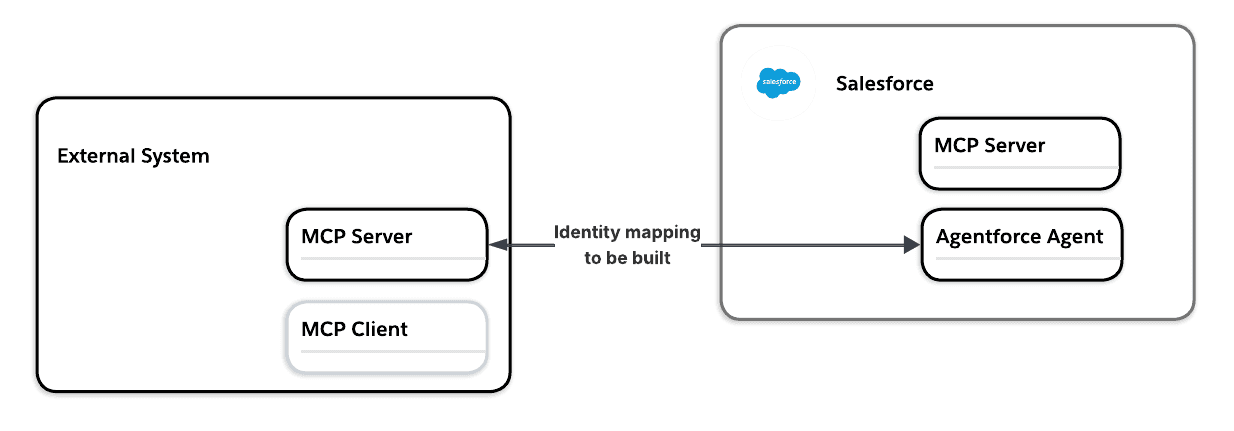
Salesforce describes three connection designs. In the first, an Agentforce agent connects to an external MCP server and can combine Salesforce context with external context in one reasoning chain. In the second, Slackbot connects directly to an external MCP server for a Slack-native task that does not need Salesforce context. In the third, Slackbot calls selected Agentforce subagents while Agentforce manages the external MCP connection. These are architecture options from Salesforce's own article, not proof that any design is enabled, licensed, suitable, or correctly configured in a reader's environment.
For an authenticated Agentforce-to-MCP connection, the source says the external server must support OAuth 2.0. It tells architects to verify the grant types exposed by that specific MCP server: authorization code for a per-user path or client credentials for a service-account path. With a Salesforce per-user setup, the article describes a named credential and external credential using a Per-User Principal, a one-time user consent flow, and a separate stored token for each user. The external system then applies its own permissions. A Salesforce permission review therefore does not establish what that person can read or do in Docusign, Snowflake, a contract system, or another external service.
For the native Slack path, Salesforce says the Slackbot MCP client is generally available and read-only by default. The article describes an app manifest with the mcp:connect OAuth scope, administrator approval of requested MCP server domains, and user OAuth. It also says write and delete tools require explicit confirmation for each action. At the time of the source, however, app access is described as all users with app access or none; narrower controls by user, group, or role had not shipped. Availability, partner count, default behavior, and control limits are source claims that operators should confirm in current product documentation and their own tenant.
The source treats a service-account connection as a shared boundary because every call resolves to one credential regardless of the person invoking the agent. It also warns that per-user OAuth inherits the external user's access rather than narrowing it automatically, and that a stored token may remain valid after a role change, permission change, or offboarding event unless revocation is designed. DailyRevOps has not tested Agentforce Registry, Agent Builder, Slackbot, an MCP server, the OAuth discovery response, token storage, confirmation behavior, audit events, or deprovisioning in a production environment.
The first review question is whether the signal changes work in CRM data quality and reporting, AI-assisted operator workflows, Pipeline inspection and forecasting, Tool administration and implementation. A headline can be relevant without being implementation-ready. Confirm the product scope, affected users, data requirements, and actual release or availability details in the original source.
Why this matters to RevOps
This is a direct RevOps signal because an external tool call can join CRM evidence with contract, document, warehouse, support, product, billing, or communication data. The source's forecast example is concrete: close date and forecast category in Salesforce may need to be weighed with contract redline history outside Salesforce. That can improve inspection, but it also gives an agent a path across two authorization models. RevOps must know whether the output is a read-only summary, a recommendation, a generated document, or a production write before treating the connector as one workflow.
Identity propagation is not the same as least privilege. A per-user flow can preserve who initiated a request, yet the agent may inherit an external entitlement that was already too broad. A service account can be deliberately narrow, yet it can also expose the same shared authority to every eligible invoker. Tool assignment adds another boundary, but it does not correct an over-privileged source account. The control must be evaluated as a chain: human or service identity, OAuth grant, stored token, external permissions, MCP tools, agent instructions, confirmation, target record, and audit evidence.
The system-of-record risk is equally important. An agent can combine a correct Salesforce field with stale or misassociated external content and still produce a confident answer. A contract file may belong to another account, a redline may be superseded, a forecast category may have changed after the retrieval, or a Slack user may map to the wrong Salesforce identity. The useful operating design keeps stable record identifiers, source timestamps, access decisions, and the final human action visible so the team can distinguish retrieved facts from model interpretation.
CRM changes matter when they alter the record model, ownership, routing, automation, or reporting logic that revenue teams use every day. RevOps should translate the source signal into a concrete question about which object, field, workflow, or user action could change.
The useful test is not whether a feature sounds modern. It is whether the change reduces manual work or improves evidence without weakening the CRM as the system of record. Adoption, permissions, data history, and rollback should be considered before a production rollout.
Workflow impact
The affected workflow areas recorded for this item are CRM data quality and reporting, AI-assisted operator workflows, Pipeline inspection and forecasting, Tool administration and implementation. Relevant source and operating terms include CRM, AI Workflows, Salesforce. Use those labels to find the current owner, system, report, queue, or recurring meeting where the signal would create a decision.
Start with a single decision and draw the shortest justified route. If a task is entirely Slack-native and does not need CRM context, routing it through Salesforce adds identity, availability, and audit dependencies without improving the answer. If the task needs Salesforce and external evidence in one decision, document why Agentforce is the reasoning layer and which fields and tools are necessary. If Slackbot delegates to an Agentforce subagent, record both identity transitions rather than treating the intermediate agent as an invisible implementation detail.
For a forecast-risk pilot, define a read-only input contract. The Salesforce side might include opportunity ID, account ID, owner, amount, close date, stage, forecast category, last meaningful activity, buyer-confirmed next step, and last-modified timestamp. The external side might include contract ID, account or opportunity association, redline count, redline dates, open clause owners, document status, and last-modified timestamp. The agent should cite those records and surface conflicts; it should not silently change the forecast category or contract state.
Choose per-user or service-account authentication from the authorization requirement, not from setup convenience. Per-user access fits when the external action should reflect the invoking person's existing entitlement and when external entitlements are governed. A service account fits only when every allowed invoker may use the exact same bounded data and action surface. Split read and write capabilities where possible. Do not use one broad credential for research, document creation, deletion, and CRM updates merely because one connection is easier to maintain.
Put production writes behind a separate decision contract. Define the permitted tool, object, fields, validation rules, confirmation text, approver, idempotency key, expected current state, request and response IDs, timeout behavior, retry limit, partial-failure handling, and rollback. A confirmation click is not sufficient if it does not show the specific account, record, action, old value, proposed value, and external evidence that caused the recommendation.
Map the signal to the current CRM flow from record creation through enrichment, assignment, stage movement, task creation, and reporting. A change in one step can create hidden effects in another, especially when several automations write to the same field or owner property.
Compare the proposed workflow with the manual path operators use today. If the new path cannot explain why a record changed, who owns the next action, and where the source evidence lives, the automation is not ready for broad use.
What to inspect in the system of record
Use the checklist below as an inspection sequence, not as an instruction to enable a feature immediately. Capture the current state before changing fields, automation, routing, scoring, alerts, or reporting.
For each exception, save the source record, evidence, owner, due date, and expected close condition. That makes the test reviewable and prevents a promising update from becoming an unowned experiment.
Inspect the Salesforce user, Slack user, integration user, service account, named credential, external credential, OAuth client, token owner, Agentforce agent, subagent, MCP server, exposed tool, and external-system account as separate records in the control inventory. For each, capture a stable identifier, business owner, technical owner, environment, authentication mode, scopes, permissions, last review, last use, expiration or rotation rule, and revocation path. A friendly display name is not enough to reconcile identities during an incident or access review.
For the revenue workflow, inspect the account, contact, opportunity, activity, task, forecast entry, quote, contract, document, case, and any custom object touched by the agent. Record which system is authoritative for each field and which integrations can write it. Confirm the association keys between Salesforce and the external system, especially when one account has several opportunities, contracts, subsidiaries, or workspaces. Do not let name similarity stand in for a verified record link.
Retain evidence for every material call: invoking identity, resolved Salesforce identity, external identity or service credential, agent and version, tool name, arguments, source record IDs, source modification times, permission decision, confirmation event, result, error, write-back, and correlation ID. Log sensitive payloads according to the company's security and retention rules rather than copying full customer or contract content into an unrestricted audit store. The goal is reproducibility without creating a second uncontrolled data leak.
Inspect deprovisioning across both sides. Test what happens when a Slack account is disabled, a Salesforce user is frozen, an external entitlement is removed, an Agentforce tool grant changes, an OAuth client secret rotates, or a stored user token should be revoked. The source explicitly warns that an old token may remain live. A complete offboarding ticket should therefore close the credential path, not only remove the employee from one application directory.
- Name the affected CRM object before making a change: contact, company, deal, ticket, or a custom record.
- Check the current owner, lifecycle or stage, next step, and reporting field before changing a sync, workflow, or routing rule.
- Keep the CRM as the source of truth and assign a process owner plus a rollback path for any production change.
- Read the MCP server's authorization discovery response and record the supported grant types; do not infer per-user support from the underlying product alone.
- Reconcile one Slack user to the intended Salesforce user and external-system account using immutable identifiers, then compare their effective permissions with the approved workflow scope.
- List every exposed MCP tool and mark it read, create, update, delete, send, approve, or administer; remove or hold any tool that is not needed for the bounded pilot.
- Run a read-only request against one known opportunity and external contract, then verify account and opportunity associations, source timestamps, cited evidence, and the absence of unintended writes.
- Test denied access, a stale token, an expired token, a missing external account, a mismatched record, a timeout, and a partial response; confirm that the agent stops safely and does not fill gaps with unsupported output.
- Simulate a role change or offboarding event and prove that the stored credential can no longer invoke the external tool; retain the revocation event and follow-up owner.
- For any proposed write, verify that the confirmation shows the exact record, current value, new value, evidence, and consequence, and that a duplicate request cannot repeat the action.
A 15-minute operator action
Choose five records or workflow examples from CRM data quality and reporting. Do not start with the cleanest examples. Include at least one stale record, one ownership or data exception, and one case where the current process required manual follow-up.
Use 15 minutes to choose one current agent or integration proposal and write an identity chain on one line: invoking person, Slack identity if used, Salesforce identity, agent or subagent, OAuth grant, stored credential, MCP server, external identity, exposed tool, target record, and audit destination. Mark every step where the owner, scope, or revocation behavior is unknown. Do not connect a production server during this review.
Then select the smallest unknown with the highest impact. If it is authorization, inspect the external entitlement and OAuth discovery metadata. If it is record integrity, reconcile one CRM record to one external record. If it is action risk, remove write tools from the pilot and keep the first test read-only. Assign one owner and decision date to the gap rather than opening a broad agent-governance project with no close condition.
Write down the trigger, source evidence, current owner, next action, due date, and expected outcome for each example. Then ask whether the source signal would make one of those fields clearer, reduce a manual step, or surface an exception earlier.
If the answer is yes, define one bounded test with a process owner and rollback path. If the answer is unclear, keep the item on a monitored list and wait for stronger documentation, product access, or a more concrete operating problem.
Risks and limits
The main risks are silent overwrites, duplicate automation, changed permissions, broken routing, and reports that continue to look correct while the underlying definitions have shifted.
A vendor announcement or source article does not prove that the capability fits the current portal, edition, data model, or operating cadence. Confirm availability and test behavior in a controlled environment.
The article is Salesforce architecture guidance about Salesforce and Slack products. It is not an independent security evaluation, penetration test, implementation benchmark, or guarantee that the described controls prevent data exposure or incorrect action. It does not publish a tested tenant configuration, full edition and pricing matrix, audit-event schema, token lifetime, revocation latency, failure-rate study, or production outcome from a RevOps deployment.
A per-user design can fail open operationally even when OAuth works correctly. Users may be over-privileged in the external system, shared accounts may obscure identity, account matching may be wrong, and authorization changes may lag behind employment or role changes. Conversely, a service account can become a powerful shared principal whose activity is difficult to attribute and whose secret creates a broad failure radius.
Agent reasoning can combine individually authorized facts into a conclusion the user should not receive or act on. Contract language, support details, pricing, personal data, and forecast evidence may be permitted in their source applications yet inappropriate to summarize into a broad Slack channel or CRM note. Review output destination, channel membership, retention, and secondary use as well as source access.
Confirmation and read-only defaults reduce risk but do not remove it. A user can approve the wrong record, a tool description can be misleading, a read can expose sensitive data, and a retry can duplicate a write. Granular Slack app access was not available according to the source, so a team that needs a narrow pilot group must enforce the boundary elsewhere or wait rather than represent app approval as user-level scoping.
Architecture and product behavior can change after publication. Operators should recheck current Salesforce, Slack, external-system, and MCP documentation before implementation. DailyRevOps' checklist is an operating interpretation, not a substitute for security, privacy, legal, or platform-owner approval in the reader's organization.
DailyRevOps does not treat a source announcement as proof of revenue impact. Outcomes depend on process design, data quality, adoption, manager behavior, customer context, and the baseline used for comparison.
Decision and follow-up
A production change should have a named owner, a narrow scope, a documented current state, a success measure, and a way to reverse the change. The owner should also define when the team will review the result and which evidence will decide whether to keep, expand, change, or stop the test.
Approve a read-only pilot only when the business decision is named, the shortest connection route is justified, identities reconcile across systems, external entitlements match the intended audience, exposed tools are minimal, source records are linked by stable IDs, failures stop safely, and logs show who retrieved which evidence. Keep a separate human decision for forecast, contract, customer, access, and other commercially material outcomes.
Approve write capability later and separately. Require narrow fields and actions, explicit record-level confirmation, least-privilege credentials, idempotency, precondition checks, complete response logging, a tested correction or rollback route, and a deprovisioning test. Reject a service-account write path when any eligible invoker should not have the same authority. Reject a per-user path when the external entitlements cannot be audited or token revocation cannot be proved.
After one operating cycle, compare successful identity resolution, denied requests, mismatched associations, stale-token findings, unsupported outputs, confirmations, corrections, duplicate attempts, review time, and operator effort with the manual path. Expand only if the connection makes evidence easier to inspect without broadening access or weakening record authority. Pause when the team cannot explain the identity chain, external permissions, source association, or final write from the retained audit record.
Track exception volume, manual corrections, ownership accuracy, time to next action, and the number of records that require rollback or cleanup.
Review the result after one operating cycle. Keep the change only if operators can explain the record history and the workflow produces clearer action with less rework.
Keep the original source attached to the decision record. If later documentation changes the product scope or operating assumption, the team should be able to trace why the test was started and which version of the source information informed it.
Original source
This DailyRevOps article is written in our own words from the source signal and adds RevOps context, workflow analysis, and operator interpretation.
- Original source: Salesforce Blog
- Original publication date:
- Source link: Read the original article