Short verdict
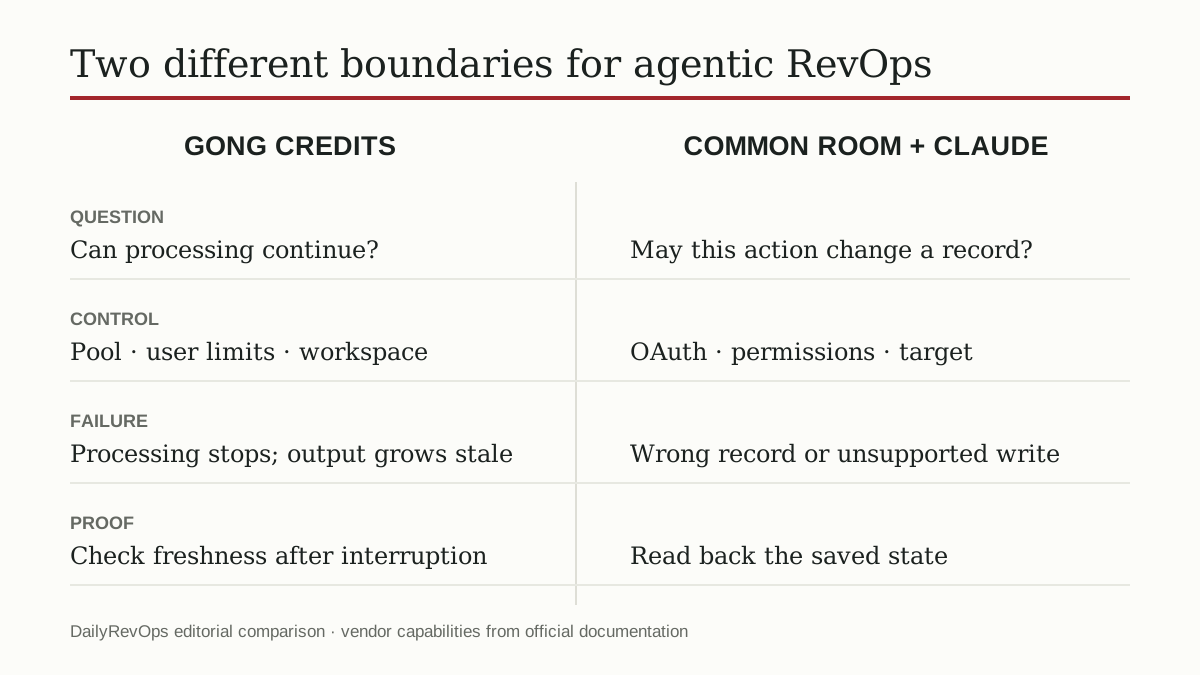
These are different control surfaces. Gong's credit model answers how constrained AI-processing capacity is distributed and what stops when it is exhausted. Common Room's Claude integration answers how an external conversational interface can query and update buyer-intelligence records. Teams should govern the first through usage allocation and freshness, and the second through identity, permission, action preview and destination verification.
This comparison is written for RevOps, Sales Ops, GTM Operations, and Customer Success Ops teams that need a practical decision framework. It focuses on workflow ownership, CRM data quality, implementation effort, source-of-truth behavior, and the operating rhythm each option supports.
Who each option is best for
Gong's controls fit teams managing shared AI-processing capacity across Gong features. Common Room's Claude connector and plugin fit teams that want buyer-intelligence research and workspace actions inside Claude while preserving enterprise authentication and workspace authority.
The right answer depends on the job the team is trying to improve. A tool that is strong for one operating model can be a poor fit when the real problem is ownership, dirty CRM data, missing renewal dates, weak handoffs, or an unclear forecast process. Use this page to map the workflow before treating either option as the default.
Operating questions before choosing
- Which recurring meeting or workflow will change if the team chooses Gong credit controls or Common Room Claude integration?
- Which CRM records, fields, activities, or customer signals are required for the workflow to be trusted?
- Who owns the next action when the system surfaces a risk, alert, forecast change, or customer signal?
- Does the option write usable context back to the system of record, or does it create another place to inspect?
- What manual review work should decrease after implementation?
Side-by-side table
| Criterion | Gong credit controls | Common Room Claude integration | Editorial note |
|---|---|---|---|
| Primary boundary | Shared AI-processing capacity | Conversational access to Common Room data and actions | Resource governance and action governance solve different problems. |
| Admin control | Shared pool, thresholds, monthly user limits and workspace allocation | Enterprise authentication plus Common Room workspace permissions | Both need a named business owner beyond the platform admin. |
| User action | Selected credit-based features initiated by users consume from available capacity | Claude can research accounts, log activities, create contacts and update segments | User intent should remain attributable. |
| Background behavior | Some automated features consume from the shared pool outside individual monthly limits | Connector/plugin behavior depends on user prompts and supported commands | Separate scheduled consumption from interactive use. |
| Failure mode | Processing can stop and dependent output can become stale when credits are exhausted | A request can target the wrong record or attempt an action outside policy | Design separate recovery paths. |
| Freshness question | When was the credit-based evidence last processed? | What source and record state did Claude use for this action? | Time and provenance are part of correctness. |
| Write boundary | Credits themselves do not define business write authority | The integration can create and update workspace records | Usage entitlement is not action permission. |
| Verification | Confirm dependent outputs are current after capacity interruptions | Read the workspace or downstream system after material mutations | A completed interaction is not enough. |
| Best metric | Usage per verified business outcome inside a named workflow | Verified actions and rework by command type | Avoid raw activity as a value claim. |
| Pilot | One feature with known consumption, stop behavior and owner | One bounded research-to-write workflow with test records | Start where every result can be inspected. |
Workflow comparison
- Map the exact business workflow before enabling either control surface.
- For Gong, identify which selected features consume credits and which downstream decisions depend on their freshness.
- Set shared, workspace and user controls according to real ownership rather than distributing capacity evenly by default.
- For Common Room, separate read-only research from record-creating or record-updating commands.
- Use stable business IDs and preserve the initiating identity for each material action.
- Test one exhausted-capacity case and one denied or ambiguous action before production expansion.
- Verify final business state independently of the chat or agent completion message.
- Review usage, exceptions and rework by workflow rather than by vendor-wide totals.
A RevOps workflow should produce a visible action, not only a report. When comparing Gong credit controls and Common Room Claude integration, the team should look at the handoff from signal to owner to customer action. If the output does not change a task, meeting, field, renewal follow-up, forecast inspection, or manager review, the tool may become another dashboard rather than operating leverage.
Implementation complexity
Medium: both become operational controls only when RevOps maps them to business workflows. The real complexity depends on data quality, ownership clarity, and whether the team changes its operating rhythm.
Implementation should start with source fields, permissions, integration points, and the review process. The most common failure is buying a tool before defining the workflow. A narrow pilot is usually safer than a full rollout because it reveals bad CRM fields, unclear owners, duplicate definitions, and gaps between the tool and the team operating cadence.
Data and CRM requirements
Reliable RevOps decisions need clean CRM data. Before choosing between Gong credit controls and Common Room Claude integration, check owner fields, lifecycle stage, account and opportunity status, renewal or close dates, activity history, task ownership, and the fields that drive routing or reporting. If these fields are not trusted, the comparison should include a data cleanup step.
- Define the system of record for the workflow.
- List the fields that trigger action or reporting.
- Decide which fields can be written automatically and which need review.
- Document what evidence an operator should inspect before acting.
- Measure whether the workflow reduces missed follow-up or manual reconciliation.
Data model impact
- Gong usage records should be connected to the feature, workspace, initiating user where applicable and the business workflow that depends on the processed data.
- Common Room actions should preserve the workspace record ID, object type, source evidence and command or workflow version that led to a mutation.
- Keep usage metadata separate from customer or account truth; credits consumed do not become a CRM field or business outcome.
- Store freshness timestamps for AI-derived evidence that can stop updating when a capacity limit is reached.
CRM fields and signals to check
- Stable account/contact/deal ID
- Workspace or team ID
- Initiating user
- Feature or command
- Usage consumed
- Source timestamp
- Proposed action
- Current value
- Final value
- Verification timestamp
- Exception owner
Cost and maintenance considerations
Gong publishes a credit model for selected advanced AI processing, including shared default and purchased credits and current consumption rules. Common Room's connector and plugin availability depends on its commercial packaging and the connected Claude environment. Do not compare headline units directly. Model the actual entitlement, workflow volume, admin effort and rework in the target accounts.
Cost should include licenses, setup time, admin maintenance, integration work, enablement, governance, and the opportunity cost of manual review. A cheaper workflow can become expensive if it requires weekly spreadsheet cleanup. A larger platform can become expensive if the team only uses a narrow part of it. RevOps should compare total operating cost, not only subscription price.
Risks and limitations
- Treating credit availability as permission to execute a high-impact business action.
- Treating a user limit as complete protection while shared background processing continues.
- Allowing a natural-language interface to create or update records without a stable target identity.
- Continuing downstream decisions on stale output after credit-based processing stops.
- Using vendor activity counts as a productivity benchmark without independent outcome verification.
The main risk in any RevOps tool comparison is overgeneralizing. No tool is universally best. The fit depends on company stage, CRM maturity, sales motion, renewal volume, customer success model, admin capacity, and how disciplined the team is about acting on signals.
Implementation risk
- Test low-balance and exhausted-pool behavior before critical teams depend on credit-based outputs.
- Test Common Room with duplicates, missing identifiers, similar account names and denied actions before allowing broader writes.
- Confirm authentication and permissions with a representative non-admin identity.
- Review the destination after a successful mutation and record the before-and-after state.
Governance risk
- Assign an owner to every recurring credit-consuming workflow and every mutation-capable conversational integration.
- Review vendor packaging and documentation when limits or feature behavior change.
- Keep a fallback for stale or unavailable evidence and a separate fallback for denied or ambiguous actions.
- Do not infer business ROI from consumption, chat volume or completion counts alone.
Alternatives and complements
- A deterministic CRM workflow may be simpler when the action can be expressed as a fixed rule with no agent interpretation.
- A read-only Common Room query can be the right pilot when the team wants conversational research before enabling mutation.
- Gong's normal interface can remain appropriate for manual analysis when automated processing is not required.
- A lightweight usage and exception register can connect both systems to the weekly RevOps review without creating another source of customer truth.
Weekly operating rhythm
- Monday: inspect shared usage, upcoming limits and any workflows depending on near-exhausted capacity.
- Midweek: sample Common Room mutations and reconcile them with target records.
- Friday: review stale-output holds, denied actions, rework and largest usage drivers.
- Monthly: adjust limits, retire unused workflows and retest any materially changed action scope.
Decision framework
- Use Gong credit controls when the operational problem is allocating and monitoring Gong's metered AI-processing capacity.
- Use Common Room's Claude connector or plugin when the operational problem is bringing buyer-intelligence research and bounded workspace actions into Claude.
- Use both only if their workflows genuinely intersect and the organization documents which system owns evidence, actions and verification.
- Keep the workflow manual or read-only when target identity, action authority or fallback behavior is not yet reliable.
- Expand after sampled production work can be reconstructed from source through action to verified state.
If the team cannot name the owner, source field, review cadence, and next action, pause the purchase and map the workflow first. Strong RevOps teams buy tools to close a defined operating gap. They do not use tools to discover the process after the contract is signed.
FAQ
Are these products alternatives?
No. Gong credit controls govern capacity inside Gong, while Common Room's Claude integration exposes Common Room research and actions through another interface.
Which control matters most?
For Gong, usage and freshness are central. For Common Room, identity, permission and post-write verification are central. A production workflow may need both kinds of control.
Can raw credit consumption be compared with Claude actions?
No. They are different units with different commercial and technical meanings. Compare each to a locally defined verified business outcome instead.
Source notes
These official references support the product and workflow context. DailyRevOps uses them to bound the comparison, not to imply outcomes, rankings, or adoption claims.
- Gong: About Gong credits: Official documentation updated September 27, 2026.
- Common Room: Claude Connector & Plugin: Official guide updated September 23, 2026.
Last updated: 2026-09-28