Problem
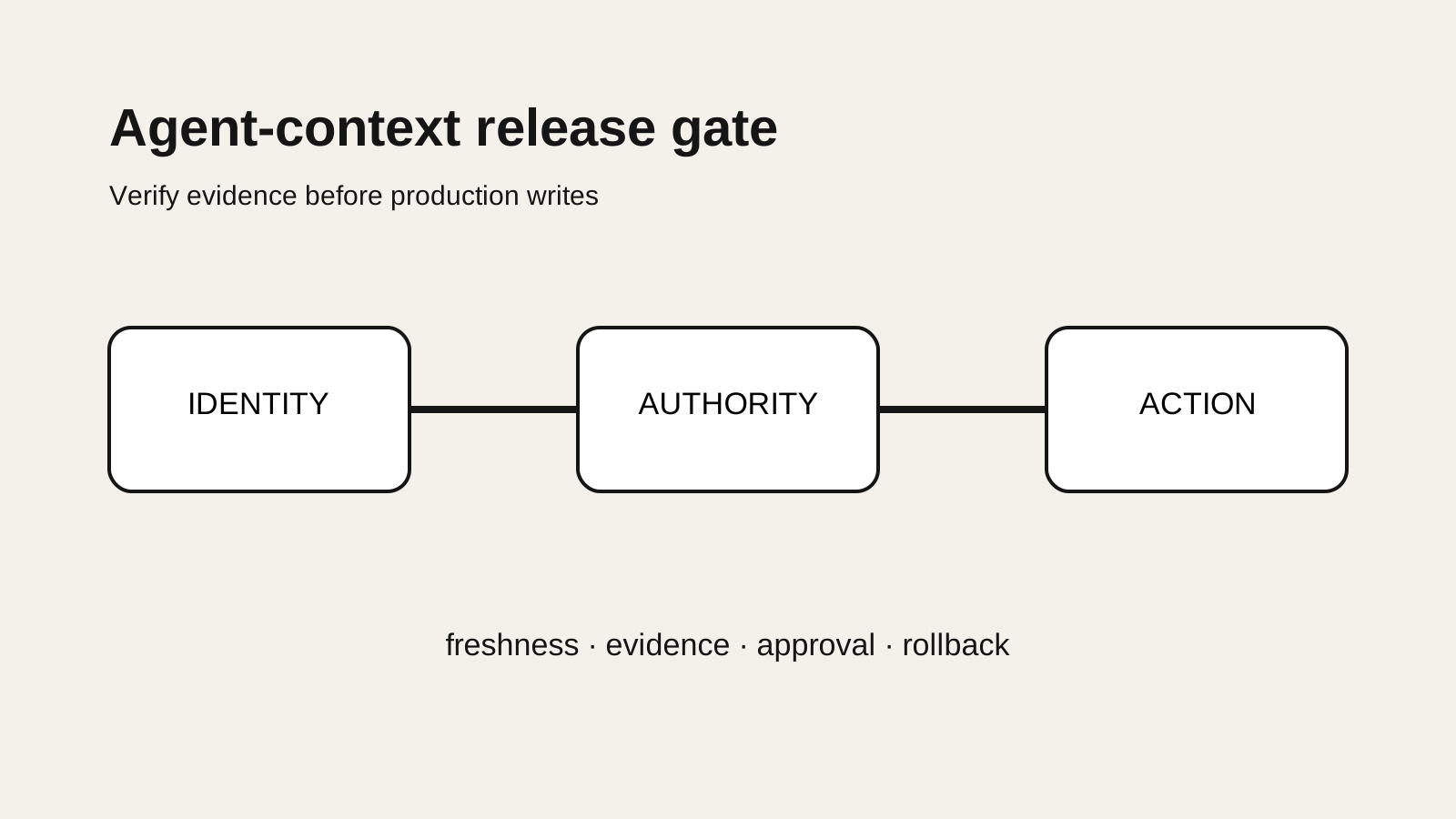
An agent can retrieve plausible customer context and still act on the wrong account, stale state, incomplete evidence or a field that another system owns. The failure becomes harder to investigate when retrieval, reasoning and execution happen in one conversational surface.
Why it matters
Gainsight's new Agentforce integration, HubSpot's Agent Hub direction and the broader move toward MCP-connected business systems all shorten the path from customer context to action. RevOps needs a small, repeatable release gate that proves the source, record identity, current state and action authority before writes are enabled.
1. Name one decision boundary
Choose one agent job and write the business decision in a sentence. Good examples are propose a renewal follow-up task when the current customer record has no next meeting, or draft an internal account-risk summary from approved customer signals. Avoid broad goals such as improve retention or automate sales.
Name the human or policy that owns the decision today. The agent can prepare evidence or execute a pre-approved rule, but it should not inherit authority simply because it can access the data.
2. Build the context contract
List each required fact, its authoritative system, stable record ID, allowed freshness, fallback and conflict rule. Include identity, owner, commercial timing, consent where relevant and the source evidence needed for the proposed action.
Separate optional context from blocking context. If the agent cannot verify a customer identity, binding date, permission or current state that the action depends on, the correct result is an exception, not a guessed value.
3. Test read-only retrieval
Use a representative sample that includes clean, duplicate, stale, incomplete, permission-limited and recently changed records. Compare agent-visible context with source systems and keep a mismatch log.
Do not measure success by whether the agent produces a fluent answer. Measure whether the right record was retrieved, required facts were present, timestamps were acceptable and unknowns remained unknown.
4. Add one reversible action
Choose a write that can be safely reversed, such as creating a tagged internal task on test accounts. Show the target record, current value, proposed action and evidence immediately before approval or policy execution.
Verify the destination after execution. Retry once using the same execution key and confirm that the system prevents duplicate business actions even if transport retries occur.
5. Force changed-state and failure cases
Change the source record after the proposal but before execution. The workflow should re-read material state or reject the stale proposal. Then test timeout, unavailable source, ambiguous identity, permission denial and destination failure.
Define which failures can degrade to an informational response and which must stop. Customer messaging, commercial terms, consent, billing and irreversible record changes should have the strictest current-state requirements.
6. Approve, monitor and revoke
Approve only the named record population, action type and identity. Store the release version, owner, monitoring query, exception queue and emergency stop path.
After one operating cycle, review successful actions and denials together. A high success rate can still hide wrong-record writes; a high denial rate can show that prerequisites or permission scope are poorly designed.
Step-by-step workflow
- Write the single business decision and current human or policy owner.
- List authoritative systems, stable IDs, required fields, freshness rules and conflict behavior.
- Create representative clean and failure-case records.
- Run the workflow read-only and reconcile every required fact with its source.
- Enable one reversible write on test or explicitly approved records.
- Capture current state, proposal, evidence, approval or policy and execution identity.
- Retry the same action and prove duplicate prevention.
- Change material state between proposal and execution and require revalidation.
- Test timeout, missing source, ambiguous identity, permission denial and destination failure.
- Document monitoring, exception ownership, rollback and emergency revocation before wider rollout.
CRM fields and signals needed
- Source system, source object, stable record ID, association ID and fetched-at timestamp
- Customer or account identity, current owner, source authority and conflict state
- Material commercial, support, billing, consent, usage or lifecycle fields required by the decision
- Agent version, instruction version, connected tool, effective identity and action scope
- Prior value, proposed value, approver or policy, execution ID, destination result and rollback state
Common mistakes
- Treating a fluent answer as proof that the correct record and current state were used.
- Using one broad service identity for unrelated read and write actions.
- Letting the agent resolve conflicting source systems without an authority rule.
- Approving an action without rechecking material state before execution.
- Testing success paths but not retries, duplicate prevention, denial and revocation.
- Keeping the only audit evidence inside a chat thread.
Example operating rhythm
- Before launch: complete read-only and failure-case reconciliation.
- Daily during the first production week: inspect writes, denials, stale-context exceptions and wrong-record near misses.
- After any prompt, workflow, permission, connector or schema change: rerun the representative test set.
- Monthly: review action scope, unused permissions, source freshness and exception reasons.
- After an incident: revoke first, reconcile affected actions, then reopen only after the failed control is tested.
Tooling options
- Use the CRM for stable business record IDs and final action history.
- Use source systems for the facts they author rather than copying every field into an agent prompt.
- Use Agent Hub, Agentforce or another agent surface only within the documented context and action contract.
- Use an exception queue that exposes missing identity, stale data, permission denial and conflicting authority.
- Keep versioned release evidence outside transient chat history.
Source notes
These sources support the workflow model and product concepts. They do not prove a specific business outcome, benchmark result, or vendor claim.
- HubSpot Agent Hub session: Official HubSpot UNBOUND description of Agent Hub and Agent Builder.
- HubSpot Agent Hub workflow documentation: Official HubSpot documentation for building workflow triggers and actions with Breeze Assistant.
- Gainsight Agentforce integration announcement: Official Gainsight announcement describing customer context surfaced into Agentforce and Slack.
Last updated: 2026-09-16
Decision frameworks to read next
FAQ
Does every agent write need human approval?
No. A deterministic, low-impact and reversible action can be policy-approved once its prerequisites are proven. Higher-impact, ambiguous or customer-facing actions need stronger review. The release gate decides by consequence and evidence rather than by the label AI.
What should block an agent action?
Missing or ambiguous identity, stale material state, absent required evidence, conflicting authority, denied permission, an expired approval or an unavailable destination should block any action that depends on that condition.
Why test a retry?
Network failures can happen after a destination commits a change. Without an idempotency or duplicate-prevention strategy, a retry can create a second task, message, association or commercial action.
Can CRM context be treated as authoritative?
Only for facts the CRM actually owns. Customer context may be assembled from billing, contracts, product usage, support and lifecycle systems, each with its own authority and freshness.