Stripe's August billing API changes need cross-system verification
The 2026-08-26 Dahlia release adds customer-portal links, entitlement access in Customer Sessions, frozen invoice-item fields, another invoice payment method, and a higher subscription-item limit. Each is non-breaking at the API level, but each can still change an operating workflow.
What Stripe added in Dahlia
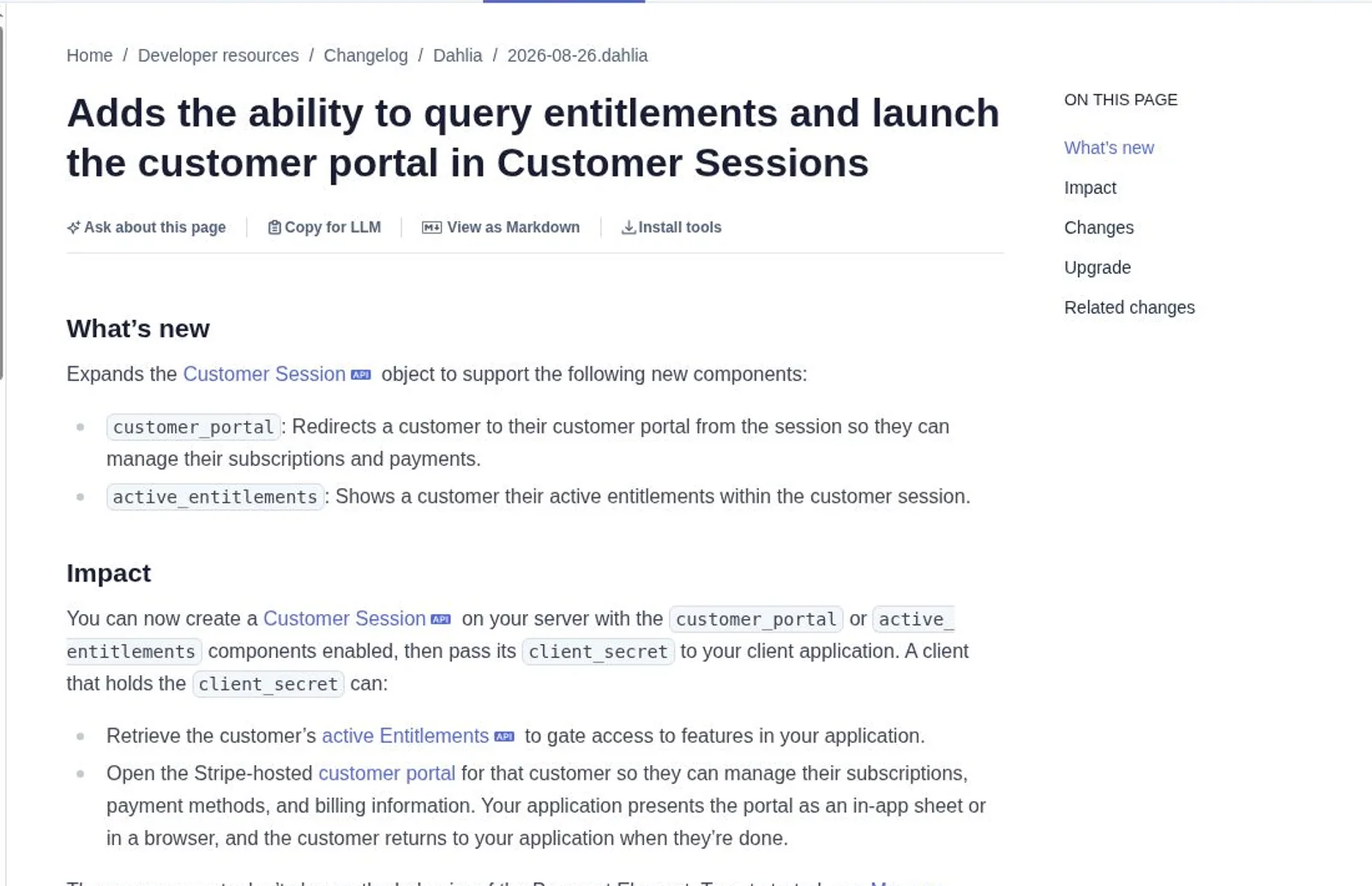
Stripe's changelog lists five billing and invoicing changes in the 2026-08-26 Dahlia API version. It adds a direct customer-update destination for Billing Portal sessions, the ability to query entitlements and launch the customer portal in Customer Sessions, a frozen-fields property on invoice items, Billie support for invoices and subscriptions using send-invoice collection, and a higher subscription-item limit.
Stripe labels these entries non-breaking. That describes API compatibility, not the absence of operational consequence. A new portal path can let a customer change information that also lives in the CRM. Entitlement data can affect service access. Frozen fields expose which invoice-item values are no longer editable. More subscription items can alter payload size, user interfaces, exports, forecasts, and sync logic.
The changelog is the factual release source. Individual eligibility, regional availability, account configuration, pinned API versions, SDK behavior, and later changes must be checked in current Stripe documentation and the target account. DailyRevOps does not interpret the payment-method addition as a recommendation for a country, customer, credit decision, or collection policy.
Name the authority behind each new surface
For customer updates, define which system owns legal name, billing email, address, tax details, payment method, and customer-contact fields. A portal session should not create an unexplained last-write-wins contest with the CRM, ERP, tax system, or support tool. Record session creation, customer ID, return path, fields permitted to change, webhook events, sync result, and the owner of conflicts.
For entitlements, keep commercial commitment, billing status, and service access as related but distinct states. Querying an entitlement does not prove the CRM has the correct renewal or contract state, and a payment issue does not automatically decide whether access should stop. Store the customer and subscription identifiers, feature or entitlement key, effective period, source decision, observed result, and the product or support owner responsible for exceptions.
Frozen invoice fields and larger subscriptions are schema signals. Identify when an invoice item becomes frozen, what correction route remains, and which downstream record preserves the approved commercial evidence. Review integrations for hard-coded item counts, pagination, array limits, totals, line ordering, rounding, and timeout assumptions before using a higher platform limit.
Test the state transition, not only the response
Pin the new API version in a test environment. Choose one representative customer with a subscription, several line items, a defined entitlement, a billing contact, a CRM account, and a safe portal configuration. Capture IDs, quantities, prices, currency, billing cycle, invoice status, entitlement state, CRM fields, and current webhook consumers before the test.
Create a portal or Customer Session, follow the intended deep link, make one permitted update, retrieve entitlements, inspect invoice-item frozen fields, and exercise the increased item shape without creating an artificial live obligation. Test a stale session, unauthorized field, missing entitlement, frozen correction attempt, webhook retry, and a payload larger than the old integration normally receives.
Verify Stripe objects, event log, CRM sync, product access, finance or accounting record, support view, renewal workflow, and reporting. A 200 response or successful portal screen does not prove every dependent system received the correct value once. Preserve request and event IDs so a timeout, duplicate delivery, or later field reversal can be reconstructed.
- Pin and record the Stripe API version for every representative test.
- Define field authority between the Billing Portal, CRM, finance, tax, and support systems.
- Reconcile entitlement, subscription, invoice, and service state without collapsing them.
- Test downstream limits and pagination before increasing subscription-item volume.
- Trace portal changes and webhook retries through the first normal reporting cycle.
Decision and limits
Adopt the new surface when it removes a real support or engineering step and the team can identify authoritative fields, permissions, session expiry, events, error handling, reconciliation, and rollback. Defer it when customer identity is ambiguous, entitlement rules are contested, invoice corrections are manual and unowned, or downstream systems cannot accept the expanded record shape.
Measure portal sessions completed, conflicts with CRM authority, entitlement mismatches, frozen-field exceptions, webhook retries, duplicate processing, oversized-record failures, post-sync reversals, and support cases. These are operational controls. They do not establish improved renewal performance, lower support cost, higher collection, or better customer experience.
Finance, Billing, Tax, Legal, Product, Support, and the commercial owner retain their respective decisions. RevOps can coordinate IDs, CRM state, workflows, exception queues, and reporting. Platform behavior depends on the account, API version, configuration, region, and integration. Confirm the current Stripe documentation before production.
Original source
This DailyRevOps article is written in our own words from the source signal and adds RevOps context, workflow analysis, and operator interpretation.
- Original source: Stripe Documentation
- Original publication date:
- Source link: Read the original article