Clay Sequencer moves send-time eligibility into the outbound workflow
Clay has made its sequencer generally available with audience, eligibility, inbox, reply, and analytics controls. The operator question is whether the combined workflow remains inspectable when source data changes between enrollment and send.
What Clay released on 1 September
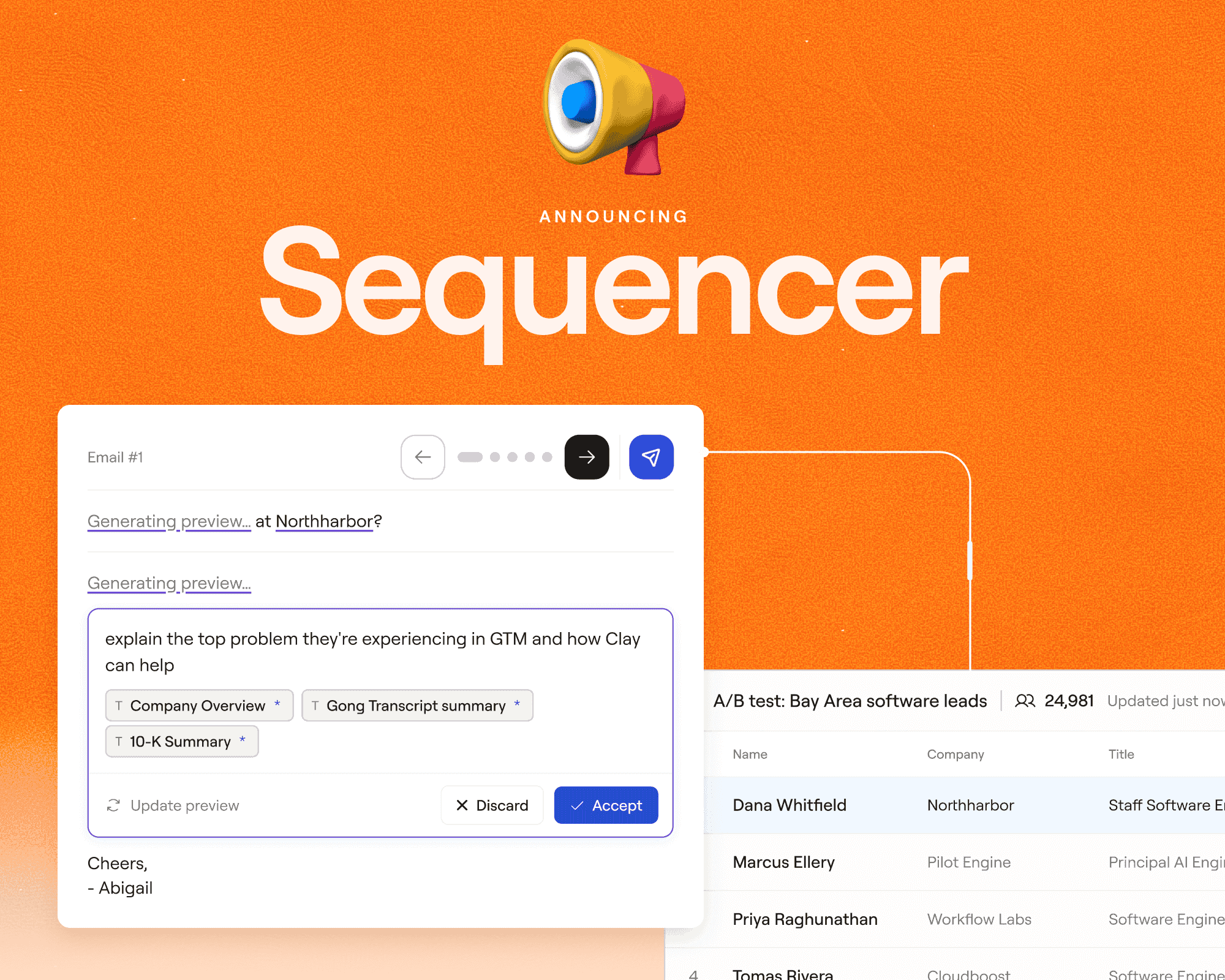
Clay announced the general availability of Clay Sequencer on 1 September 2026. The company says the product brings lead sourcing, enrichment, audience definition, sequencing, deliverability controls, reply handling, and analytics into one workflow. Clay lists the release as available on Launch, Growth, and Enterprise plans.
The source article describes audiences that update from data and signals, eligibility checks that can be applied when a message is due to send, permissioned inboxes, deliverability management, reply handling, and performance analysis. These are vendor-described capabilities, not independent evidence that the workflow improves conversion, deliverability, or productivity in every environment.
For RevOps, the substantive change is the removal of several handoffs between a data workspace and a sending tool. That can reduce transfer work, but it also concentrates identity, suppression, eligibility, execution, and measurement in one operating surface. A simpler interface still needs explicit authority and an audit trail.
- Confirm the plan, permissions, regions, inbox providers, and sequence features available in the target Clay workspace.
- Record the source article date as 1 September 2026; do not replace it with the later DailyRevOps processing date.
- Use Clay's original announcement artwork for the news page and preserve source attribution.
Define what may change after enrollment
A dynamic audience is useful only when the team can explain which source fields admit or remove a person. Document the table, record identifier, match key, enrichment outputs, audience conditions, suppression rules, and the person or system allowed to change each input.
Send-time eligibility deserves a specific test because the record may change after it first enters the audience. A new job title, account status, consent state, territory, owner, duplicate match, active opportunity, customer status, or recent reply can make an originally valid contact inappropriate to message. The operator needs to know whether the sequencer re-evaluates the current record, which rule wins when sources disagree, and where the final decision is logged.
Preserve both the enrollment event and the final send decision. If a contact becomes ineligible, record the reason and time rather than making the record silently disappear. If the team later changes the rule, keep enough version context to reconstruct why a message was or was not sent.
- Change one eligibility field after enrollment and verify the due message follows the documented current-state rule.
- Test an existing customer, an active opportunity, a recently replied contact, a duplicate, and a record with missing evidence.
- Verify that suppression remains effective after enrichment refreshes or audience rule edits.
Keep source authority and CRM writeback explicit
Combining research and execution does not settle which system owns the record. Define whether Clay, the CRM, a warehouse, or another governed source is authoritative for company identity, person identity, employment status, owner, lifecycle stage, territory, opportunity state, consent, and do-not-contact controls.
Do not overwrite a trusted CRM field merely because a newer enrichment value exists. Store the candidate value, source, observed time, confidence or evidence, prior value, decision, and reviewer for high-impact changes. Employment and account changes can alter routing, segmentation, reporting, and active commercial work far beyond the sequence.
Writeback should support the operating record rather than create a second activity universe. Decide which events the CRM needs: audience entry, sequence status, send, bounce, unsubscribe, reply, qualified response, ownership transfer, and final outcome. Use stable external identifiers so retries and syncs do not create duplicate activities.
- Trace one contact from source record to audience, send decision, inbox, reply, owner action, CRM activity, and reporting output.
- Retry the writeback and confirm the integration is idempotent.
- Confirm that owner, lifecycle, and opportunity fields cannot be changed by an unreviewed reply classification.
Treat inboxes and deliverability as a control plane
Clay describes mailbox provisioning and deliverability management inside the product. Operators should still define who is permitted to connect or create an inbox, which domains may be used, how sending limits are approved, how authentication and provider policy are checked, and who can pause a sequence or domain.
Separate infrastructure health from campaign performance. Delivery, bounce, spam complaints, unsubscribe, provider restrictions, domain authentication, and mailbox errors describe the sending system. Replies, qualified conversations, meetings, opportunities, and commercial outcomes describe the audience and motion. A combined dashboard can display both without implying that one caused the other.
Set hard stop conditions before launch. A sequence should pause when identity or consent evidence is missing, suppressions fail, bounce or complaint behavior exceeds the team's approved limit, the selected inbox is not authorized, or reply ownership is broken. Exact limits are company and provider decisions; DailyRevOps does not invent a universal benchmark.
- Approve domains, inbox owners, daily limits, authentication, suppression sources, and pause authority before the first production send.
- Test bounce, unsubscribe, complaint, provider error, and disconnected-inbox paths.
- Verify that a pause stops queued sends and that resumption does not bypass a fresh eligibility check.
Make reply ownership observable
Reply handling is an operational workflow, not only a classification feature. Define who owns positive interest, objection, referral, wrong-person, unsubscribe, out-of-office, existing-customer, support request, security concern, and ambiguous responses. Each route needs a destination, service expectation, and closure state.
Automated classification can assist triage, but customer-facing or record-changing action should remain reviewable. Store the original message, classification, confidence or reason when available, reviewer action, final owner, and CRM outcome. Protect sensitive content and restrict who can read connected inboxes.
Measure the handoff, not just the model label. Track replies without an owner, time to first human action, reclassified messages, duplicates, missing CRM activities, and cases where the reply should have suppressed later sends. These measures reveal whether the combined workflow is actually controlled.
- Send test replies for positive interest, unsubscribe, out-of-office, existing customer, and an ambiguous message.
- Confirm each reply stops or continues later steps according to the documented rule.
- Verify the final human action and CRM state are visible to the next operator.
A bounded operator test plan
Use one small, representative audience that includes ordinary records and known edge cases. Freeze the rule version, export the expected members, preserve the prior state, and name an owner for data, sending, replies, CRM writeback, and rollback.
Run a dry review of audience membership and message variables. Then allow a small number of controlled sends. Change selected source fields between enrollment and due time, produce test replies, trigger an integration retry, and pause the sequence. Compare actual membership, send decisions, inbox choice, delivery state, reply route, CRM events, and analytics with the expected record.
Do not migrate active outbound simply because the pilot can send. Complete at least one normal operating cycle, resolve every unexplained exception, verify that existing suppressions and reply history remain effective, and document which older workflow will be retired. Keeping both paths indefinitely creates duplicate sends, conflicting activity histories, and unclear ownership.
- The final decision record should name scope, source fields, rule version, inboxes, owners, expected outputs, actual outputs, exceptions, and approval.
- Retain the old path until rollback is tested, then retire it deliberately after the new flow is verified.
- Recheck vendor documentation before expanding because availability and behavior can change after release.
What the announcement does not prove
The announcement does not prove higher reply rates, better data quality, improved deliverability, faster pipeline creation, or lower operating cost for a particular team. It also does not remove obligations relating to consent, suppression, privacy, security, provider policies, employment data, or local law.
The credible operator conclusion is narrower: Clay has joined more of the outbound workflow and added controls that can be tested. The release is useful when the combined path stays explainable from source record to final CRM outcome, exceptions have owners, and the team can stop or reverse the workflow without reconstructing it from several dashboards.
Original source
This DailyRevOps article is written in our own words from the source signal and adds RevOps context, workflow analysis, and operator interpretation.
- Original source: Clay
- Original publication date:
- Source link: Read the original article