HubSpot's August rollup changes three CRM control points
Webhook data sources, merge-safe workflow enrollment and app-object associations can remove custom integration work, but each feature also moves an operational boundary. RevOps should review secret handling, match keys, merge outcomes, pending automation and association authority before relying on the new behavior.
What HubSpot announced
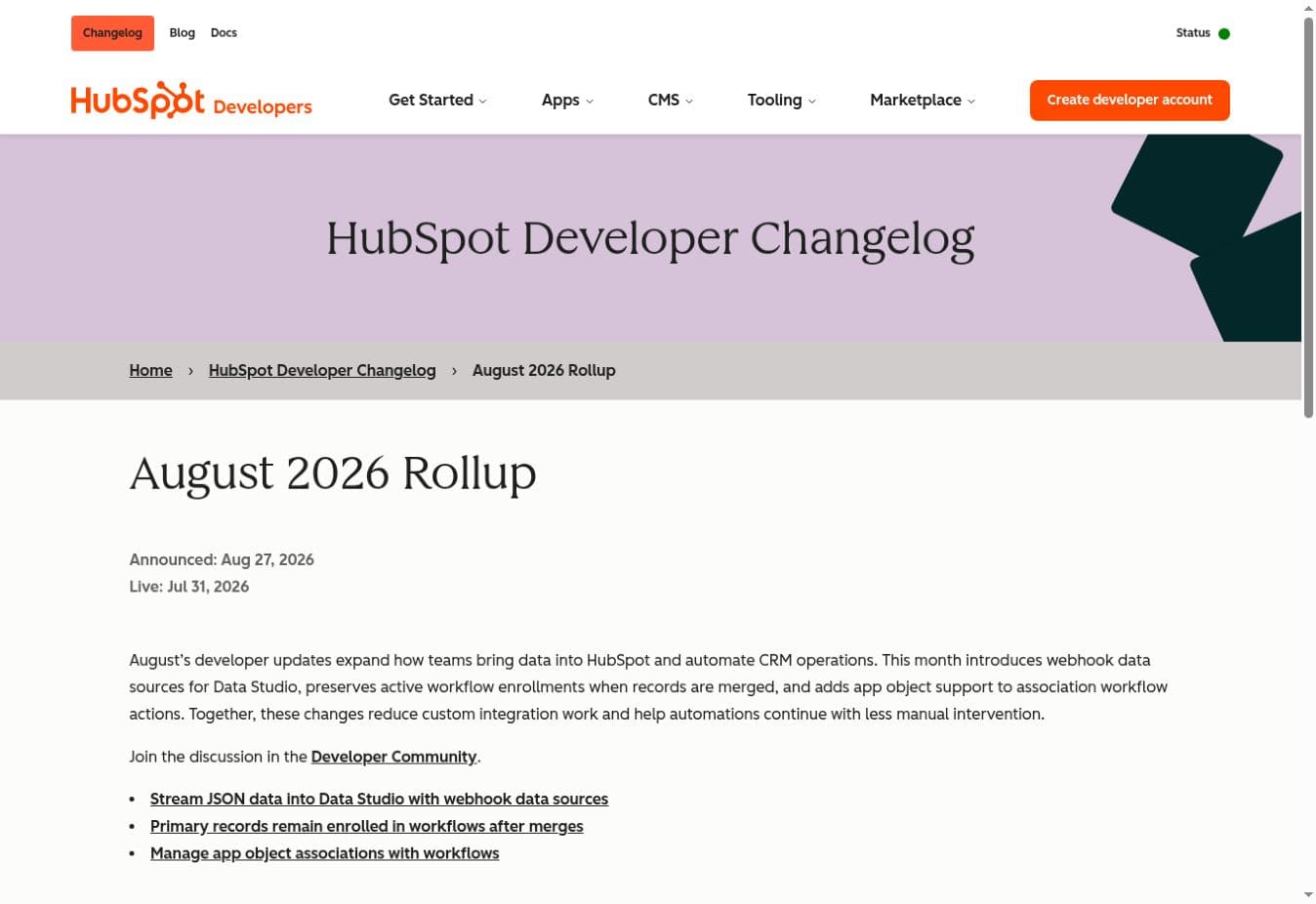
HubSpot announced its August 2026 developer rollup on August 27 and lists July 31 as the live date. The source groups three changes that affect CRM operations. Data Studio can accept real-time JSON from HTTP-capable systems through webhook data sources. A primary CRM record now remains enrolled in active workflows when a duplicate is merged into it. The workflow action for managing CRM record associations now supports app objects supplied by connected applications.
For webhook data sources, HubSpot says each source receives a unique inbound URL and supports GET, POST and PUT requests. The request can create a record or update an existing record through a match key. HubSpot currently limits requests to one record each, and explicitly says the inbound URL should be treated as a secret because it is the source's only authentication mechanism. Ingested data can then feed datasets, segments, workflows and reports.
For record merges, HubSpot says the primary record preserves its current position in active workflows, including delays, branches and pending actions, while the duplicate record being merged away is unenrolled. The change applies automatically to mergeable CRM object types. For app objects, workflows can create, update or remove associations between connected-app records and other CRM records. These are product-behavior statements from HubSpot, not independent evidence that every portal, integration and workflow will produce the intended business outcome.
The control boundary moves; it does not disappear
A webhook source replaces part of a custom connector, but its secret URL becomes an effective write credential. RevOps and the integration owner should record where that URL is stored, which system may use it, who can rotate it, which network and application logs may expose it, and how a compromised source is disabled. A match key also becomes an identity rule. If it is mutable, non-unique or missing, a replay can create duplicates or update the wrong business record.
Merge-safe enrollment reduces one familiar cleanup risk: the primary record no longer leaves an active workflow simply because a duplicate is removed. It can also preserve actions that an operator expected a merge to stop. Pending emails, tasks, delays, branches and property updates should therefore be reviewed against the surviving record. The question changes from 'did the workflow stop?' to 'is every pending action still correct for the merged identity and current customer state?'.
App-object associations bring connected application data deeper into native automation. That can improve pipeline, attribution, segmentation and reporting, as HubSpot notes. It can also create a second association writer next to the source application or a sync. Teams need one authority rule for creating, changing and removing each relationship, plus an audit trail that explains whether HubSpot, the app or an operator made the latest decision.
A bounded operator test
Start with one webhook source and a non-customer dataset. Define the schema, required fields, match key, permitted methods, expected response, retry behavior and maximum replay window. Send one create, one valid update, one duplicate delivery, one missing-key request and one malformed request. Confirm which records, datasets, segments, workflows and reports changed. Rotate or revoke the inbound URL after the test if its handling did not meet the team's secret-management standard.
Then select one duplicate pair whose primary record is actively enrolled. Capture both record IDs, enrollment history, current step, delays, pending actions, associations, owners and customer-facing communications before the merge. Merge through the approved process, then compare the surviving record, enrollment position and every pending action. Do not use a high-risk billing, consent, renewal or customer-message workflow as the first production test.
Finally, test one app-object association with a record pair whose identity is unambiguous. Create the relationship through the workflow, observe the connected app and any sync, update it once, remove it once and inspect the resulting audit history. A successful test proves the configured path behaved once; it does not prove that every object, permission, retry and concurrent writer is governed.
- Record the owner, storage location, rotation path and revocation test for every webhook source URL.
- Require a stable, unique and monitored match key before update behavior is enabled.
- Review pending workflow actions after a merge, not only enrollment status.
- Define one writer and one reconciliation rule for each app-object association type.
- Keep source IDs, request IDs, workflow history and association audit events in the release evidence.
Decision and limits
Adopt the webhook path when it removes a real integration burden and the team can protect, rotate and revoke the URL, validate payloads, control identity and reconcile writes. Keep the existing connector when it provides stronger authentication, batching, observability, replay controls or schema management that the simpler source does not replace. One-record requests can also change throughput and retry economics; measure those rather than assuming the new path is cheaper.
Accept merge-safe enrollment as a useful default only after workflows with customer messages, billing effects, consent, stage changes, renewal tasks and owner changes have explicit post-merge checks. A primary record that remains enrolled is not automatically the correct commercial or customer identity. Preserve source records and merge evidence so a later exception can be reconstructed.
Use app-object workflow associations when the relationship has a named business meaning and authority. Avoid enabling broad association automation simply because it is now available. DailyRevOps has not independently tested the rollout in a production portal and does not infer revenue impact from the release. The operating value depends on data quality, permissions, workflow design, connected-app behavior and the team's ability to detect and reverse an incorrect result.
Original source
This DailyRevOps article is written in our own words from the source signal and adds RevOps context, workflow analysis, and operator interpretation.
- Original source: HubSpot Developer Changelog
- Original publication date:
- Source link: Read the original article