Short verdict
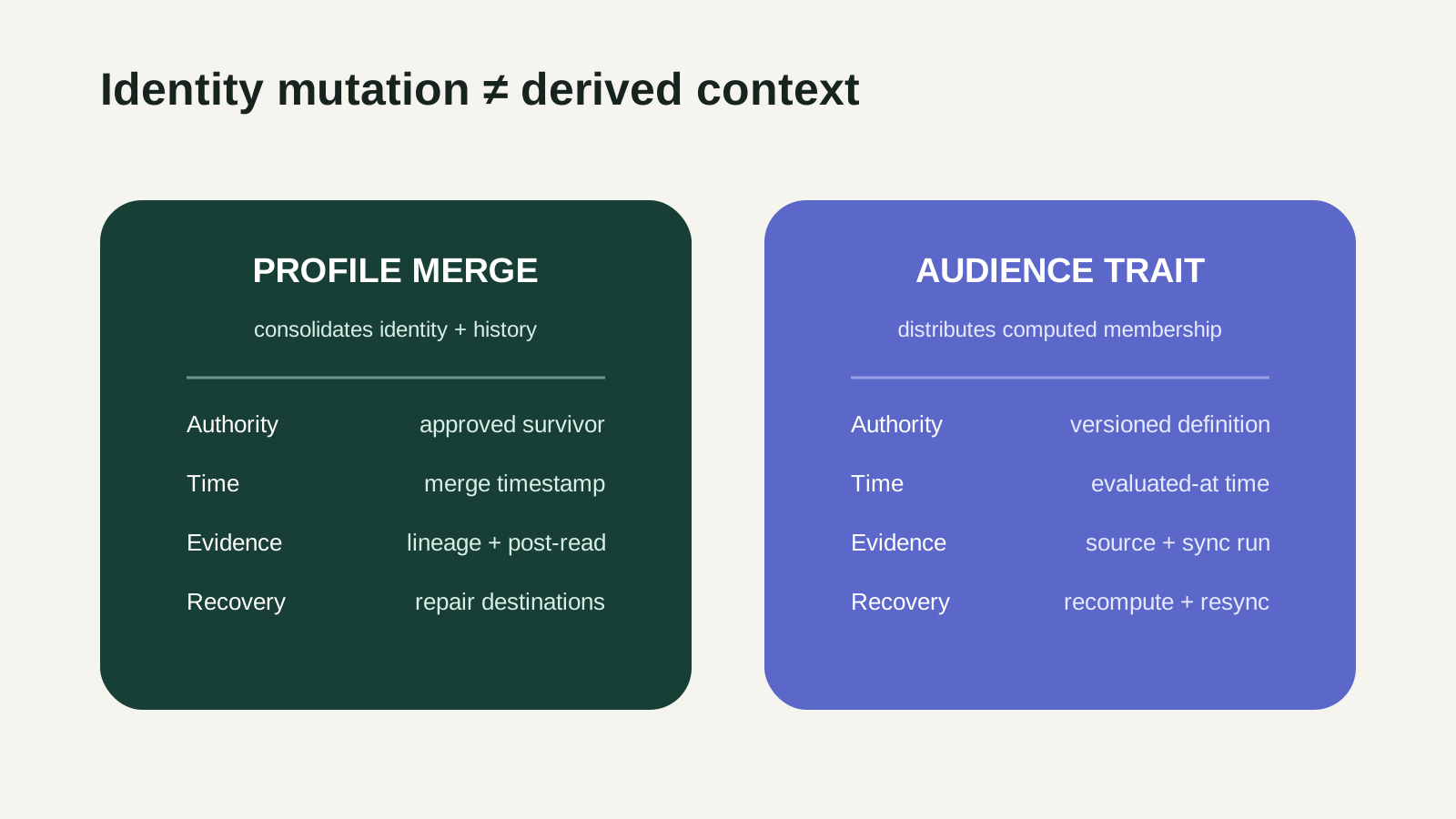
These capabilities are complements, not substitutes. A merge mutates identity and history; an audience trait communicates a current computed state. Merge approval should preserve survivorship evidence, while trait activation should preserve definition, evaluation time and destination use.
This comparison is written for RevOps, Sales Ops, GTM Operations, and Customer Success Ops teams that need a practical decision framework. It focuses on workflow ownership, CRM data quality, implementation effort, source-of-truth behavior, and the operating rhythm each option supports.
Who each option is best for
Use Intercom merge when two support user profiles represent the same person and their histories should be consolidated after review. Use Hightouch membership traits when destinations need current audience context derived from a governed parent model.
The right answer depends on the job the team is trying to improve. A tool that is strong for one operating model can be a poor fit when the real problem is ownership, dirty CRM data, missing renewal dates, weak handoffs, or an unclear forecast process. Use this page to map the workflow before treating either option as the default.
Operating questions before choosing
- Which recurring meeting or workflow will change if the team chooses Intercom profile merge or Hightouch audience-membership traits?
- Which CRM records, fields, activities, or customer signals are required for the workflow to be trusted?
- Who owns the next action when the system surfaces a risk, alert, forecast change, or customer signal?
- Does the option write usable context back to the system of record, or does it create another place to inspect?
- What manual review work should decrease after implementation?
Side-by-side table
| Criterion | Intercom profile merge | Hightouch audience-membership traits | Editorial note |
|---|---|---|---|
| Primary object | Support user profile and its history | Parent-model row plus current audience list | Durable identity and derived state have different authority. |
| Core operation | Consolidate one profile into another | Expose and sync computed memberships | One mutates; one derives and distributes. |
| Official date | September 28, 2026 | September 2026 month-level changelog | Hightouch does not state an item-level day on the source page. |
| Built-in control | Move preview and teammate permission | Model, audience definition, sync and destination controls | Validate actual account permissions. |
| API or automation | REST API in Preview | Trait can sync with other traits | Both require target-account testing. |
| Main identity risk | Wrong survivor or false match | Wrong person-to-parent-model association | Stable IDs remain essential. |
| Main time risk | Historic evidence loses separate lineage | Membership becomes stale or definition changes | Preserve merge time and evaluated-at time. |
| Downstream risk | Consolidated profile alters later service context | Membership triggers unintended destination action | High-impact actions need a current-state check. |
| Recovery | Correction may require vendor-supported remediation and downstream repair | Fix source or definition, recompute and resync | Test one recovery scenario before scale. |
| Success evidence | Approved survivor and verified moved history | Explainable membership and reconciled destination | A successful job alone is insufficient. |
Workflow comparison
- Classify the requirement as identity consolidation or derived-context distribution.
- Map stable identifiers, authoritative fields and affected destinations.
- Test one normal, one ambiguous and one recovery case.
- Hold consequential customer actions until the destination state is verified.
- Review exceptions and recurring upstream causes before expanding volume.
A RevOps workflow should produce a visible action, not only a report. When comparing Intercom profile merge and Hightouch audience-membership traits, the team should look at the handoff from signal to owner to customer action. If the output does not change a task, meeting, field, renewal follow-up, forecast inspection, or manager review, the tool may become another dashboard rather than operating leverage.
Implementation complexity
Medium: both are straightforward product capabilities but depend on identity, authority, freshness and downstream controls. The real complexity depends on data quality, ownership clarity, and whether the team changes its operating rhythm.
Implementation should start with source fields, permissions, integration points, and the review process. The most common failure is buying a tool before defining the workflow. A narrow pilot is usually safer than a full rollout because it reveals bad CRM fields, unclear owners, duplicate definitions, and gaps between the tool and the team operating cadence.
Data and CRM requirements
Reliable RevOps decisions need clean CRM data. Before choosing between Intercom profile merge and Hightouch audience-membership traits, check owner fields, lifecycle stage, account and opportunity status, renewal or close dates, activity history, task ownership, and the fields that drive routing or reporting. If these fields are not trusted, the comparison should include a data cleanup step.
- Define the system of record for the workflow.
- List the fields that trigger action or reporting.
- Decide which fields can be written automatically and which need review.
- Document what evidence an operator should inspect before acting.
- Measure whether the workflow reduces missed follow-up or manual reconciliation.
Data model impact
- Intercom merge requires source and survivor IDs, match evidence, field authority and a retained merge record.
- Hightouch membership traits require a parent-model key, audience definition, evaluated-at time and destination mapping.
- When both are used, recompute membership from the surviving identity rather than copying an old list.
- Keep contractual, billing, preference and ownership fields in their named authoritative systems.
CRM fields and signals to check
- Source profile ID
- Survivor profile ID
- CRM contact ID
- Account ID
- External product user ID
- Merge reason
- Approved-by and approved-at
- Audience ID and definition version
- Evaluated-at time
- Destination sync ID
- Hold and release state
- Correction owner
Cost and maintenance considerations
Intercom and Hightouch packaging varies by plan, usage and contracted features. The official changelogs do not provide a comparable price or a cross-vendor unit. Model platform entitlement, operator review, data engineering, destination volume and correction work in the target accounts.
Cost should include licenses, setup time, admin maintenance, integration work, enablement, governance, and the opportunity cost of manual review. A cheaper workflow can become expensive if it requires weekly spreadsheet cleanup. A larger platform can become expensive if the team only uses a narrow part of it. RevOps should compare total operating cost, not only subscription price.
Risks and limitations
- Using an audience membership as permanent customer truth.
- Using a merge to repair an account relationship that should remain separate.
- Copying derived state across a merge without recomputation.
- Allowing preview APIs or destination syncs to scale without idempotency and evidence.
- Treating either product's completion status as proof that customer workflows are correct.
The main risk in any RevOps tool comparison is overgeneralizing. No tool is universally best. The fit depends on company stage, CRM maturity, sales motion, renewal volume, customer success model, admin capacity, and how disciplined the team is about acting on signals.
Implementation risk
- Intercom's REST merge is in Preview and should be tested with representative conflicts and retries.
- Hightouch publishes the membership trait in a month-level changelog; confirm availability and behavior in the target workspace.
- Test duplicate identifiers, missing parent matches, large audience lists, stale source data and destination failures.
- Verify mobile or interface convenience separately from backend correctness.
Governance risk
- Limit merge permission to trained roles and review membership changes for privileged destinations.
- Version survivorship rules and audience definitions separately.
- Preserve actor, evidence, execution and post-read state for merge cases.
- Preserve source, definition, evaluation and sync state for audience traits.
Alternatives and complements
- A CRM master-data workflow may own identity when support profiles are downstream copies.
- A warehouse identity table can provide a stable cross-system mapping without merging every source object.
- A reverse-ETL sync without membership lists may be simpler when only one bounded attribute is required.
- A manual review queue remains appropriate for employer changes, shared addresses and conflicting consent.
Weekly operating rhythm
- Monday: review unresolved merge candidates and stale audience evaluations.
- Midweek: sample executed merges and membership syncs against destination state.
- Friday: inspect corrections, customer-action holds and recurring source causes.
- Monthly: review permissions, API usage, definition changes and recovery evidence.
Decision framework
- Choose Intercom merge for reviewed duplicate profiles where conversations, tickets or notes should belong to one survivor.
- Choose Hightouch membership traits when a destination needs current audience context without making that context the identity source of truth.
- Use both when a verified identity repair should lead to audience recomputation and governed destination updates.
- Keep the case manual or read-only when stable identifiers, authority or recovery are unclear.
If the team cannot name the owner, source field, review cadence, and next action, pause the purchase and map the workflow first. Strong RevOps teams buy tools to close a defined operating gap. They do not use tools to discover the process after the contract is signed.
FAQ
Are profile merge and audience traits alternatives?
No. The merge changes a profile and its history. The trait exposes a currently computed list for activation or analysis.
Should membership be copied during a merge?
Usually recompute it from the surviving identity and current model. Preserve the old evaluation only as evidence when needed.
Which operation is riskier?
Risk depends on consequence. A wrong merge can compress identity history; a wrong audience sync can trigger customer action. Both need controls proportional to their use.
Source notes
These official references support the product and workflow context. DailyRevOps uses them to bound the comparison, not to imply outcomes, rankings, or adoption claims.
- Intercom: Merge duplicate users into one profile: Official product changelog shared September 28, 2026; describes preview, teammate permission and REST API Preview.
- Hightouch: September 2026 changelog: Official month-level September 2026 changelog; no item-level publication day is stated.
- Amplitude: User properties on survey responses: Official changelog dated September 23, 2026; describes user-property columns, DAC filtering and CSV exports.
Last updated: 2026-09-29