Short verdict
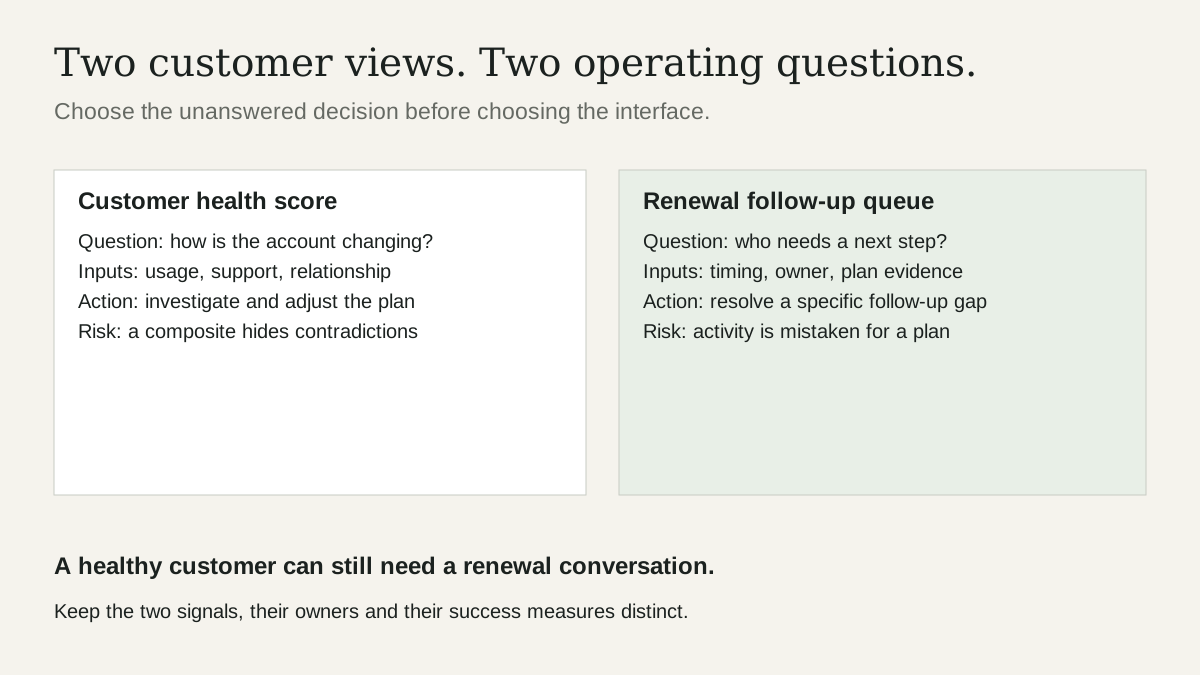
The better starting point is the one that answers the team's unanswered operating question. If nobody knows who must act before the next renewal, begin with timing and follow-up. If that work is already covered but account deterioration remains hard to interpret, develop the broader health view. Buying or building both at once can hide which problem was actually solved.
This comparison is written for RevOps, Sales Ops, GTM Operations, and Customer Success Ops teams that need a practical decision framework. It focuses on workflow ownership, CRM data quality, implementation effort, source-of-truth behavior, and the operating rhythm each option supports.
Who each option is best for
Use a health score when the decision requires a broader view of account condition across multiple signals. Use a renewal follow-up queue when the immediate decision is which upcoming commercial event lacks an owned next step. Many teams need both, but each should earn its place through a clearly defined action.
The right answer depends on the job the team is trying to improve. A tool that is strong for one operating model can be a poor fit when the real problem is ownership, dirty CRM data, missing renewal dates, weak handoffs, or an unclear forecast process. Use this page to map the workflow before treating either option as the default.
Operating questions before choosing
- Which recurring meeting or workflow will change if the team chooses Customer health score or Renewal follow-up queue?
- Which CRM records, fields, activities, or customer signals are required for the workflow to be trusted?
- Who owns the next action when the system surfaces a risk, alert, forecast change, or customer signal?
- Does the option write usable context back to the system of record, or does it create another place to inspect?
- What manual review work should decrease after implementation?
Side-by-side table
| Criterion | Customer health score | Renewal follow-up queue | Editorial note |
|---|---|---|---|
| Primary question | How is this customer's relationship or adoption changing? | Does this renewal decision have a clear next step? | Do not treat a favorable score as evidence that a commercial conversation is scheduled. |
| Required evidence | Defined signals, observation windows, weighting and treatment of missing data. | Authoritative timing, commercial identity, owner and qualifying follow-up evidence. | Both approaches depend on source quality, but their minimum data contracts differ. |
| Action | Investigate a change, engage the account or review the success plan. | Resolve a timing gap, assign an owner or arrange the next renewal action. | Each signal needs an owner who can explain the expected work. |
| Common failure | A composite score hides contradictory signals or stale inputs. | Recent activity suppresses an account despite no real renewal plan. | Sample apparently healthy and unflagged accounts as well as flagged ones. |
Workflow comparison
- Begin by sampling the current customer book. Ask which decisions the team could not make from the existing records. Separate uncertainty about account health from uncertainty about commercial timing and follow-up. Keep a few concrete examples for each category so the proposed solution can be evaluated against actual cases.
- Define the operating unit. Health may be assessed at company or product level, while renewal work may follow a contract or subscription. Preserve the mapping between those units. One company can have a stable relationship while one product is at risk, or a difficult support history while its immediate renewal conversation is already well covered.
- Run the proposed view alongside the current process before it writes new customer work. Have the owner explain each surfaced case and inspect the evidence. Record false alarms, missed cases and unresolved data. Expand only when the team can distinguish a useful signal from a merely plausible label.
A RevOps workflow should produce a visible action, not only a report. When comparing Customer health score and Renewal follow-up queue, the team should look at the handoff from signal to owner to customer action. If the output does not change a task, meeting, field, renewal follow-up, forecast inspection, or manager review, the tool may become another dashboard rather than operating leverage.
Implementation complexity
Depends on source coverage, score design, date authority and ownership. The real complexity depends on data quality, ownership clarity, and whether the team changes its operating rhythm.
Implementation should start with source fields, permissions, integration points, and the review process. The most common failure is buying a tool before defining the workflow. A narrow pilot is usually safer than a full rollout because it reveals bad CRM fields, unclear owners, duplicate definitions, and gaps between the tool and the team operating cadence.
Data and CRM requirements
Reliable RevOps decisions need clean CRM data. Before choosing between Customer health score and Renewal follow-up queue, check owner fields, lifecycle stage, account and opportunity status, renewal or close dates, activity history, task ownership, and the fields that drive routing or reporting. If these fields are not trusted, the comparison should include a data cleanup step.
- Define the system of record for the workflow.
- List the fields that trigger action or reporting.
- Decide which fields can be written automatically and which need review.
- Document what evidence an operator should inspect before acting.
- Measure whether the workflow reduces missed follow-up or manual reconciliation.
Data model impact
- Keep company, product and commercial-event identifiers explicit. Preserve source timestamps and avoid overwriting the original facts with the derived label.
CRM fields and signals to check
- Company ID, contract or subscription reference, renewal date, owner, next step, source timestamp and review outcome.
Cost and maintenance considerations
Compare the total cost of maintaining the decision, not only the subscription. Include source integration, field ownership, rule changes, manual review, task reconciliation and training. A lightweight native CRM view can be sufficient for a small, well-governed portfolio. A broader platform can be justified when multiple teams need shared account context. A focused renewal application can be appropriate when one repetitive timing-and-action problem remains expensive to maintain.
Cost should include licenses, setup time, admin maintenance, integration work, enablement, governance, and the opportunity cost of manual review. A cheaper workflow can become expensive if it requires weekly spreadsheet cleanup. A larger platform can become expensive if the team only uses a narrow part of it. RevOps should compare total operating cost, not only subscription price.
Risks and limitations
- A health score can acquire authority that its evidence does not deserve. Review which signals dominate, how old they are and whether missing data raises uncertainty or incorrectly improves the score. Keep the underlying inputs available to the person making the customer decision.
- A renewal queue can make a narrow operational gap look like a prediction of churn. State what the flag means and what it does not establish. An account requiring follow-up is not necessarily likely to cancel, and a suppressed account is not guaranteed to renew.
- Parallel systems can create duplicate tasks, conflicting owners or inconsistent dates. Choose the system of record for each fact and the single authority for each action. Review association changes and multi-contract cases before enabling automation.
The main risk in any RevOps tool comparison is overgeneralizing. No tool is universally best. The fit depends on company stage, CRM maturity, sales motion, renewal volume, customer success model, admin capacity, and how disciplined the team is about acting on signals.
Implementation risk
- Pilot on a representative cohort with known hard cases. Evaluate missing data and incorrect associations before measuring task volume.
Governance risk
- Name the rule owner, customer-action owner and reviewer. Changes to definitions should be versioned and explained to the people using the queue.
Alternatives and complements
- Native CRM views, a governed manual review and focused applications are all legitimate options. A warehouse or product-analytics integration may supply missing evidence without becoming another action system.
Weekly operating rhythm
- Review new exceptions, sample suppressed accounts and inspect whether completed tasks produced the expected evidence.
Decision framework
- Choose the health view first when the team can manage renewals but lacks a structured way to interpret adoption, support and relationship signals.
- Choose the follow-up queue first when the practical failure is missed timing, unclear ownership or an absent next step.
- Use both when they produce different, justified actions. Keep their labels and success measures separate instead of merging them into an unexplained risk score.
If the team cannot name the owner, source field, review cadence, and next action, pause the purchase and map the workflow first. Strong RevOps teams buy tools to close a defined operating gap. They do not use tools to discover the process after the contract is signed.
FAQ
Can a customer be healthy and still need renewal follow-up?
Yes. General account condition and preparation for a specific commercial decision are different questions.
Does a renewal alert replace a customer success platform?
No. A focused queue addresses a bounded timing-and-follow-up requirement. Broader customer-success work may involve additional signals, teams and processes.
Source notes
These official references support the product and workflow context. DailyRevOps uses them to bound the comparison, not to imply outcomes, rankings, or adoption claims.
- HubSpot: Customer Success Management: Native customer-success product context.
- Sighub: Renewal Radar: Focused renewal application scope; validate the workflow against the team's HubSpot data and operating needs.
Last updated: 2026-09-08