Short verdict
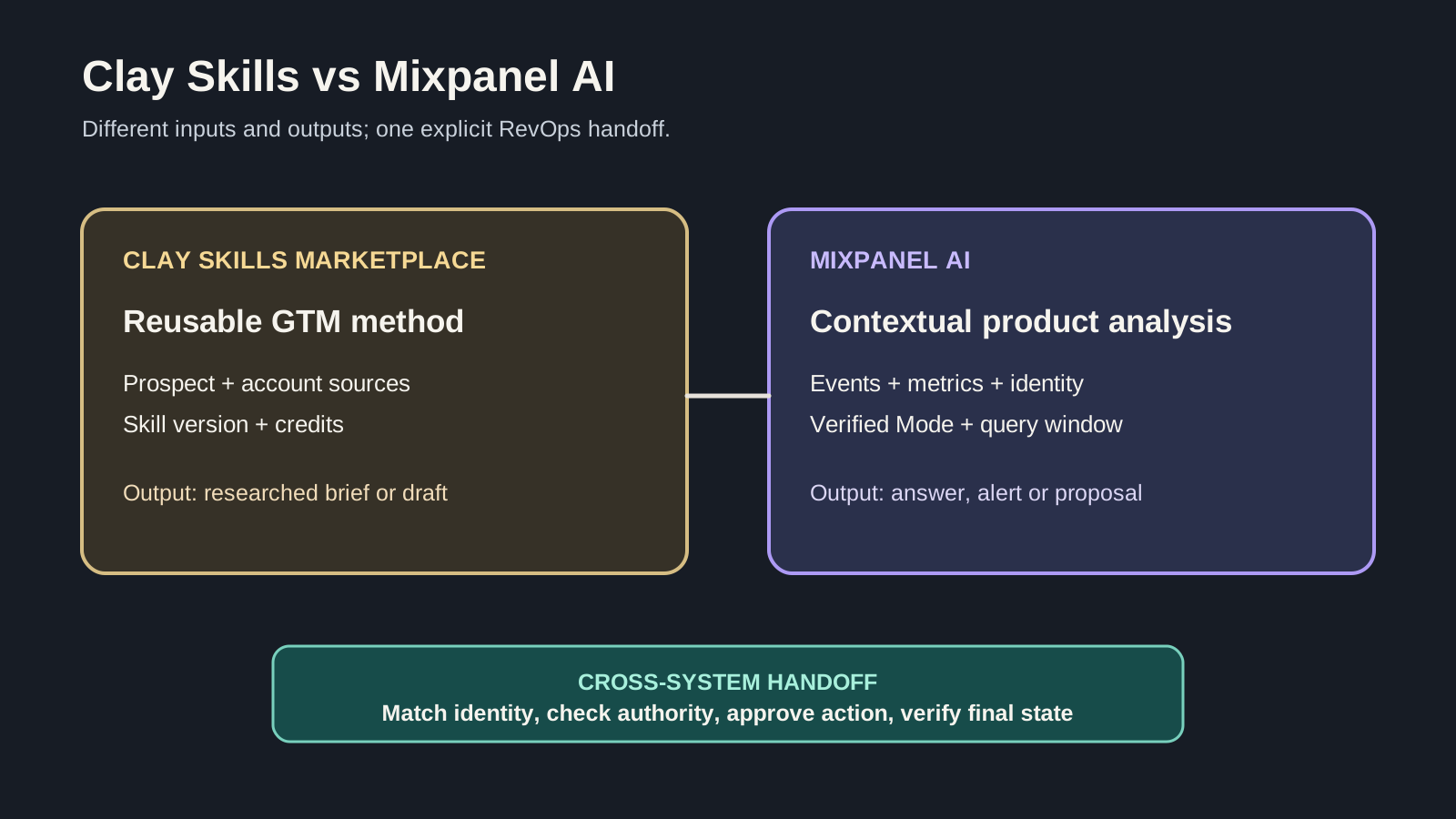
These are adjacent layers rather than interchangeable assistants. Clay publishes installable GTM skills for coding agents and charges credits when skills use Clay data. Mixpanel describes an Agent, Context Engine and Verified Mode for product analytics, with access in its product and connected work surfaces. Choose the system that owns the question, then design the cross-system handoff. Neither launch grants an agent authority to send outreach, change a CRM field or decide a commercial outcome.
This comparison is written for RevOps, Sales Ops, GTM Operations, and Customer Success Ops teams that need a practical decision framework. It focuses on workflow ownership, CRM data quality, implementation effort, source-of-truth behavior, and the operating rhythm each option supports.
Who each option is best for
Clay fits a team that needs repeatable prospect research, enrichment and outbound preparation in coding agents. Mixpanel AI fits a team that needs product-behavior questions, metric monitoring and contextual analysis grounded in its Mixpanel project. Many teams may need both, with an explicit boundary between research or analysis and customer-facing action.
The right answer depends on the job the team is trying to improve. A tool that is strong for one operating model can be a poor fit when the real problem is ownership, dirty CRM data, missing renewal dates, weak handoffs, or an unclear forecast process. Use this page to map the workflow before treating either option as the default.
Operating questions before choosing
- Which recurring meeting or workflow will change if the team chooses Clay Skills Marketplace or Mixpanel AI?
- Which CRM records, fields, activities, or customer signals are required for the workflow to be trusted?
- Who owns the next action when the system surfaces a risk, alert, forecast change, or customer signal?
- Does the option write usable context back to the system of record, or does it create another place to inspect?
- What manual review work should decrease after implementation?
Side-by-side table
| Criterion | Clay Skills Marketplace | Mixpanel AI | Editorial note |
|---|---|---|---|
| Primary job | Package and repeat a GTM method such as research, scoring or personalization. | Answer product-behavior questions and proactively surface metric changes. | A method and an analytical observation can feed one workflow, but they are different outputs. |
| Starting context | An installed skill, its inputs, connected Clay account and permitted data sources. | Mixpanel project data, organizational and project context, approved events and properties. | Inspect the source and version behind either answer. |
| Agent surface | Coding agents such as Claude Code, Codex and Cursor using a Clay skill or plugin. | Mixpanel Agent plus announced Slack, coding-tool and MCP access. | Availability and permissions should be tested in the actual tenant and tool. |
| Distribution control | Clay describes creator submission and early review before marketplace availability. | Verified Mode lets admins designate events and properties that AI may query. | Marketplace review and data allowlisting solve different governance problems. |
| Operating cost | Skills are free to install; runs that pull Clay data consume Clay credits. | Current plan and AI availability must be checked with Mixpanel; the announcement does not establish this team's unit cost. | Measure cost per reviewed usable result, not merely per invocation. |
| Likely failure | A reusable skill repeats a poor identity match or stale source across many accounts. | An approved event still has wrong instrumentation, denominator or account join. | Neither system can replace sample-level evidence review. |
| Downstream action | Can produce research or a draft for an outreach workflow. | Can produce an answer, alert, chart or recommendation for an operator. | A separate destination owner must authorize a CRM write, send or financial consequence. |
Workflow comparison
- Write the business question first. If it asks who to research or how to execute a prospecting method, test Clay. If it asks how users behave in the product or why a metric moved, test Mixpanel.
- Name the stable subject and source records. Clay outputs need prospect and account evidence; Mixpanel outputs need event, user and account semantics.
- Run a bounded pilot with known cases and deliberate exceptions. Compare each output with its underlying record and document unknowns rather than forcing a match.
- Review the exact skill or metric definition and connector scopes. Record who can alter the method, verified event list, alert threshold and destinations.
- Pass only an approved proposal into CRM, lifecycle or support work. Recheck current customer state before a send or write and inspect the final destination afterward.
A RevOps workflow should produce a visible action, not only a report. When comparing Clay Skills Marketplace and Mixpanel AI, the team should look at the handoff from signal to owner to customer action. If the output does not change a task, meeting, field, renewal follow-up, forecast inspection, or manager review, the tool may become another dashboard rather than operating leverage.
Implementation complexity
Medium to high. The real complexity depends on data quality, ownership clarity, and whether the team changes its operating rhythm.
Implementation should start with source fields, permissions, integration points, and the review process. The most common failure is buying a tool before defining the workflow. A narrow pilot is usually safer than a full rollout because it reveals bad CRM fields, unclear owners, duplicate definitions, and gaps between the tool and the team operating cadence.
Data and CRM requirements
Reliable RevOps decisions need clean CRM data. Before choosing between Clay Skills Marketplace and Mixpanel AI, check owner fields, lifecycle stage, account and opportunity status, renewal or close dates, activity history, task ownership, and the fields that drive routing or reporting. If these fields are not trusted, the comparison should include a data cleanup step.
- Define the system of record for the workflow.
- List the fields that trigger action or reporting.
- Decide which fields can be written automatically and which need review.
- Document what evidence an operator should inspect before acting.
- Measure whether the workflow reduces missed follow-up or manual reconciliation.
Data model impact
- Clay pilot: preserve source provider, retrieval time, contact ID, account ID, skill version, run ID and review result.
- Mixpanel pilot: preserve event version, event time, ingestion time, user and account joins, metric definition, query window and Verified Mode selection.
- Cross-system activation: keep the analytic subject distinct from the CRM customer and require an explicit identity bridge before action.
CRM fields and signals to check
- Account and contact IDs with match confidence
- Source and event timestamps
- Current owner and communication preference
- Proposed action with reviewer
- Destination execution and final-state IDs
Cost and maintenance considerations
Clay explicitly says marketplace skills are free to install and Clay-data use consumes credits. Mixpanel's October 1 announcement describes capability, but pricing, rollout and account-specific limits should be checked in current official terms. Include human review, correction effort, connector operation and downstream reconciliation in either pilot's cost model. A cheap run that causes repeated cleanup is not a cheap workflow.
Cost should include licenses, setup time, admin maintenance, integration work, enablement, governance, and the opportunity cost of manual review. A cheaper workflow can become expensive if it requires weekly spreadsheet cleanup. A larger platform can become expensive if the team only uses a narrow part of it. RevOps should compare total operating cost, not only subscription price.
Risks and limitations
- Calling both products 'AI agents' can hide whether the decision depends on external prospect data or instrumented product behavior.
- A marketplace listing may change; preserve the tested skill version and install command.
- Verified events do not automatically validate metric definitions, identity joins or billing meaning.
- Slack or coding-tool access can distribute an answer to a wider audience than the original analytics workspace.
- A draft, alert or recommendation can trigger unauthorized CRM or customer-contact action if the destination lacks its own gate.
The main risk in any RevOps tool comparison is overgeneralizing. No tool is universally best. The fit depends on company stage, CRM maturity, sales motion, renewal volume, customer success model, admin capacity, and how disciplined the team is about acting on signals.
Implementation risk
- Do not roll a skill to all sellers after one successful demo; sample no-match, duplicate and stale-signal cases.
- Do not enable proactive alerts without an owner, severity rule, follow-up path and noise review.
- Do not equate apparent plan availability with access in a specific account or region; test the actual tenant.
Governance risk
- Limit Clay connector write scopes and record credit use per run.
- Limit Mixpanel event/property access and inspect the audience for shared-channel answers.
- Keep send, CRM write, renewal and billing authority outside either agent's unreviewed output.
Alternatives and complements
- A governed SQL or warehouse workflow may be sufficient for a narrow product-data question.
- A documented human research checklist may be sufficient for a low-volume named-account process.
- CRM, preference and billing systems remain complements when the result affects a customer or financial record.
Weekly operating rhythm
- Review sampled Clay skill runs for source quality, match errors and credits per usable brief.
- Review sampled Mixpanel alerts for reproducibility, metric changes and action quality.
- Reconcile downstream sends or writes with approval and final destination state.
Decision framework
- Choose Clay first when the constrained use case is repeatable prospect or account research and the team can govern data credits, match quality and outreach review.
- Choose Mixpanel AI first when the constrained use case is product measurement and the team already has a trustworthy event, identity and metric model.
- Use both only when an explicit join turns product evidence into a legitimate account-level question, with CRM identity, current preferences and a human-owned commercial decision.
- Defer either rollout if a team cannot identify source records, method versions, permitted readers and the authoritative system for the proposed action.
If the team cannot name the owner, source field, review cadence, and next action, pause the purchase and map the workflow first. Strong RevOps teams buy tools to close a defined operating gap. They do not use tools to discover the process after the contract is signed.
FAQ
Are Clay Skills Marketplace and Mixpanel AI substitutes?
No direct substitution follows from their official announcements. Clay centers reusable GTM methods and data use in coding agents; Mixpanel centers contextual product analytics and monitoring.
Does Verified Mode make a Mixpanel answer commercially authoritative?
It restricts which events and properties AI can query, according to Mixpanel. The team must still test instrumentation, metric definitions, identity joins and the authority for any commercial action.
Can a Clay skill send outreach without review?
Technical possibilities depend on its connectors and scopes, but a production process should require current identity, consent, claim and destination checks before customer contact.
Source notes
These official references support the product and workflow context. DailyRevOps uses them to bound the comparison, not to imply outcomes, rankings, or adoption claims.
- Clay Skills Marketplace announcement: Official Clay announcement dated September 29, 2026; describes installation, skill contents, review and credit use.
- Mixpanel AI announcement: Official Mixpanel announcement dated October 1, 2026; describes Agent, Context Engine, Verified Mode and connected surfaces.
Last updated: 2026-10-02