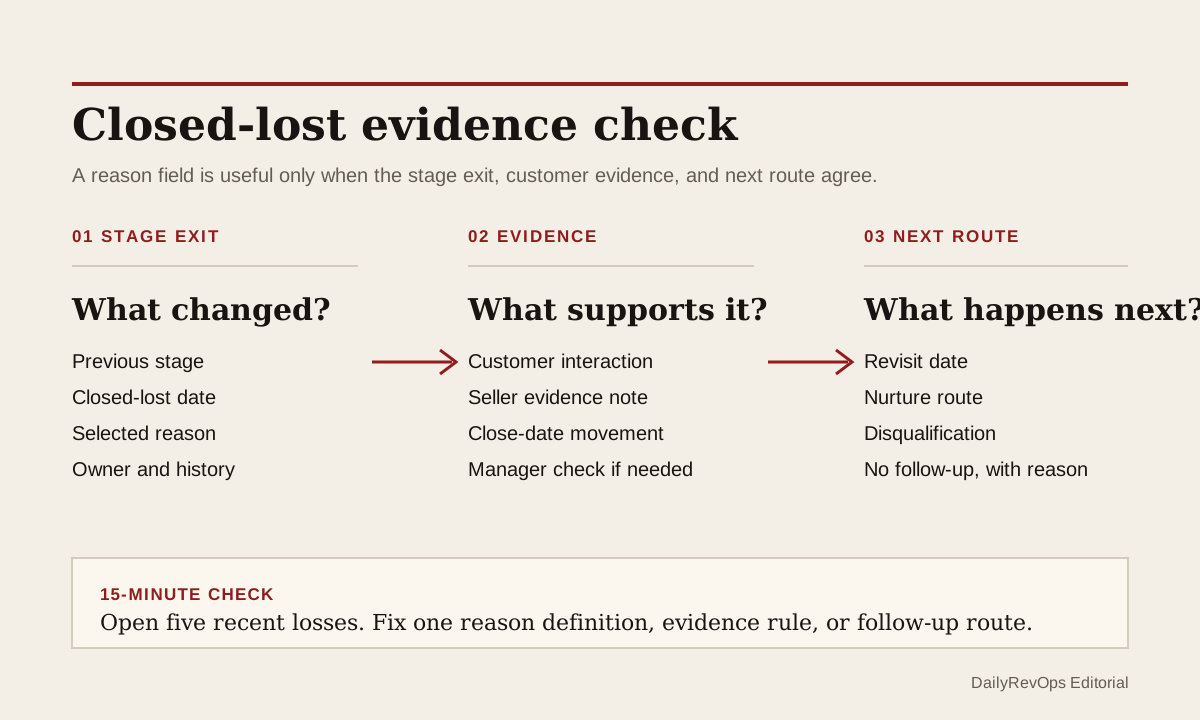
A closed-lost field can make pipeline reporting look organized while explaining very little. Values such as price, timing, competitor, no decision, and other are useful only when the record also shows what happened, when the deal left active pipeline, which evidence supports the reason, and what should happen to the account next.
The problem is not that sellers make imperfect judgments. A buyer may give a polite answer, several issues may affect the decision, and the most important evidence may sit in a call, email, meeting note, or manager conversation. The operating failure starts when one broad dropdown value becomes the only durable explanation.
RevOps should treat closed-lost quality as a pipeline-hygiene workflow. The purpose is not to turn every loss into formal win-loss research. It is to preserve enough structured context for Sales Ops to inspect stage exits, for managers to challenge weak evidence, for marketing or sales development to route a credible revisit, and for future pipeline reviews to distinguish a real loss from an administrative close-out.
What RevOps should inspect
Start with recent stage exits from one pipeline, segment, or team. Do not begin with a company-wide chart. Open the records behind the distribution and test whether another operator can understand the exit without asking the owner to reconstruct the deal from memory.
Watch for a catch-all reason becoming the default, notes that repeat the picklist without adding evidence, and lost opportunities with no recent customer activity. Also inspect records that moved to closed-lost after repeated close-date changes, a long late-stage age, an owner change, or a period with no customer-confirmed next step. Those patterns do not prove the reason is wrong. They show where the reason needs stronger context.
A second warning is reason drift. Teams may use budget, price, timing, no decision, unqualified, and not a fit as if they mean the same thing. If one value can describe several different stage exits, Sales Ops cannot tell whether the next process question belongs in qualification, commercial terms, stakeholder coverage, follow-up, product fit, or CRM cleanup.
A third warning is route drift. The reason says timing, but there is no revisit date. The reason says competitor, but no competitor or decision context is recorded. The reason says unqualified, but the record stays in a nurture sequence intended for qualified future demand. A reason is operational only when it changes a review question or a next route.
CRM fields and signals required
Keep the evidence model small enough for sellers and managers to maintain, but explicit enough for RevOps to inspect. The exact field names differ by CRM. The useful minimum is the connection between the stage exit, the reason, the source evidence, and the next decision.
- Opportunity or deal ID, account, owner, manager, segment, amount, currency, and pipeline
- Previous stage, stage-entered date, closed-lost date, and stage-change timestamp
- Primary lost reason, optional secondary reason, reason version, and short evidence note
- Last meaningful customer conversation, outcome, source activity type, source record, and activity date
- Customer-confirmed blocker, decision status, stakeholder status, and procurement or legal context when relevant
- Close-date history, stage age, forecast-category history, and number of prior reopenings
- Manager-review requirement, reviewer, review date, review result, and correction owner
- Next route: revisit, nurture, disqualified, product feedback, partner route, or explicit no follow-up
- Revisit date, revisit trigger, future owner, and the evidence required before pipeline re-entry
- Data-quality status when the reason, activity history, ownership, or stage exit cannot be verified
Pipedrive documents freeform reasons, an admin-managed predefined reason list, additional comments, filtering, and reporting. Salesforce documents opportunity stages, close dates, activities, and a validation-rule example that requires a Close Reason when an opportunity becomes Closed Lost. These sources show that the stage exit, reason, activity context, and required checks can be structured. They do not prove why a buyer decided, that a taxonomy improves win rate, or that every team should use the same fields.
Design reasons around operating decisions
A long reason picklist creates false precision. A list that is too short pushes unrelated situations into other. Start with a small set of reasons that lead to different review questions, ownership, or future routes. Define each value by inclusion, exclusion, required evidence, and expected next action.
- No decision: the buyer did not choose a vendor or project path. Inspect urgency, internal ownership, stakeholder alignment, and whether a dated revisit trigger exists.
- Timing or priority changed: the need may remain, but the active buying window ended. Record what event would justify a revisit and who owns that future check.
- Unqualified: the opportunity did not meet the team's qualification rule. Name which criterion failed so the loss can inform routing and qualification without becoming a vague seller label.
- Product or service fit: the required use case, integration, control, or delivery model did not fit. Route specific evidence to the appropriate product, services, or leadership review without presenting one seller note as market proof.
- Commercial terms: price, budget, contract, procurement, legal, or security blocked the path. Keep these distinct enough to identify the actual operating owner, but do not create a separate picklist value for every negotiation detail.
- Competitor selected: record the named alternative only when the seller has credible evidence. Do not use competitor as a default for any deal that stopped responding.
The reason and the evidence note serve different jobs. The controlled value supports routing and comparison. The short note preserves account context. A note should explain the observed customer situation, not copy the dropdown into a sentence. For an important late-stage loss, a manager can confirm that the selected reason, stage history, and source evidence agree before the record leaves the active review.
Use an evidence ladder, not a certainty claim
Closed-lost evidence has different strengths. A direct buyer statement recorded from a meeting or email is stronger than a seller inference. A seller inference with recent customer context is stronger than an administrative value selected to clear the pipeline. RevOps can make that distinction visible without claiming that any source contains the complete truth.
A simple evidence status can use buyer-confirmed, seller-observed, manager-reviewed inference, and evidence missing. The status should describe the source, not score the seller. Buyer-confirmed still has limitations because customers may simplify their explanation. Evidence missing does not mean the deal was mishandled. It means the record should not support a strong process conclusion until someone reviews it.
For conversation evidence, preserve a link or stable reference to the source activity when access rules allow it. A summary can support inspection, but it should not replace the original call, email, meeting, or note when the team needs to challenge the interpretation. If recordings or transcripts are involved, apply the organization's access, retention, and consent rules rather than copying sensitive text into a broadly visible reason field.
Implementation workflow
Begin with a sample, not a full taxonomy project. Open the five most recent closed-lost deals in one pipeline. Compare the reason with stage history, close-date movement, the last meaningful customer interaction, and the recorded next route. Classify each sample as evidence clear, reason too broad, source missing, stage exit unclear, route missing, or reason conflicts with the note.
Choose one bounded correction. Clarify one overloaded reason, add one short evidence field for late-stage losses, require a revisit date when timing is selected, or add manager review for a narrow material segment. Do not redesign every value from five records. The first change should be small enough to test in normal seller work.
For the pilot, define when the check runs. It can run before the stage change, immediately after the change in an exception queue, or during the next manager pipeline review. Blocking the stage change can improve completeness but can also encourage rushed answers. A post-change queue reduces interruption but needs a close condition and owner. Use stricter controls only where stage, amount, forecast status, or strategic-account context makes the record worth the extra review.
Keep a reason-definition register outside the picklist label. For each value, record the definition, exclusions, required evidence, next route, owner, effective date, and prior value it replaced. When the taxonomy changes, preserve the reason version or mapping used by older records. Otherwise a dashboard can mix values created under different definitions and present them as one consistent history.
Test the downstream workflow as well as field completion. Confirm that revisit records receive a date and owner, product-fit evidence reaches a reviewable product-feedback route, disqualified records stop inappropriate follow-up, and pipeline re-entry requires fresh customer evidence. Reopened pipeline needs a re-entry gate explains that later control in detail.
Cost, maintenance, and data-quality risk
The visible cost is configuration: fields, validation, workflow rules, reports, permissions, and manager guidance. The larger maintenance cost is semantic. Someone must own definitions, review edge cases, retire unused values, map changed reasons, and explain how downstream reports should interpret historical records.
Do not add more required fields than the review can use. If sellers enter a primary reason, secondary reason, detailed narrative, competitor, blocker, buyer status, follow-up route, and product feedback on every loss, field completion can rise while evidence quality falls. Start with the smallest model that changes a real operating decision, then add a field only when repeated samples show a blind spot.
Automation introduces another risk. A workflow can infer a reason from stage age, missing activity, or an email outcome, but those signals are not customer truth. Use automation to prepare an exception, suggest a route, or check completeness. Keep a named human reviewer for high-impact losses and preserve the source evidence behind any suggested classification.
Integrations can also create conflicting reasons. A CRM, conversation platform, product-feedback system, and data warehouse may each hold a version of the loss. Name the CRM field that controls pipeline state, the system that holds source evidence, and the write path allowed to update the reason. If several systems can overwrite the field, the report is not an inspectable operating record.
Measurement and weekly rhythm
Measure the workflow before using the reason distribution for strategic conclusions. Useful operating measures include closed-lost records with a defined reason, records with accessible source evidence, late-stage losses with manager review where required, timing losses with a revisit date, exceptions closed after correction, and reasons changed after review. These are internal quality measures, not universal benchmarks.
On Monday, Sales Ops can prepare a narrow closed-lost exception queue from the prior week. Prioritize missing evidence, catch-all values, late-stage exits, large close-date movement before loss, and records without a next route. Managers review only the exceptions that need judgment, not every lost deal.
Midweek, RevOps samples completed corrections. Check whether the seller or manager added real context, whether the route now matches the reason, and whether the source activity is available to the people allowed to inspect it. Record recurring disputes about definitions rather than silently fixing every record.
On Friday or in the regular sales-process review, close the loop on one pattern. Tighten a definition, remove an unused value, improve a route, change a review threshold, or leave the model unchanged because the evidence was insufficient. Once a month, review reason usage by pipeline and segment for definition drift, but inspect the records behind any surprising distribution before drawing a process conclusion.
Risks and limitations
Do not treat the CRM reason as the buyer's complete truth. Buyers may give incomplete or polite explanations, several factors may be involved, and sellers may lack access to the final decision. Use the field as an operating record with an evidence status, not as a universal causal claim.
Do not use lost-reason reporting to rank individual sellers without context. Pipeline mix, territory, product, segment, deal stage, and evidence access can differ. The safer primary use is process inspection: identify unclear exits, repeated no-decision patterns, missing customer evidence, mismatched routes, and records that should not return to active pipeline without a new buying signal.
Do not infer product strategy, pricing strategy, or market demand from one picklist chart. Stronger research may require interviews, a defined sample, source review, and a method that separates buyer statements from internal interpretation. Closed-lost hygiene creates better records for that later work. It does not replace it.
Finally, do not measure success by a lower share of other alone. Teams can make the chart look cleaner by forcing uncertain records into specific values. A stronger outcome is inspectability: the stage exit, evidence status, reason definition, accountable reviewer, next route, and any later re-entry decision can all be explained from the operating record.
Related reading
CRM workflows · Revenue forecasting workflows · Reopened pipeline needs a re-entry gate · Forecast commit needs CRM evidence · Why pipeline coverage is deceiving · CRM exception queues need hygiene · Gong vs Clari for revenue intelligence · Pipedrive profile · HubSpot profile · Salesforce profile · Clari profile
Source notes
These official sources support the workflow model and product concepts. They do not prove a specific retention outcome, benchmark, or vendor claim.
- Pipedrive lost reasons: Official reference for freeform and predefined lost reasons, additional comments, filtering, and lost-reason reporting on deals.
- Pipedrive predefined lost reasons: Official reference for an admin-managed reason list that sellers can use when a deal is marked lost.
- Salesforce opportunity management: Official learning reference for opportunity stages, close dates, activities, and task-based deal work.
- Salesforce validation rules: Official learning example for requiring a Close Reason when an opportunity stage becomes Closed Lost.
Last updated: 2026-07-22